

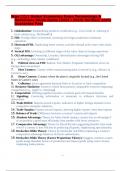
Wgu C211 Global Economics Exam Terminology &
Definitions Study Guide () Verified, 100%
Guarantee Pass
1. Globalization: Standardizing products worldwide (e.g., Coca-Cola) vs. tailoring to
local cultures (e.g., McDonald's)
2. FDI: Foreign Direct Investment: investing in foreign production or business
operations
3. Horizontal FDI: Duplicating home country activities abroad at the same value chain
stage
4. Vertical FDI: Investing in different stages of the value chain in foreign operations
5. OLI advantage: Ownership, Location, Internalization advantages driving FDI
(e.g., technology, host country conditions)
6. Political views on FDI: Radical, Free Market, Pragmatic Nationalism views on
foreign direct investment
7. Host Country: Country where manufacturing plant is moved to (e.g., Mexico in
Carrier's case)
8. Home Country: Country where the plant is originally located (e.g., the United
States in Carrier's case)
9. Collusion: Secret agreement between firms to fix prices or limit competition
10. Resource Similarity: Extent to which firms possess comparable resources impacting
competition (e.g., Apple vs. Samsung)
11. Cooperation: Working together towards a common goal with mutual benefits
12. Signaling: Conveying information or intentions to influence decisions and
interactions
13. Trade Deficit: Imports exceed exports, indicative of higher foreign demand or less
competitive domestic industries
14. Trade Surplus: Exports exceed imports, showing higher exports value than imports
15. Balance of Trade: Difference between a country's exports and imports
16. Absolute Advantage: Theory by Adam Smith stating a country has an advantage if
it can produce a good more efficiently than another with fewer resources.
17. Comparative Advantage: Theory by David Ricardo suggesting benefits from trade
even if a country is less efficient in producing all goods, emphasizing specialization.
18. Heckscher-Ohlin Theory: Theory by Heckscher and Ohlin explaining a country's
comparative advantage based on its factor endowments.
19. Heckscher-Ohlin Theory (Factor Proportions Theory): Suggests countries export
goods using abundant factors of production and import goods using scarce factors,
explaining trade patterns.
1/6
, .
20. New Trade Theory: Theory by economists like Paul Krugman incorporating
economies of scale and network effects to explain trade benefits.
21 Porter's Diamond Theory (Competitive Advantage Theory): Theory by
Michael Porter focusing on factors contributing to a nation's competitive advantage in
industries.
22. Exchange Rate: The value at which one currency can be exchanged for another,
impacting international trade, investment flows, and economic relationships.
23. Fixed Exchange Rate: Currency value pegged to another major currency or a
basket, maintained by central banks or governments.
24. Floating Exchange Rate: Currency value determined by market forces like supply
and demand, fluctuating freely based on market conditions.
25. Managed Float: System where currency primarily floats but central bank intervenes
occasionally to stabilize or influence its value.
26. Determinants of Demand for a Currency: Factors like interest rates, economic
performance, trade balances, inflation rates, political stability, and speculation that
influence currency demand.
27. Determinants of Supply for a Currency: Factors like interest rates affecting supply
by attracting or repelling investors seeking higher returns.
28. Economic Performance: Weak economic performance or prospects can reduce
confidence in a currency, leading to increased supply as investors and businesses
seek to exchange it for more stable currencies.
29. Trade Balances: A trade deficit (imports > exports) leads to higher supply of a
currency, as domestic entities need to sell their currency to buy foreign currencies for
imports.
30. Inflation Rates: Higher inflation rates erode the value of a currency, leading to
increased supply as holders exchange it for more stable currencies.
31. Political Instability: Political instability can decrease confidence in a currency,
increasing supply as investors seek safer currencies.
32. Speculation: Expectations of future depreciation can increase supply as investors
and traders sell off the currency in anticipation of its decline.
33. Purchasing Power Parity (PPP): An economic theory that equalizes currency
purchasing power by comparing identical goods across countries.
34. Currency Depreciation: Means a currency loses value relative to other currencies.
35. Currency Appreciation: Means a currency gains value relative to others.
36. Fixed Exchange Rates: Rates that remain constant.
37. Pegged Exchange Rates: Rates that align with another currency.
38. Floating Exchange Rates: Rates that fluctuate.
39. Managed (Dirty) Float Exchange Rates: Semi-controlled by authorities.
2/6
Definitions Study Guide () Verified, 100%
Guarantee Pass
1. Globalization: Standardizing products worldwide (e.g., Coca-Cola) vs. tailoring to
local cultures (e.g., McDonald's)
2. FDI: Foreign Direct Investment: investing in foreign production or business
operations
3. Horizontal FDI: Duplicating home country activities abroad at the same value chain
stage
4. Vertical FDI: Investing in different stages of the value chain in foreign operations
5. OLI advantage: Ownership, Location, Internalization advantages driving FDI
(e.g., technology, host country conditions)
6. Political views on FDI: Radical, Free Market, Pragmatic Nationalism views on
foreign direct investment
7. Host Country: Country where manufacturing plant is moved to (e.g., Mexico in
Carrier's case)
8. Home Country: Country where the plant is originally located (e.g., the United
States in Carrier's case)
9. Collusion: Secret agreement between firms to fix prices or limit competition
10. Resource Similarity: Extent to which firms possess comparable resources impacting
competition (e.g., Apple vs. Samsung)
11. Cooperation: Working together towards a common goal with mutual benefits
12. Signaling: Conveying information or intentions to influence decisions and
interactions
13. Trade Deficit: Imports exceed exports, indicative of higher foreign demand or less
competitive domestic industries
14. Trade Surplus: Exports exceed imports, showing higher exports value than imports
15. Balance of Trade: Difference between a country's exports and imports
16. Absolute Advantage: Theory by Adam Smith stating a country has an advantage if
it can produce a good more efficiently than another with fewer resources.
17. Comparative Advantage: Theory by David Ricardo suggesting benefits from trade
even if a country is less efficient in producing all goods, emphasizing specialization.
18. Heckscher-Ohlin Theory: Theory by Heckscher and Ohlin explaining a country's
comparative advantage based on its factor endowments.
19. Heckscher-Ohlin Theory (Factor Proportions Theory): Suggests countries export
goods using abundant factors of production and import goods using scarce factors,
explaining trade patterns.
1/6
, .
20. New Trade Theory: Theory by economists like Paul Krugman incorporating
economies of scale and network effects to explain trade benefits.
21 Porter's Diamond Theory (Competitive Advantage Theory): Theory by
Michael Porter focusing on factors contributing to a nation's competitive advantage in
industries.
22. Exchange Rate: The value at which one currency can be exchanged for another,
impacting international trade, investment flows, and economic relationships.
23. Fixed Exchange Rate: Currency value pegged to another major currency or a
basket, maintained by central banks or governments.
24. Floating Exchange Rate: Currency value determined by market forces like supply
and demand, fluctuating freely based on market conditions.
25. Managed Float: System where currency primarily floats but central bank intervenes
occasionally to stabilize or influence its value.
26. Determinants of Demand for a Currency: Factors like interest rates, economic
performance, trade balances, inflation rates, political stability, and speculation that
influence currency demand.
27. Determinants of Supply for a Currency: Factors like interest rates affecting supply
by attracting or repelling investors seeking higher returns.
28. Economic Performance: Weak economic performance or prospects can reduce
confidence in a currency, leading to increased supply as investors and businesses
seek to exchange it for more stable currencies.
29. Trade Balances: A trade deficit (imports > exports) leads to higher supply of a
currency, as domestic entities need to sell their currency to buy foreign currencies for
imports.
30. Inflation Rates: Higher inflation rates erode the value of a currency, leading to
increased supply as holders exchange it for more stable currencies.
31. Political Instability: Political instability can decrease confidence in a currency,
increasing supply as investors seek safer currencies.
32. Speculation: Expectations of future depreciation can increase supply as investors
and traders sell off the currency in anticipation of its decline.
33. Purchasing Power Parity (PPP): An economic theory that equalizes currency
purchasing power by comparing identical goods across countries.
34. Currency Depreciation: Means a currency loses value relative to other currencies.
35. Currency Appreciation: Means a currency gains value relative to others.
36. Fixed Exchange Rates: Rates that remain constant.
37. Pegged Exchange Rates: Rates that align with another currency.
38. Floating Exchange Rates: Rates that fluctuate.
39. Managed (Dirty) Float Exchange Rates: Semi-controlled by authorities.
2/6


