Sherpath: Shock,
Sepsis, SIRS, MODS
TEST questions and
answers
A nursing student is caring for a patient who is at risk for shock.
The student asks, "Which laboratory results should I monitor to
see if shock has developed?" How should the instructor
respond?
Shock is a complex condition with various manifestations and
requires monitoring of multiple laboratory results."
-CBC, DIC, cardiac enzymes, creatinine, GFR, BUN, electrolytes,
ABGs, cultures, liver enzymes (one test alone is not enough to
monitor development of shock)
The nurse is caring for a patient who is being treated for shock.
Initial laboratory results show elevated white blood cell (WBC)
counts and an elevated procalcitonin (PCT) level. What do these
laboratory results indicate?
,The patient has shock caused by a systemic bacterial infection.
- An elevated WBC count indicates an infection, and PCT is a
biomarker released in response to a bacterial infection.
Previous
Play
Next
Rewind 10 seconds
Move forward 10 seconds
Unmute
0:00
/
0:15
Full screen
Brainpower
Read More
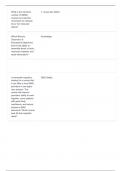
The nurse is caring for a patient with early signs of shock. Which
laboratory values should the nurse expect?
Respiratory alkalosis
Elevated sodium level
Decreased potassium level
Dobutamine
, ↑ Myocardial contractility
↓ Ventricular filling pressures
↓ Systemic vascular resistance (SVR), pulmonary arterial wedge
pressure (PAWP)
↑ CO, stroke volume, CVP
↑/↓ HR
Cardiogenic shock:Severe systolic dysfunction
Septic shock:↑O2 delivery and raise ScvO2 or SvO2 to 70% if
hemoglobin >7g/dL or hematocrit ≥30%
Administer via central line.
Be careful with other drugs not compatible with dobutamine
infusion.
Monitor vital signs.
Stop infusion if tachydysrhythmias develop.
Dopamine
Positive inotropic effects:
↑ Myocardial contractility
↑ Automaticity
↑ Atrioventricular conduction
↑ HR, CO
↑ BP
Sepsis, SIRS, MODS
TEST questions and
answers
A nursing student is caring for a patient who is at risk for shock.
The student asks, "Which laboratory results should I monitor to
see if shock has developed?" How should the instructor
respond?
Shock is a complex condition with various manifestations and
requires monitoring of multiple laboratory results."
-CBC, DIC, cardiac enzymes, creatinine, GFR, BUN, electrolytes,
ABGs, cultures, liver enzymes (one test alone is not enough to
monitor development of shock)
The nurse is caring for a patient who is being treated for shock.
Initial laboratory results show elevated white blood cell (WBC)
counts and an elevated procalcitonin (PCT) level. What do these
laboratory results indicate?
,The patient has shock caused by a systemic bacterial infection.
- An elevated WBC count indicates an infection, and PCT is a
biomarker released in response to a bacterial infection.
Previous
Play
Next
Rewind 10 seconds
Move forward 10 seconds
Unmute
0:00
/
0:15
Full screen
Brainpower
Read More
The nurse is caring for a patient with early signs of shock. Which
laboratory values should the nurse expect?
Respiratory alkalosis
Elevated sodium level
Decreased potassium level
Dobutamine
, ↑ Myocardial contractility
↓ Ventricular filling pressures
↓ Systemic vascular resistance (SVR), pulmonary arterial wedge
pressure (PAWP)
↑ CO, stroke volume, CVP
↑/↓ HR
Cardiogenic shock:Severe systolic dysfunction
Septic shock:↑O2 delivery and raise ScvO2 or SvO2 to 70% if
hemoglobin >7g/dL or hematocrit ≥30%
Administer via central line.
Be careful with other drugs not compatible with dobutamine
infusion.
Monitor vital signs.
Stop infusion if tachydysrhythmias develop.
Dopamine
Positive inotropic effects:
↑ Myocardial contractility
↑ Automaticity
↑ Atrioventricular conduction
↑ HR, CO
↑ BP