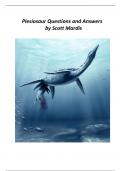
Plesiosaur Questions and Answers
by Scott Mardis
, If plesiosaurs gave live birth, can we be sure they were
reptiles and not mammals? Yes, we can (sort of), as I will
explain.
Not only has live birth been reasonably well documented
for plesiosaurs
(http://news.nationalgeographic.com/news/2011/08/110811
-plesiosaurs-live-birth-fossils-young-science-chiappe-
dinosaurs-fetus/ ) , it has also been demonstrated to have
occurred in their amphibious ancestors
(http://www.nature.com/nature/journal/v432/n7015/full/na
ture03050.html ) . In fact, live birth was also the reproductive
strategy for the plesiosaur’s ari e reptile o te poraries,
the ichthyosaurs
(http://news.nationalgeographic.com/news/2014/02/140212
-sea-monster-ichthyosaur-reptiles-paleontology-science-
animals/ ) and the mosasaurs
(http://smithsonianscience.si.edu/2015/05/fossil-proves-
prehistoric-reptile-gave-birth-in-open-ocean/ ) .What would
appear to set the plesiosaurs apart from these other animals
is hat is alled a K-“ele ted “trategy
(https://en.wikipedia.org/wiki/R/K_selection_theory ) in
which live birth is combined with the birth of a small brood or
only one fetus of large size
(http://science.sciencemag.org/content/333/6044/870 ) , a
reproductive strategy seen in all marine mammals and a few
lizard species. Animals that follow this reproductive strategy
usually show maternal care for the young after birth and live
in social groups.
While this information paints an image of plesiosaurs as
by Scott Mardis
, If plesiosaurs gave live birth, can we be sure they were
reptiles and not mammals? Yes, we can (sort of), as I will
explain.
Not only has live birth been reasonably well documented
for plesiosaurs
(http://news.nationalgeographic.com/news/2011/08/110811
-plesiosaurs-live-birth-fossils-young-science-chiappe-
dinosaurs-fetus/ ) , it has also been demonstrated to have
occurred in their amphibious ancestors
(http://www.nature.com/nature/journal/v432/n7015/full/na
ture03050.html ) . In fact, live birth was also the reproductive
strategy for the plesiosaur’s ari e reptile o te poraries,
the ichthyosaurs
(http://news.nationalgeographic.com/news/2014/02/140212
-sea-monster-ichthyosaur-reptiles-paleontology-science-
animals/ ) and the mosasaurs
(http://smithsonianscience.si.edu/2015/05/fossil-proves-
prehistoric-reptile-gave-birth-in-open-ocean/ ) .What would
appear to set the plesiosaurs apart from these other animals
is hat is alled a K-“ele ted “trategy
(https://en.wikipedia.org/wiki/R/K_selection_theory ) in
which live birth is combined with the birth of a small brood or
only one fetus of large size
(http://science.sciencemag.org/content/333/6044/870 ) , a
reproductive strategy seen in all marine mammals and a few
lizard species. Animals that follow this reproductive strategy
usually show maternal care for the young after birth and live
in social groups.
While this information paints an image of plesiosaurs as