

NSG 460 Neuro Study Guide with Questions and Correct A nswers Can changes in mental status be minimal? ✅- YES Mental status is a spectrum. Changes in mental status do not go from one extreme to another, it can be as subtle as restlessness and confusion Acute mental status change ✅- when a patient has a change from their usual baseline Many causes from many systems - neuro: infection, tumor, trauma, CVA, psychiatric - CV/pulm: MI, PE, hypotension - systemic (changes in fluid and electrolytes): hypoglycemia, hyponatremia, ammonia AEIOU TIPS for altered mental status ✅- A: ALCOHOL - E: ELECTROLYTE, ENDOCRINE, EPILEPSY, ECP. Hypernatremia is the most common electrolyte abnormality causing AMS. Hypo or hyperthyroidism. Addisonian crisis. Hypo/hyperglycemia (DKA and HHS). Metabolic or toxic encephalopathy. Epilepsy - I: INFECTION. Particularly sepsis, severe sepsis, and septic shock situations. CNS infections (meningitis, encephalitis) are also common - O: OVERDOSE, OPIOID, OXYGEN. Drug overdoses such as benzos, TCA, SSRI, OPIOID are common causes. Hypoxemia causes agitation. Hypercapnia causes drowsiness - U: UREMIA. There are three significant components of serum osmolarity that affect mental status. Urea is one of them. Any increase of a component in calculated osmolality results in high osmolarity which causes disequilibrium which results in AMS - T: TRAUMA, TEMPERATURE, TOXICITY. For toxicity, look "O". Trauma to the head may cause a concussion, bleeding or DAI. But, hypovolemic shock and obstructive shock (e.g. Tension pneumothorax) should also be considered. Hyperthermia and hypothermia affect mental status, esp in extreme ages. - I: INSULIN. Insulin is a drug that can affect mental status in patients with diabetes type I and cases presented with a suicidal attempt - P: PSYCHOSIS. We should eliminate any pathology caused by various disease and drugs first. However , we need to keep in mind that acute or chronic psychological problems may cause AMS. - S: SHOCK, SEPSIS, SOL, SAH. Shock situations, sepsis, space -occupying lesions, subarachnoid hemorrhage should be considered in patients where clinical findings are relevant. Glasgow Coma Scale (GCS) ✅- a scale used to assess the degree of mental status changes - 14-15 = mild. Someone who is confused, awake and alert - 9-13= moderate - 8 or less = severe. Typically call them comatose (varying degrees of this) Criteria for GCS ✅EYE OPENING (4) - spontaneous = 4 - to voice = 3 - to touch = 2 - none = 1 VERBAL RESPONSE (5) - oriented = 5 - confused = 4 - inappropriate = 3 - incoherent = 2 - none = 1 MOTOR RESPONSE (6) - follows commands (6) - localizes pain (5) - withdraws from pain (4) - decorticate (3) - decerebrate (2) - none (1) Cranial nerves responsible for cardinal signs of gaze ✅- III: oculomotor - IV: trochlear - VI: abducens Cranial nerves ✅- O: olfactory. Smell - O: optic. Sight - O: oculomotor. Eye movement - T: trochlear. Eye movement - T: trigeminal: face sensation and chewing - A: abducens. Eye movement - F: facial. Face sensation - A: auditory/vestibulocochlear. Hearing - G: glossopharyngeal. Throat sensation, taste and swallowing - V: Vagus. Movement , GAG REFLEX!! (protective mechanism) - A: accessory. Neck movement - H: hypoglossal. Tongue movement Pupils ✅- controlled by cranial nerve 3 - used to assess problems with neuro impacted pt - REACTIVITY IS MORE IMPORTANT What is more important with pupils, the size or reactivity ✅- REACTIVITY
Preview 2 out of 10 pages
Exam (elaborations)
NSG 460 Neuro Study Guide with Questions and Correct Answers
Preview 2 out of 10 pages
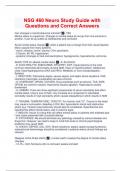
Can changes in mental status be minimal? - YES Mental status is a spectrum. Changes in mental status do not go from one extreme to another, it can be as subtle as restlessness and confusion Acute mental status change - when a patient has a change from their usual baseline Many causes from many systems - neuro: infection, tumor, trauma, CVA, psychiatric - CV/pulm: MI, PE, hypotension - systemic (changes in fluid and electrolytes): hypoglycemia, hyponatremia, ammonia AEIOU TIPS for altered mental status - A: ALCOHOL - E: ELECTROLYTE, ENDOCRINE, EPILEPSY, ECP. Hypernatremia is the most common electrolyte abnormality causing AMS. Hypo or hyperthyroidism. Addisonian crisis. Hypo/hyperglycemia (DKA and HHS). Metabolic or toxic encephalopathy. Epilepsy - I: INFECTION. Particularly sepsis, severe sepsis, and septic shock situations. CNS infections (meningitis, encephalitis) are also common - O: OVERDOSE, OPIOID, OXYGEN. Drug overdoses such as benzos, TCA, SSRI, OPIOID are common causes. Hypoxemia causes agitation. Hypercapnia causes drowsiness - U: UREMIA. There are three significant components of serum osmolarity that affect mental status. Urea is one of them. Any increase of a component in calculated osmolality results in high osmolarity which causes disequilibrium which results in AMS - T: TRAUMA, TEMPERATURE, TOXICITY. For toxicity, look "O". Trauma to the head may cause a concussion, bleeding or DAI. But, hypovolemic shock and obstructive shock (e.g. Tension pneumothorax) should also be considered. Hyperthermia and hypothermia affect mental status, esp in extreme ages. - I: INSULIN. Insulin is a drug that can affect mental status in patients with diabetes type I and cases presented with a suicidal attempt - P: PSYCHOSIS. We should eliminate any pathology caused by various disease and drugs first. However, we need to keep in mind that acute or chronic psychological problems may cause AMS. - S: SHOCK, SEPSIS, SOL, SAH. Shock situations, sepsis, space-occupying lesions, subarachnoid hemorrhage should be considered in patients where clinical findings are relevant. Glasgow Coma Scale (GCS) - a scale used to assess the degree of mental status changes - 14-15 = mild. Someone who is confused, awake and alert - 9-13= moderate - 8 or less = severe. Typically call them comatose (varying degrees of this) Criteria for GCS EYE OPENING (4)
Content preview
Document information
- Uploaded on
- August 2, 2024
- Number of pages
- 10
- Written in
- 2024/2025
- Type
- Exam (elaborations)
- Contains
- Questions & answers
$10.49
Wrong document? Swap it for free
Within 14 days of purchase and before downloading, you can choose a different document. You can simply spend the amount again.
Written by students who passed
Immediately available after payment
Read online or as PDF

Reputation scores are based on the amount of documents a seller has sold for a fee and the reviews they have received for those documents. There are three levels: Bronze, Silver and Gold. The better the reputation, the more your can rely on the quality of the sellers work.
Available in package deal
Package deal
Comprehensive NURS 460 Q&A Bundle

