

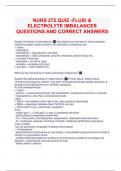
NURS 272 QUIZ -FLUID & ELECTROLYTE IMBALANCES QUESTIONS AND CORRECT ANSWERS Explain the basics of fluid balance. ✅*fluid balance is important for temp regulation, nutrient transport, waste excretion, join lubrication, protections, etc! > Types... - intracellular - extracellular = intravascular, interstitial - transcellular = CBS, pericardial, synovial, intraocular, pleural fluids, etc... > Sources of fluid loss - insensible = via skin & lungs - sensible = via kidney & GI tract > avg I&O = 1,500 -3,500/24 hrs What are the risk factors for fluid & electrolyte imbalances? ✅ Explain the pathophysiology of hypervolemia. ✅E) heart failure, kidney failure, cirrhosis (end -stage liver failure), long -term corticosteroid therapy (kidney retention), & excessive fluid replacement (ex: athletes, iatrogenic) P) fluid overload/excess > Types... - isotonic = excess isotonic fluid in the extracellular compartment (common in clinical) - hyponatremia = decr Na+ & diluted body fluids Labs) > CBCs = hemodilution (decr Hgb & Hct), decr protein & electrolytes > ABGs = respiratory alkalosis (decr PaCO2 & incr pH) > CXR (chest X -ray) = pulmonary congestion S/Sx) - weight gain = > 0.5lb gain in a day is considered abnormal - pitting edema in dependent extremities - CV = tachycardia, bounding pulse, hypertension, distended neck/hand veins - R = tachypnea, dyspnea, shortness of breath, orthopnea (SOB when lying down), moist crackles *call out pulmonary congestion & altered neuro status! > Complications... - pleural effusion (fluid buildup in lung lining) = thoracentesis (manual removal of fluid) & monitor for hypovolemic shock - ascites (distended abdomen resulting from fluid backup caused by end -stage liver disease) = paracentesis (manual removal of fluid) - kidney failure = dialysis Tx) - administer diuretics - limit fluid & sodium intake - monitor edema & I&Os - auscultate lung sounds & administer O2 therapy PRN - monitor vitals & HR What causes edema? ✅hypervolemia > incr capillary pressure > capillaries leak fluid into extracellular/interstitial space *edema = pitting in dependent areas, pale/cool to touch, weeping & moist When administering tx, how should the nurse prioritize their actions? ✅1. prioritize physiological needs using the ABCs = Airway > Breathing > Circulation 2. focus on safety & security = prioritize what is the most threatening to the pt's life! 3. address pt's feelings = provide necessary education & emotional support Explain the pathophysiology of hypovolemia. ✅E) severe hemorrhage, iatrogenic (diet restrictions/NPO), excessive vomiting/diarrhea/diaphoresis, diuretic therapy, diabetes, renal disease, NG suctioning, 3rd spacing (intestinal obstruction, peritonitis, ascites, burns) > Risk factors = age (infants & older adults), diuretics, burns & severe infections P) fluid volume deficit from an absolute decr in total body fluid OR from a "relative" movement of fluid from the intravascular compartment to the interstitial compartment > Types... - isotonic = fluid loss from the extracellular compartment Labs) > CBC = hemoconcentration (incr Hgb & Hct) > serum osmolality = measures protein, electrolytes, glucose levels/conc > BUN = measures protein break down > urine specific gravity = measures density of urine S/Sx) - CV = tachycardia, thready pulse, hypotension, syncope (fainting), decr capillary refill, & flattened neck veins - R = tachypnea & hypoxia - Neuro = dizziness, confusion, hyperthermia, weakness, & fatigue - GI = thirst, nausea, vomiting, anorexia, acute weight loss - decr output = oliguria (< 400 mL/day) & anuria (< 50 mL/day) - skin tenting, dry/scaly skin, dry mucous membranes, & furrowed tongue > Complications = hypovolemic shock Tx) *identify cause to determine tx! - health history = age? environment? medications? - weight & I&Os - monitor labs, vitals, & HR = orthostatic hypotension? (change in BP > 20 mm Hg in systolic OR > 10 mm Hg in diastolic within 3 mins of standing) - administer O2 therapy PRN - monitor LOC
Preview 2 out of 12 pages
Exam (elaborations)
NURS 272 QUIZ -FLUID & ELECTROLYTE IMBALANCES QUESTIONS AND CORRECT ANSWERS
Preview 2 out of 12 pages
Explain the basics of fluid balance. *fluid balance is important for temp regulation, nutrient transport, waste excretion, join lubrication, protections, etc! Types... - intracellular - extracellular = intravascular, interstitial - transcellular = CBS, pericardial, synovial, intraocular, pleural fluids, etc... Sources of fluid loss - insensible = via skin & lungs - sensible = via kidney & GI tract avg I&O = 1,500-3,500/24 hrs What are the risk factors for fluid & electrolyte imbalances? Explain the pathophysiology of hypervolemia. E) heart failure, kidney failure, cirrhosis (end-stage liver failure), long-term corticosteroid therapy (kidney retention), & excessive fluid replacement (ex: athletes, iatrogenic) P) fluid overload/excess Types... - isotonic = excess isotonic fluid in the extracellular compartment (common in clinical) - hyponatremia = decr Na+ & diluted body fluids Labs) CBCs = hemodilution (decr Hgb & Hct), decr protein & electrolytes ABGs = respiratory alkalosis (decr PaCO2 & incr pH) CXR (chest X-ray) = pulmonary congestion S/Sx) - weight gain = 0.5lb gain in a day is considered abnormal - pitting edema in dependent extremities - CV = tachycardia, bounding pulse, hypertension, distended neck/hand veins - R = tachypnea, dyspnea, shortness of breath, orthopnea (SOB when lying down), moist crackles *call out pulmonary congestion & altered neuro status! Complications... - pleural effusion (fluid buildup in lung lining) = thoracentesis (manual removal of fluid) & monitor for hypovolemic shock - ascites (distended abdomen resulting from fluid backup caused by end-stage liver disease) = paracentesis (manual removal of fluid) - kidney failure = dialysis
Content preview
Document information
- Uploaded on
- August 2, 2024
- Number of pages
- 12
- Written in
- 2024/2025
- Type
- Exam (elaborations)
- Contains
- Questions & answers
$9.49
Wrong document? Swap it for free
Within 14 days of purchase and before downloading, you can choose a different document. You can simply spend the amount again.
Written by students who passed
Immediately available after payment
Read online or as PDF

Reputation scores are based on the amount of documents a seller has sold for a fee and the reviews they have received for those documents. There are three levels: Bronze, Silver and Gold. The better the reputation, the more your can rely on the quality of the sellers work.
Available in package deal
Package deal
NURS 272 Q&A Bundle

