

NURS 272 —Exam 3, Set 2 Questions and Correct Answers A client has a history of demonstrating aggression physically. What short -term goal will best help the client manage this anger? A. Strike objects rather than people. B. Limit aggression to verbal outbursts. C. Isolate in lieu of striking people. D. Identify situations that precipitate hostility. ✅Correct: D The identification of situations that create hostile feelings must occur if the client is to develop new coping strategies. All the remaining options only suggest limiting the anger. An angry client frequently loses patience with the nurses and shouts at them while they perform a complicated dressing change. Which plan could they create to intervene effectively in this behavior that focuses on behavior therapy concepts? A. Telling him they will not change his dressing if he is going to abuse them. B. When the client begins to become abusive, the nurse suggests returning in 20 minutes when he has regained control. C. Assuring him they will complete the dressing change as quickly as possible. D. Explaining that they are professionals and unused to being shouted at by people they are trying to help. ✅Correct: B The nurse is using behavioral techniques to reinforce desirable behavior (spending time with the client when he is calm) and limit reinforcement of undesirable behavior (leaving when he is acting out anger). None of the other options demonstrates behavior therapy. Which characteristic places the client at highest risk for violence directed at others? A. Has a history of recurrent severe depression B. Is in an alcohol rehabilitation program C. Has delusions of persecution D. Is experiencing somatic symptoms for which no organic basis is found ✅Correct: C The client who perceives others to be against him/her may lash out if he/she feels threatened. Depression and somatic symptoms are risk factors for self -directed violence. A client has been placed in seclusion to control aggressive behavior. Nursing care while the client is in mechanical restraints should include which intervention? A. Observation every 30 minutes B. Releasing the client every 8 hours C. Increasing sensory stimulation D. Providing regularly scheduled nutrition and hydration ✅Correct: D Clients must be given meals on schedule and frequently offered cold liquids in paper cups (at least every 2 hours; hourly if the client is highly hyperactive). None of the remaining options present accurate information about the management of a client in mechanical restraints. An adolescent male is swearing and shouting at his physician who refused to give him a pass to leave the unit. What is the primary importance of this behavior? A. It is acceptable if directed at staff but not when directed at other clients. B. It may reduce tension and prevent the client from physically acting out. C. It is a major indicator that the client may become physically aggressive. D. It can be attributed to lack of parental controls applied at an early age. ✅Correct: C Physical aggression is preceded by anger, which may be expressed by swearing and shouting, pacing, and other menacing behaviors. It is not acceptable behavior regardless of its focus nor is it generally associated with a lack of parental controls. The release of tension is not the focus of this question. A nurse attempts to intervene verbally when an angry client initially threatens to throw a chair but quickly focuses the anger toward the nurse. Several staff members gather behind the nurse, but then the client shouts, "I will calm down when that nurse is n't in my face." The nurse best demonstrates the ability to help the client deescalate by implementing which intervention? A. Continuing to manage the situation personally. B. Telling the client, "It isn't safe for me to leave the room." C. Moving outside of the client's personal space. D. Apologizing for upsetting the client. ✅Correct: C There is no need for the nurse to stand her ground to save face. The goal is to deescalate the situation. When the client makes a request that can be met without compromising safety, granting the request is acceptable. None of the other options are address ing the client's reasonable request. Which statement made by a parent of a child diagnosed with Tourette's syndrome would be assessed as a risk factor for family violence? A. "My husband lost his job, and it seems all our savings are going to pay for our son's expensive medication and all the other things he needs." B. "Our son is really a good little boy, but he needs to be disciplined both at home and in school." C. "We shouldn't be, but we are ashamed of our son's disorder and his inability to control the tics in public." D. "We have become active in the support group but still find the suggestions extremely difficult to put into practice." ✅Correct: A Job loss, financial problems, and a child who is "different" and has special needs should alert the nurse to the risk for family violence, because all these factors contribute to a crisis situation. None of the other options present with numerous risk fact ors. An abuse victim tearfully tells the nurse in the emergency department, "Don't tell my husband that you know he beats me because if he thinks anyone knows, he will beat me again." Based on this information, what is the most appropriate nursing diagnosis? A. Hopelessness
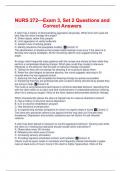
Preview 2 out of 13 pages
Exam (elaborations)
NURS 272—Exam 3, Set 2 Questions and Correct Answers
Preview 2 out of 13 pages
client has a history of demonstrating aggression physically. What short-term goal will best help the client manage this anger? A. Strike objects rather than people. B. Limit aggression to verbal outbursts. C. Isolate in lieu of striking people. D. Identify situations that precipitate hostility. Correct: D The identification of situations that create hostile feelings must occur if the client is to develop new coping strategies. All the remaining options only suggest limiting the anger. An angry client frequently loses patience with the nurses and shouts at them while they perform a complicated dressing change. Which plan could they create to intervene effectively in this behavior that focuses on behavior therapy concepts? A. Telling him they will not change his dressing if he is going to abuse them. B. When the client begins to become abusive, the nurse suggests returning in 20 minutes when he has regained control. C. Assuring him they will complete the dressing change as quickly as possible. D. Explaining that they are professionals and unused to being shouted at by people they are trying to help. Correct: B The nurse is using behavioral techniques to reinforce desirable behavior (spending time with the client when he is calm) and limit reinforcement of undesirable behavior (leaving when he is acting out anger). None of the other options demonstrates behavior therapy. Which characteristic places the client at highest risk for violence directed at others? A. Has a history of recurrent severe depression B. Is in an alcohol rehabilitation program C. Has delusions of persecution D. Is experiencing somatic symptoms for which no organic basis is found Correct: C The client who perceives others to be against him/her may lash out if he/she feels threatened. Depression and somatic symptoms are risk factors for self-directed violence. A client has been placed in seclusion to control aggressive behavior. Nursing care while the client is in mechanical restraints should include which intervention? A. Observation every 30 minutes B. Releasing the client every 8 hours C. Increasing sensory stimulation D. Providing regularly scheduled nutrition and hydration Correct: D
Content preview
Document information
- Uploaded on
- August 1, 2024
- Number of pages
- 13
- Written in
- 2024/2025
- Type
- Exam (elaborations)
- Contains
- Questions & answers
$10.49
Wrong document? Swap it for free
Within 14 days of purchase and before downloading, you can choose a different document. You can simply spend the amount again.
Written by students who passed
Immediately available after payment
Read online or as PDF

Reputation scores are based on the amount of documents a seller has sold for a fee and the reviews they have received for those documents. There are three levels: Bronze, Silver and Gold. The better the reputation, the more your can rely on the quality of the sellers work.
Available in package deal
Package deal
NURS 272 Q&A Bundle

