Ahip 2024 module 3
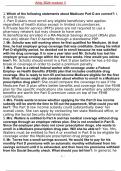
1. Which of the following statements about Medicare Part D are correct?: I,
II, and III only
-I. Part D plans must enroll any eligible beneficiary who applies
regardless of health status except in limited circumstances.
II. Private fee-for-service (PFFS) plans are not required to use a
pharmacy network but may choose to have one.
III. Beneficiaries enrolled in a MA-Medical Savings Account (MSA) plan
may only obtain Part D benefits through a standalone PDP.
2. Mr. Schultz was still working when he first qualified for Medicare. At that
time, he had employer group coverage that was creditable. During his initial
Part D eligibility period, he decided not to enroll because he was satisfied
with his drug coverage. It is now a year later and Mr. Schultz has lost his
employer group coverage within the last two weeks. How would you advise
him?: Mr. Schultz should enroll in a Part D plan before he has a 63-day
break in coverage in order to avoid a premium penalty.
3. Mrs. Fiore is a retired federal worker with coverage under a Federal
Employ- ee Health Benefits (FEHB) plan that includes creditable drug
coverage. She is ready to turn 65 and become Medicare eligible for the first
time. What issues might she consider about whether to enroll in a Medicare
prescription drug plan?: She could compare the coverage to see if the
Medicare Part D plan offers better benefits and coverage than the FEHB
plan for the specific medications she needs and whether any additional
benefits are worth the Part D premium costs on top of her FEHB
contribution.
4. Mrs. Fields wants to know whether applying for the Part D low income
subsidy will be worth the time to fill out the paperwork. What could you tell
her?: The Part D low income subsidy could substantially lower her
overall costs. She can apply by contacting her state Medicaid office, or
calling the Social Security Administration.
5. Mrs. Walters is entitled to Part A and has medical coverage without drug
coverage through an employer retiree plan. She is not enrolled in Part B.
Since the employer plan does not cover prescription drugs, she wants to
enroll in a Medicare prescription drug plan. Will she be able to?: Yes. Mrs.
Walters must be entitled to Part A or enrolled in Part B to be eligible for
coverage under the Medicare prescription drug program.
6. Mr. Torres has a small savings account. He would like to pay for his
monthly Part D premiums with an automatic monthly withdrawal from his
savings account until it is exhausted, and then have his premiums withheld
from his Social Security check. What should you tell him?: In general, he
1/4
, Ahip 2024 module 3
must select a single Part D premium payment mechanism that will be
used throughout the year.
2/4
1. Which of the following statements about Medicare Part D are correct?: I,
II, and III only
-I. Part D plans must enroll any eligible beneficiary who applies
regardless of health status except in limited circumstances.
II. Private fee-for-service (PFFS) plans are not required to use a
pharmacy network but may choose to have one.
III. Beneficiaries enrolled in a MA-Medical Savings Account (MSA) plan
may only obtain Part D benefits through a standalone PDP.
2. Mr. Schultz was still working when he first qualified for Medicare. At that
time, he had employer group coverage that was creditable. During his initial
Part D eligibility period, he decided not to enroll because he was satisfied
with his drug coverage. It is now a year later and Mr. Schultz has lost his
employer group coverage within the last two weeks. How would you advise
him?: Mr. Schultz should enroll in a Part D plan before he has a 63-day
break in coverage in order to avoid a premium penalty.
3. Mrs. Fiore is a retired federal worker with coverage under a Federal
Employ- ee Health Benefits (FEHB) plan that includes creditable drug
coverage. She is ready to turn 65 and become Medicare eligible for the first
time. What issues might she consider about whether to enroll in a Medicare
prescription drug plan?: She could compare the coverage to see if the
Medicare Part D plan offers better benefits and coverage than the FEHB
plan for the specific medications she needs and whether any additional
benefits are worth the Part D premium costs on top of her FEHB
contribution.
4. Mrs. Fields wants to know whether applying for the Part D low income
subsidy will be worth the time to fill out the paperwork. What could you tell
her?: The Part D low income subsidy could substantially lower her
overall costs. She can apply by contacting her state Medicaid office, or
calling the Social Security Administration.
5. Mrs. Walters is entitled to Part A and has medical coverage without drug
coverage through an employer retiree plan. She is not enrolled in Part B.
Since the employer plan does not cover prescription drugs, she wants to
enroll in a Medicare prescription drug plan. Will she be able to?: Yes. Mrs.
Walters must be entitled to Part A or enrolled in Part B to be eligible for
coverage under the Medicare prescription drug program.
6. Mr. Torres has a small savings account. He would like to pay for his
monthly Part D premiums with an automatic monthly withdrawal from his
savings account until it is exhausted, and then have his premiums withheld
from his Social Security check. What should you tell him?: In general, he
1/4
, Ahip 2024 module 3
must select a single Part D premium payment mechanism that will be
used throughout the year.
2/4