

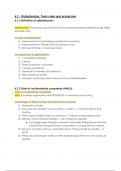
6.2 - Globalisation, free trade and protection
6.2.1 Definition of globalisation
Globalisation: The process by which the world is becoming interconnected through trade
and other links
Causes of globalisation
1) Improvements in technology (e.g telecommunication)
2) Improvements in infrastructure (↓ transport cost)
3) Removal of trade + travel restrictions
Consequences of globalisation
1) ↑ competition globally
2) ↓ prices
3) Great choices for consumers
4) ↑ quality of products
5) Expansion of markets for producers
6) Role of external shocks
7) Less govt autonomy, where every country is interdependent
6.2.2 Role of multinational companies (MNCs)
Role of multinational companies
MNC: A business organisation that PRODUCES in more than one country
Advantages of MNCs to their host and home countries
1) Economies of scale
2) New jobs are created in host countries → raises Y → improves SOL in that
country
3) MNCs setup facilities closer to customers → reduces transportation costs
4) Selling in many national markets → risk of failure is reduced
● E.g If Egypt goes through a recession (with sales falling there), then this
could be less impactful due to rising sales in a strong German market
5) Set up in countries with low corporation tax or if they provide tax breaks → ↑
profit
6) MNCs can avoid import tariffs on their products exported from one country to
another
, Disadvantages of MNCs to their host and home countries
1) Worker exploitation - poor working conditions + pay
2) Resource plundering - extract large quantities of natural resources
3) Reduce competition - out-compete domestic firms
4) Over reliance on MNCs for jobs - countries rely on MNCs to provide jobs for their
citizens, bc if MNCs leave → UE
5) Diseconomies of scale
6) MNCs are associated with many negative externalities of production in
developing countries
Why MNCs expand into LDCs
● To bypass any trade barriers
● To expand into growing markets → ↑ sales + ↑ R (e.g China, Brazil, India)
● To lower costs of production (some countries have cheaper labour)
● To take advantages of tax breaks
● To exploit the natural resources in other countries (MNCs have the technology
and expertise)
6.2.3 The benefits of free trade
International trade: The selling and buying of G/S between countries
International competitiveness: The ability of a country to sell successfully internationally
with other countries on their exports
Why do countries trade with each other?
1) Difference in factor endowment
● Every country has different resources, and have G/S other countries don’t
have
● So they trade with each other (e.g natural resources)
● With more access to resources → ↑Q + fall in cost of production
2) Variety and quality of goods
● International trade → more choices for consumers
● More competition → ↓P + good quality
3) Political reasons
● Improve relationship between govts
4) Gain specialisation
● Specialisation → mass produce → sell to other countries
6.2.1 Definition of globalisation
Globalisation: The process by which the world is becoming interconnected through trade
and other links
Causes of globalisation
1) Improvements in technology (e.g telecommunication)
2) Improvements in infrastructure (↓ transport cost)
3) Removal of trade + travel restrictions
Consequences of globalisation
1) ↑ competition globally
2) ↓ prices
3) Great choices for consumers
4) ↑ quality of products
5) Expansion of markets for producers
6) Role of external shocks
7) Less govt autonomy, where every country is interdependent
6.2.2 Role of multinational companies (MNCs)
Role of multinational companies
MNC: A business organisation that PRODUCES in more than one country
Advantages of MNCs to their host and home countries
1) Economies of scale
2) New jobs are created in host countries → raises Y → improves SOL in that
country
3) MNCs setup facilities closer to customers → reduces transportation costs
4) Selling in many national markets → risk of failure is reduced
● E.g If Egypt goes through a recession (with sales falling there), then this
could be less impactful due to rising sales in a strong German market
5) Set up in countries with low corporation tax or if they provide tax breaks → ↑
profit
6) MNCs can avoid import tariffs on their products exported from one country to
another
, Disadvantages of MNCs to their host and home countries
1) Worker exploitation - poor working conditions + pay
2) Resource plundering - extract large quantities of natural resources
3) Reduce competition - out-compete domestic firms
4) Over reliance on MNCs for jobs - countries rely on MNCs to provide jobs for their
citizens, bc if MNCs leave → UE
5) Diseconomies of scale
6) MNCs are associated with many negative externalities of production in
developing countries
Why MNCs expand into LDCs
● To bypass any trade barriers
● To expand into growing markets → ↑ sales + ↑ R (e.g China, Brazil, India)
● To lower costs of production (some countries have cheaper labour)
● To take advantages of tax breaks
● To exploit the natural resources in other countries (MNCs have the technology
and expertise)
6.2.3 The benefits of free trade
International trade: The selling and buying of G/S between countries
International competitiveness: The ability of a country to sell successfully internationally
with other countries on their exports
Why do countries trade with each other?
1) Difference in factor endowment
● Every country has different resources, and have G/S other countries don’t
have
● So they trade with each other (e.g natural resources)
● With more access to resources → ↑Q + fall in cost of production
2) Variety and quality of goods
● International trade → more choices for consumers
● More competition → ↓P + good quality
3) Political reasons
● Improve relationship between govts
4) Gain specialisation
● Specialisation → mass produce → sell to other countries


