

Topic 5: Chemical energetics
5.1 EXOTHERMIC AND ENDOTHERMIC REACTIONS---------------
● Exothermic reaction: transfers thermal energy (heat) to the surroundings leading to an increase in the
temperature of the surroundings
○ BOND MAKING (energy released when atoms join to form stable compounds - products)
● Endothermic reaction: takes in thermal energy from the surroundings leading to a decrease in the
temperature of the surroundings - BOND BREAKING (energy used to break all bonds of reacting
compounds - reactants)
○ Bond energy (kJ/mol): energy needed to break bonds / energy released when the same bonds
form
● Activation energy (Ea): the minimum energy that colliding particles must have to react
● Enthalpy Change (ΔH): transfer of thermal energy during a reaction
○ Enthalpy change = energy used to break bonds of reactants - energy released when products
formed
○ ENDO: ΔH = +ve → Energy used to break bonds of reactants > energy released when products
formed
○ EXO: ΔH = -ve → Energy used to break bonds of reactants < energy released when products
formed
REACTION PATHWAY DIAGRAMS
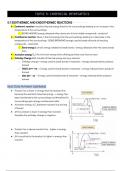
● Product line is lower in energy than the reactant line
because the reactants have lost energy → energy has
been transferred to the surroundings and therefore the
surroundings gain energy and become hotter
● Activation energy is Ea (between reactant line and top
of bump)
● ΔH: bc product is lower in energy than reactant,
therefore the enthalpy change is negative
● Product line is above reactant line - higher in energy
than reactant
● ΔH is positive bc the product is higher in energy than
reactant
5.1 EXOTHERMIC AND ENDOTHERMIC REACTIONS---------------
● Exothermic reaction: transfers thermal energy (heat) to the surroundings leading to an increase in the
temperature of the surroundings
○ BOND MAKING (energy released when atoms join to form stable compounds - products)
● Endothermic reaction: takes in thermal energy from the surroundings leading to a decrease in the
temperature of the surroundings - BOND BREAKING (energy used to break all bonds of reacting
compounds - reactants)
○ Bond energy (kJ/mol): energy needed to break bonds / energy released when the same bonds
form
● Activation energy (Ea): the minimum energy that colliding particles must have to react
● Enthalpy Change (ΔH): transfer of thermal energy during a reaction
○ Enthalpy change = energy used to break bonds of reactants - energy released when products
formed
○ ENDO: ΔH = +ve → Energy used to break bonds of reactants > energy released when products
formed
○ EXO: ΔH = -ve → Energy used to break bonds of reactants < energy released when products
formed
REACTION PATHWAY DIAGRAMS
● Product line is lower in energy than the reactant line
because the reactants have lost energy → energy has
been transferred to the surroundings and therefore the
surroundings gain energy and become hotter
● Activation energy is Ea (between reactant line and top
of bump)
● ΔH: bc product is lower in energy than reactant,
therefore the enthalpy change is negative
● Product line is above reactant line - higher in energy
than reactant
● ΔH is positive bc the product is higher in energy than
reactant


