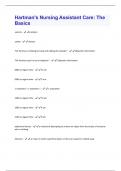
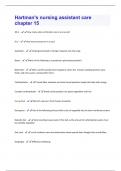
Hartman's Nursing Assistant Care: The Basics Questions and Answers 100% Verified
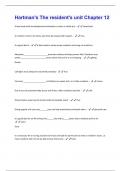
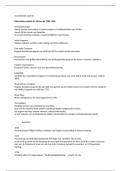
-paresis - paralysis -pathy - disease "Mr Hartman is holding his head and rubbing his temples" - Objective information "Mr Hartman says he has a headache" - Subjective information 0000 as regular time - 12 am 0900 as regular time - 9 a.m. 1 inspiration + 1 expiration = - 1 respiration 1200 as regular time - 12 pm 1600 as regular time - 4 pm 2100 as regular time - 9 pm abdominal thrusts - a method of attempting to remove an object from the airway of someone who is choking Abrasion - an injury in which superficial layers of skin are scraped or rubbed awayactive neglect - the purposeful failure to provide needed care, resulting in harm to a person Activity is an - Essential part of a persons life acute care - 24-hour skilled care for short-term illnesses or injuries; generally given in hospitals and ambulatory surgical centers advance directives - A legal document designed to indicate a person's wishes regarding care in case of a terminal illness or during the dying process Ageism - Discrimination based on age Always check the water temperature with.. - A water thermometer or on the inside of your wrist before using An Ombudsman - is assigned by law as the legal advocate for residents angina pectoris - chest pain that results when the heart does not get enough oxygen antimicrobial agent - destroys, resists, or prevents the development of pathogens Anything the endangers the resident should be - Reporter immediately (ex: falls, chest pain, severe headache, trouble breathing) Anytime you are feeding a resident they should be - Sitting at a 75-90 degrees angle apathy - a lack of feeling, emotion, or interest Arthritis - inflammation of a jointAs long as the resident can speak, breath, or cough, the NA should - Encourage her to cough as forcefully as possible to get the object out assistive or adaptive devices - special equipment that helps a person who is ill or disabled perform activities of daily living (ex: occupational therapy) Atherosclerosis - hardening and narrowing of the blood vessels Atropy - The muscle wastes away, or decreases in size, and becomes weak
Written for
- Institution
- Hartman\'s Nursing Assistant Care: The Basics
- Course
- Hartman\'s Nursing Assistant Care: The Basics
Document information
- Uploaded on
- July 30, 2024
- Number of pages
- 18
- Written in
- 2023/2024
- Type
- Exam (elaborations)
- Contains
- Questions & answers
Subjects
-
hartmans nursing assistant care the basics

Also available in package deal