

Hepatitis C Virus Encoded Antigen (Recombinant c22-3, c200 and NS5) ORTHO ® HCV Version 3.0 ELISA Test System
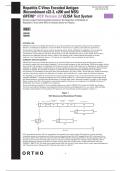
ORTHO HCV Version 3.0 ELISA Test System is an enzyme-linked immunosorbent assay (ELISA) which utilizes microwells coated with recombinant hepatitis C virus encoded antigens as the solid phase. ELISA technology utilizes the principle that antigens or antibodies which become bound to the solid phase can be detected by complementary antibody or antigen which is labeled with an enzyme capable of acting on a chromogenic substrate. When enzyme substrate is applied, the presence of antigen or antibody can be detected by the development of a colored end product. Immunoassays of this type were first developed in the early 1970s.1 Since that time, ELISA technology has been extensively used for the detection of antigens and antibodies for a wide range of infectious diseases. The hepatitis C virus (HCV) is now known to be the causative agent for most, if not all, blood-borne non-A, non-B hepatitis (NANBH).2-7 Studies throughout the world indicate that HCV is transmitted through contaminated blood and blood products, through blood transfusions or through other close, personal contacts. Currently, in the United States, greater than 90% of transfusion-associated hepatitis infections are considered to be NANBH infections.8,9 Worldwide, other forms of NANBH are recognized. Three recombinant hepatitis C virus encoded antigens are used in ORTHO HCV Version 3.0 ELISA Test System. The three recombinant antigens, developed by Novartis Vaccines and Diagnostics, Inc., are c22-3, c200 and NS5. A graphic representation of the putative HCV genome and recombinant proteins appears in Figure 1. Figure 1 HCV Genome and Recombinant Proteins Membrane Binding Helicase/Protease Membrane Binding Core Envelope Envelope/NS1 Function Function Function Polymerase Function 5' C E1 E2/NS1 NS3 NS2 NS4 NS5 1192 NS5 N-term. C-term. 154 SOD N-term. 154 SOD 740 942 1931 154 SOD 119 C-term. 2 120 3' C-term. N-term. c22-3 c200 0 3000 amino acid HCV recombinant protein c22-3 is encoded by the putative core region of the HCV genome. Amino acid and nucleotide sequence comparisons of flaviviruses and pestiviruses with HCV suggest that c22-3 is derived from a structural region of the genome which encodes the RNA-binding nucleocapsid protein. Nucleocapsid proteins are thought to be involved in forming the viral core structure. Recent studies have indicated that antibodies which develop following infection with HCV are often reactive with c22-3.10 Moreover, studies performed using the CHIRON™ RIBA™ HCV 2.0 Strip Immunoblot Assay (SIA) for anti-HCV have shown that in many cases antibodies to c22-3 develop sooner following HCV infection than those to c100-3.11 ORTHO 1 HCV recombinant protein c200 is encoded by the putative NS3 and NS4 regions of the HCV genome. Amino acid and nucleotide sequence comparisons of flaviviruses and pestiviruses with HCV suggest that c200 is derived from nonstructural regions of the genome. The c200 recombinant protein contains the c33c protein sequence genetically linked to the c100-3 protein sequence. c33c is encoded by the putative NS3 portion of the HCV genome. Amino acid and nucleotide sequence comparisons of flaviviruses and pestiviruses with HCV suggest that the NS3 region encodes the viral helicase, an enzyme involved in the unwinding of RNA during replication of the viral genome by RNA-dependent RNA polymerase. Recent studies have indicated that antibodies which develop following infection with HCV are frequently reactive with c33c. Studies performed using the CHIRON™ RIBA™ HCV 2.0 SIA for anti-HCV have shown that antibodies reactive with c33c often develop sooner following HCV infection than do those to c100-3.11 HCV recombinant protein c100-3 is encoded by the putative NS4 region of the HCV genome. Amino acid and nucleotide sequence comparisons of flaviviruses and pestiviruses with HCV suggest that c100-3 is derived from a nonstructural region of the genome. At present, the function of this portion of the HCV genome is unknown. Antibodies which develop following infection with HCV are often reactive with c100-3.3 HCV recombinant protein NS5 is encoded by the putative NS5 region of the HCV genome. Amino acid and nucleotide sequence comparisons of flaviviruses and pestiviruses with HCV suggest that NS5 is derived from a nonstructural region of the genome that encodes the viral polymerase, an enzyme involved in replication of HCV. Recent studies have indicated that a significant proportion of persons infected with HCV develop antibodies to NS5.12,13 The use of HCV recombinant proteins derived from the core, NS3, NS4 and NS5 regions of the HCV genome has shown to be effective in identifying a greater number of diagnosed acute and chronic non-A, non-B hepatitis patients than single antigen (c100-3) assays.12,13 In addition, the use of these additional proteins allows for earlier detection of seroconversion following HCV infection. Although antibody responses to NS5 region-encoded a
Document information
- Uploaded on
- July 20, 2024
- Number of pages
- 15
- Written in
- 2023/2024
- Type
- Exam (elaborations)
- Contains
- Questions & answers


