

BRIEF SUMMARY OF INTELLECTUAL PROPERTY LAW. PREPARED BY NANYUMBA NICHOLAS LLB 4 JANUARY.
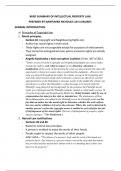
Principles of Copyright law. 1. Moral principles. - Section 10, Copyright and Neighbouring Rights Act. - Author has moral rights in their work. - These rights are not assignable except for purposes of enforcement. - They cannot be extinguished even where economic rights are wholly assigned. - Angella Katatumba v Anti-corruption Coalition CS No. 307 of 2011. - ͞Under section 10 of the Copyright and Neighbouring Rights Act, moral rights include the right to seek relief in respect of any distortion, alteration or modification of the work. At the hearing the song was played and I also taken the opportunity to listen to it again when considering this judgment….However the song was played throughout the jingle. Its volume was up at the beginning and end of the advertisement jingle and its thematic content was effectively used for appropriateness to the Defendant’s message. Lastly in the middle the volume was turned down to allow the Defendant’s verbal message to be heard while the Plaintiff’s song played in the background. In the premises the Plaintiffs moral rights were infringed and the Plaintiff would be entitled to relief under section 10 (2) of the Copyright and Neighbouring Rights Act. Relief includes relief by way of compensation for injury to her style or intended use. The displeasure of Hon Maria Mutagamba who talked to the Plaintiff proves the Plaintiffs point and the fact that an author has the moral right to determine whether the work reflects her view and to withdraw it if not is also relevant. Where the work is distorted by another person’s action the copyright owner is entitled to seek relief for the tort of infringement of her moral rights. The tort of infringement of property rights attracts damages. ͟ Per Madraŵa J. 2. Natural Law Justifications. - Sections 46 and 48. - Based on natural law principles. - A person is entitled to enjoy the works of their hands. - People ought to respect the works of other people. - John Locke – ͞The labour of a person’s body and the work of his hands are properly theirs. And whatever a person removes out of the state that that nature has provided and has mixed their labour with it to something that is their own then it is his property.͟ - Donaldson v Beckett (1774) – copyright protection is not perpetual. Court rejected the notion of a natural copyright separate and apart from statute. - Plateau Publishing House v Adophy (1986) 4 NWLR 205. – ͞The court in awarding an account for profit takes from the wrongdoer all the profit he has made from his piracy and gives them to the person who has been wronged.͟ Per Uwais JSC. 3. Economic Principles. - Section 9. - Classic Art Works Ltd v Vincent Lukenge and Children of Grace HCCS No. 207/2010. – ͞… the copyright owner may assign his or her economic rights in a copyright to another person. … Licence another person to use the economic rights…. Transfer to another person or bequeath the economic rights in a copyright in whole or on part. - The rights can only be assigned or transferred in writin
Document information
- Uploaded on
- July 15, 2024
- Number of pages
- 6
- Written in
- 2023/2024
- Type
- Exam (elaborations)
- Contains
- Questions & answers


