

A&P 2: Dr Mills TWU Ch.27 Questions With 100% Correct Answers.
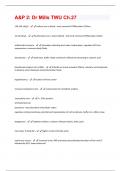
136-142 mEq/L - sodium ions in blood - most common EXTRAcellular CATions 22-26 mEq/L - bicarbonate ions in arterial blood - 2nd most common EXTRAcellular CATion antidiuretic hormone - stimulates collecting duct water reabsorption. regulates H2O loss. vasopression. conserves body fluids. bicarbonate - weak base, buffer. helps control pH of blood by interacting w carbonic acid. bicarbonate antiport ion in RBCs - chloride ion (most prevalent ANion). interacts w/ bicarbonate to balance anions between extra/intracellular fluids. hypothalamus - location of thirst center increased respiratory rate - compensates for metabolic acidosis intracellular ions - K+, PO4, proteins 2/3 body fluid vol. potassium- most abundant intracellular cation regulates resting membrane potential and repolarization of cell membrane. buffers H+, ANion, base ketogenesis - diabetes mellitus. creation of ketone bodies, krebs cycle men lower % body fat - higher content of body water natriuresis causes - increased urine. ANP promotes extra/elevated excretion of Na+ and Clfollowed by H2O. lowers blood volprimary regulator of extracellular Na - aldosterone (the hormone that stimulates kidneys to take in more Na+ and Cl- and secrete more K+ principal cells - aquaporin 2 modulated by ADH. aqp-2 is water-channel protein. a pore for H2O to travel thru to the principal cells sodium - most abundant extracellular cation sodium and chloride ions - primary determinant of body fluid volume. solute concentration - determines direction of water movement. determines which ions move where at what time strong acid and weak base - salt of strong acid plus weak acid strong base and weak acid - water and weak base women higher % body fat - lower amount of body water
Document information
- Uploaded on
- July 12, 2024
- Number of pages
- 2
- Written in
- 2023/2024
- Type
- Exam (elaborations)
- Contains
- Questions & answers


