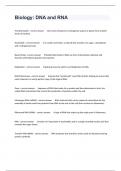
Biology: DNA and RNA Prep Exam Questions And Answers Well Elaborated .
Transformation - correct answer One strain of bacteria is changed by a gene or genes form another strain of bacteria. Nucleotide - correct answer In a nucleic-acid chain, a subunit that consists of a sugar, a phosphate, and a nitrogenous base. Base Pairing - correct answer Principle that bonds in DNA can form only between adenine and thymine and between guanine and cytosine. Replication - correct answer Copying process by which a cell duplicates its DNA. DNA Polymerase - correct answer Enzyme that "proofreads" new DNA strands, helping to ensure that each molecule is a nearly perfect copy of the original DNA. Gene - correct answer Sequence of DNA that codes for a protein and thus determines a trait. Are coded DNA instructions that control the production of proteins within the cell. Messenger RNA (mRNA) - correct answer RNA molecule that carries copies of instructions for the assembly of amino acids into proteins from DNA to the rest of the cell (from nucleus to ribosomes). Ribosomal RNA (rRNA) - correct answer A type of RNA that makes up the major part of ribosomes. RNA - correct answer Consists of a long chain of nucleotides and is a single-stranded nucleic acid that contains the sugar ribose. Transfer RNA (tRNA) - correct answer RNA molecule that transfers amino acids to ribosomes during protein synthesis. Transcription - correct answer A process in which part of the nucleotide sequence of DNA is copied into a complementary sequence in RNA. Or a process in which mRNA molecules are produced by copying part of DNA. RNA Polymerase - correct answer Enzyme that binds to DNA and separates the DNA strands during transcription. Translation - correct answer Decoding of a mRNA message into a polypeptide chain. Codon - correct answer Three-nucleotide sequence on messenger RNA that codes for a single amino acid. Anti-codon - correct answer group of three bases on a tRNA molecule that are complementary to an mRNA codon. Who discovered DNA? - correct answer James Watson & Francis Crick in 1953. The four bases in a DNA molecule. - correct answer Adenine (A), Guanine (G), Cytosine (C), and Thymine (T). The two bases that are purines. - correct answer Adenine and Guanine. The two bases that are pyrimidines. - correct answer Cytosine and Thymine. Where DNA is located. - correct answer In the nucleus. The structure of DNA is best described as a(n) - correct answer Double helix and looks like a spiral staircase. The three main types of RNA? - correct answer tRNA (transfer), mRNA (messenger), and rRNA (ribosomal). Where translation take place. - correct answer In the cytoplasm on the ribosomes. What is Chargaff's rule? - correct answer The number of guanine and cytosine bases are almost equal in any DNA sample, as are the number of adenine and thymine bases. How many possible codons are there? - correct answer 64 How many types of amino acids are there? - correct answer 20 Can more than one codon specify an amino acid? - correct answer No. The end product of translation. - correct answer The mRNA is decoded into a protein. The three differences between DNA and RNA. - correct answer 1. RNA contains ribose - DNA contains deoxyribose. 2. RNA is single stranded - DNA is a double helix. 3. RNA contains Uracil instead of thymine. DNA stands for - correct answer Deoxyribose Nucleic Acid. RNA stands for - correct answer Ribonucleic Acid. A deoxyribose molecule is otherwise known as - correct answer sugar. The three parts of a nucleotide - correct answer A deoxyribose molecule (sugar), a phosphate group, and a nitrogenous base. The backbone of a DNA chain is formed by the - correct answer Phosphate group and the deoxyribose molecule of each nucleotide. What sticks out sideways from the DNA chain? - correct answer The nitrogenous bases. Who used X-ray diffraction to get information about the structure of DNA? - correct answer Rosalind Franklin. DNA is a long ________ made of units called _________. - correct answer Molecule, nucleotides. Erwin Chargaff - correct answer An American biochemist (Chargaff's rule). Who showed that strands in DNA are twisted like the coils of a string to form a helix? - correct answer Rosalind Franklin. Composed of two strands of DNA wound around each other. - correct answer Double helix. The strands of _________ are tightly and super-coiled to make chromosomes. - correct answer Nucleosomes. The DNA in eukaryotic is packed very - correct answer Tightly. The human cell contains _________ of DNA. - correct answer 1 meter. Eukaryotic chromosomes contain DNA wrapped around proteins called. - correct answer Histones and makes a structure called Nucleosomes. What structure allows enormous amounts of DNA to fit in the cell nucleus? - correct answer Chromosomes. Each strand of the double helix serves as. - correct answer A template for the new strand. Replication Forks. - correct answer Y-shaped regions of replicating or separating DNA molecules (where new strands are growing or being synthesized). DNA replication. - correct answer Occurs at hundreds of places and proceeds in both directions until each chromosome is completely copied. Step #1 in DNA replication. - correct answer Enzymes "unzip" the DNA molecule to separate it into two strands. (RNA polymerase) Step #2 in DNA replication. - correct answer Base pairing is used to build two new complementary strands. Step #3 in DNA replication. - correct answer DNA polymerase joins individual nucleotides together to produce a DNA molecule; also proofreads for mistakes. RNA is like a. - correct answer Disposable copy or working copy of DNA. Where transcription occurs. - correct answer In the nucleus. Transcription is similar to. - correct answer DNA replication. Step #1 in Transcription. - correct answer DNA double helix unwinds. Step #2 in Transcription. - correct answer RNA nucleotides bound to their complementary bases on DNA. Step #3 in Transcription. - correct answer Nucleotides are joined together by a RNA polymerase enzyme and mRNA results. How does RNA know where to start and stop transcription? - correct answer DNA has sites known as "promoters", which have specific base sequences that indicated to RNA polymerase where to bind to make begin making RNA. Similar sites exist to stop transcription. Introns. - correct answer Sections of RNA molecules that are removed before the molecule becomes functional. Exons. - correct answer Remaining pieces of RNA that are spliced together to form the final RNA molecule. The "language" of mRNA instructions. - correct answer The genetic code. The genetic code can read ____ bases or letters at a time. - correct answer 3. Each three letter word in mRNA is called a. - correct answer Codon. 3 consecutive nucleotides make a. - correct answer Single amino acid. ___ is the start codon. - correct answer AUG. The ___ possible start codons. - correct answer 3. The possible stop codons in RNA are. - correct answer UAG, UAA, and UGA. The possible stop codons in DNA are. - correct answer TAG, TAA, and TGA. Building blocks of proteins. - correct answer Amino acids. Amino acids. - correct answer Form long chains called polypeptides which make up proteins. Step #1 in Translation. - correct answer mRNA attaches to a ribosome. Step #2 in Translation. - correct answer Transfer RNA (tRNA) reads the codon on the mRNA and taxis the corresponding amino acid or anti-codon to the strand. Step #3 in Translation. - correct answer These anti-codons are bonded. Step #4 in Translation. - correct answer When the stop codon is reached on mRNA , the new polypeptide chain and the mRNA molecules are released.
Written for
- Institution
- DNA RNA
- Course
- DNA RNA
Document information
- Uploaded on
- July 12, 2024
- Number of pages
- 9
- Written in
- 2023/2024
- Type
- Exam (elaborations)
- Contains
- Questions & answers
Subjects

Also available in package deal