

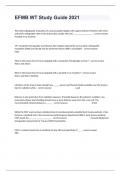
EFMB WT Study Guide 2021 Questions And Answers 100% Verified Complete Answers.
The initial radiographic evaluation of a trauma patient begins with supine Anterior-Posterior (AP) chest and pelvis radiographs taken in the trauma bay usually with a(n) _________________. - correct answer Portable x-ray machine T/F: Computed Tomography scanning has been largely replaced by cervical spine radiographic evaluation (CSRE) and should only be performed when CSRE is unavailable. - correct answer False What is the lowest level of care equipped with a Computed Tomography scanner? - correct answer Role 3 and above What is the lowest level of care equipped with a portable x-ray machine? - correct answer Role 2 and Role 3 facilities Members of the trauma team should have _____ aprons and thyroid shields available near the trauma bay for radiation safety. - correct answer Lead Distance is also protective from radiation exposure. If feasible based on the patient's condition, any personnel without lead shielding should move a short distance away from the x-ray unit. The recommended minimal distance is _____. - correct answer 6 feet While the FAST scan has been validated only in hemodynamically unstable blunt trauma patients, it has become a standard tool in the trauma bay and Emergency Department (ED) in most trauma patients. FAST stands for____________________. - correct answer Focused Abdominal Sonographic Assessment for Trauma (FAST) Examination FAST in combat trauma has a sensitivity of only 56% and specificity of ___. - correct answer 98% T/F: The FAST exam remains the most sensitive test for hollow viscus injury and mesenteric injury. - correct answer False. Diagnostic Peritoneal Lavage (DPL) T/F: At the Role 3, properly trained providers including radiologists, surgeons, and emergency physicians, can perform and interpret FAST scans in the emergency department on a hand held portable device. - correct answer True A FAST examination is performed with a portable hand-held machine most commonly using a standard 3-7 MHz curved array _______________ probe. - correct answer Ultrasound (US) The standard FAST examination is focused on evaluating for the presence of ______________ in certain areas of the body. - correct answer Free intraperitoneal fluid When performing a FAST examination on a patient, you inspect the right upper quadrant. You are inspecting between which two organs? - correct answer Liver and kidney When performing a FAST examination on a patient, you inspect the left upper quadrant. You are inspecting between which two organs? - correct answer Spleen and kidney An 18g ______________ IV is typically desired for Computed Tomography IV access. - correct answer Antecubital T/F: The goal of Computed Tomography contrast injection is to provide concurrent solid organ enhancement, arterial enhancement, and pulmonary arterial. - correct answer True T/F: When performing Computed Tomography scan on a Military Working Dog, utilize a scanning protocol based on the adult settings to include the doses of and rates of contrast administration. - correct answer False. Pediatric settings T/F: All patients evacuated through casualty evacuation should have images sent electronically ahead of time as well as have a CD created to send with the patient as a backup. - correct answer True T/F: Magnetic Resonance Imaging is widely used in theater, as its utility in the acute management of combat trauma was extensively establishment during Operation Enduring Freedom. - correct answer False All trauma patients arriving at a Role ___ will receive proper and expeditious radiologic screening of injuries. - correct answer Role 3 hospital T/F: Patients exposed to hazardous noise are only at risk for aural trauma. - correct answer False. At risk for both acoustic trauma and subsequent Hearing Loss (HL) The symptoms of acoustic trauma are: - correct answer -Hearing loss, tinnitus (ringing in the ear) -Aural fullness, recruitment (ear pain with loud noise) -Difficulty localizing sounds -Difficulty hearing in a noisy background -Vertigo Acoustic trauma may result in sensorineural hearing loss (SNHL) that is either _____________or _____________. - correct answer Temporary (temporary threshold shift, TTS) or Permanent (permanent threshold shift, PTS) The ear, specifically the _____________, is the most sensitive organ to primary blast injury. - correct answer Tympanic Membrane (TM) T/F: The smaller the size of the tympanic membrane perforation, the greater the likelihood is of spontaneous closure. - correct answer True (TM perforations heal spontaneously in 80 to 94% of cases) The majority of tympanic membrane perforations that close spontaneously do so within the first ___________ after injury. - correct answer 8 weeks Acute management of intratemporal facial nerve injury is to provide objective documentation of facial movement using the _____________ scale. - correct answer House-Brackmann grading scale T/F: For significant facial pareses/paralyses, early administration of steroids must always be provided regardless of contraindications. - correct answer False. Provided if not contraindicated Which inner ear abnormalities may cause vertigo? - correct answer -Benign paroxysmal positional vertigo (BPPV), damage to sensitive neuroepithelial rests within the inner ear -Perilymphatic fistula -Otic capsule violating temporal bone fractures -Secondary infections of the inner ear or vestibular nerves Trauma induced endolymphatic hydrops -Activation of subclinical superior semicircular canal dehiscence. All Service Members that develop symptoms consistent with noise trauma (acute tinnitus, muffled hearing, fullness in the ear) should: - correct answer Be educated and directed to self-report for evaluation and possible treatment as soon as practicable What is the best course of action if you find debris in the external auditory canal or in the middle ear? - correct answer Treat w/ fluoroquinolone and steroid containing topical antibiotic (e.g., 4 drops of ciprofloxacin/dexamethasone or ofloxacin affected ear TID X 7 Days). -Do NOT irrigate the ear as it may provoke pain and vertigo, move debris medially in the canal and middle ear, and promote infection. -Do NOT use any topical drops containing aminoglycosides (i.e. the neomycin in Cortisporin) since these are ototoxic. -Observe strict dry ear precautions and keep ALL water out of the EAC until the TM perforation has healed or is repaired. -Removal of debris should only be done by an ENT surgeon in order to avoid further injury to the EAC or the middle ear. Hearing loss that persists ___ hours after acoustic trauma warrants a hearing test or audiogram. - correct answer 72 hours T/F: Vestibular trauma to the inner ear may manifest in vertigo. - correct answer True All patients with subjective hearing loss and tinnitus following blast exposure should: - correct answer Have the exposure documented, and should be evaluated by hearing testing ASAP. Patients with TTS greater than ______ losses in three consecutive frequencies should be considered candidates for high dose oral and/or transtympanic steroid injections when not otherwise contraindicated. - correct answer 25 dB What are indications for endotracheal intubation during your initial burn survey? - correct answer Indications for endotracheal intubation include a comatose patient, symptomatic inhalation injury, deep facial burns, and burns over 40% Total Body Surface Area (TBSA). Burn casualties with injuries greater than ___ Total Body Surface Area (TBSA) are at high risk of hypothermia. - correct answer 20% TBSA T/F: When providing point of injury care to a burn patient, you must immediately debride blisters and cover burns with loose, moist gauze wraps or a wet clean sheet. - correct answer False. In the field, INTERRUPT THE BURNING PROCESS and address any life threatening bleeding, airway compromise, or tension pneumothorax as directed by Tactical Combat Casualty Care guidelines Calculate a burn patient's initial burn size using the Rule of _____. - correct answer Nines Which type of burn is NOT included in the estimation of Total Body Surface Area (TBSA) used for fluid resuscitation? - correct answer Superficial (1st degree) burn Which classification of burns are moist and sensate, blister, and blanch? - correct answer Partial thickness burns (2nd degree) Which classification of burns appear red, do not blister, and blanch readily? - correct answer Superficial burns (1st degree) Which classification of burns appear leathery, dry, non-blanching, are insensate, and often contain thrombosed vessels? - correct answer Full thickness burns (3rd degree) What is the Rule of 10s burn fluid resuscitation equation? Ensure you can apply it. - correct answer Rule of 10s (10 mL/hr x %TBSA) For children suffering burn injuries, ___ x Total Body Surface Area (TBSA) x body weight in kg gives the volume for the first 24 hrs of fluid resuscitation. - correct answer For children, 3 x TBSA x body weight in kg gives the volume for the first 24 hrs T/F: A hypotonic solution is the preferred resuscitation fluid for a burn patient. - correct answer False. Lactated Ringer's (LR), PlasmaLyte A™ (Baxter International, Deerfield, Il) or other isotonic solution is the preferred resuscitation fluid T/F: Both under- and over- fluid resuscitation of burn patients can result in serious morbidity and even mortality; patients who receive over 250 mL/kg in the first 24 hours are at increased risk for severe complications including acute respiratory distress syndrome and both abdominal and extremity compartment syndromes. - correct answer True At 8-12 hours post-burn, if the hourly IV fluid rate exceeds 1500 mL/hr or if the projected 24 hr total fluid volume approaches 250 mL/kg, initiate 5% ___________ infusion for an adult burn patient. - correct answer Albumin What are clinical signs of inhalation injury? - correct answer -Progressive voice changes -Soot about the mouth and nares -Hypoxia -Shortness of breath Definitive care for US service members suffering from burn injuries is provided at _____________. - correct answer USAISR Burn Center in San Antonio, Texas T/F: Early ambulation and physical therapy, is critical to the long-term functional outcome in burn patients. Once post-operative dressings are removed, perform range of motion of all affected joints. - correct answer True ____________ is the most common infectious complication with pediatric burn patients and usually presents within 5 days of injury. - correct answer Cellulitis A patient has suffered burn in
Document information
- Uploaded on
- July 11, 2024
- Number of pages
- 48
- Written in
- 2023/2024
- Type
- Exam (elaborations)
- Contains
- Questions & answers


