Ch. 26 NCLEX Style Questions and Answers with verified solutions
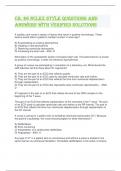
Ch. 26 NCLEX Style Questions and Answers with verified solutions A cardiac care nurse is aware of factors that result in positive chronotropy. These factors would affect a patient's cardiac function in what way? A) Exacerbating an existing dysrhythmia B) Initiating a new dysrhythmia C) Resolving ventricular tachycardia D) Increasing the heart rate - ANS -D Stimulation of the sympathetic system increases heart rate. This phenomenon is known as positive chronotropy. It does not influence dysrhythmias. A group of nurses are participating in orientation to a telemetry unit. What should the staff educator tell this class about ST segments? A) They are the part of an ECG that reflects systole. B) They are the part of an ECG used to calculate ventricular rate and rhythm. C) They are the part of an ECG that reflects the time from ventricular depolarization through repolarization. D) They are the part of an ECG that represents early ventricular repolarization. - ANS -D ST segment is the part of an ECG that reflects the end of the QRS complex to the beginning of the T wave. The part of an ECG that reflects repolarization of the ventricles is the T wave. The part of an ECG used to calculate ventricular rate and rhythm is the RR interval. The part of an ECG that reflects the time from ventricular depolarization through repolarization is the QT interval. A nurse is caring for a patient who is exhibiting ventricular tachycardia (VT). Because the patient is pulseless, the nurse should prepare for what intervention? A) Defibrillation B) ECG monitoring C) Implantation of a cardioverter defibrillator D) Angioplasty - ANS -A Any type of VT in a patient who is unconscious and without a pulse is treated in the same manner as ventricular fibrillation: Immediate defibrillation is the action of choice. ECG monitoring is appropriate, but this is an assessment, not an intervention, and will not resolve the problem. An ICD and angioplasty do not address the dysrhythmia. A nurse is providing health education to a patient scheduled for cryoablation therapy. The nurse should describe what aspect of this treatment? A) Peeling away the area of endocardium responsible for the dysrhythmia B) Using electrical shocks directly to the endocarduim to eliminate the source of dysrhythmia C) Using high-frequency sound waves to eliminate the source of dysrhythmia D) Using a cooled probe to eliminate the source of dysrhythmia - ANS -D Cryoablation therapy involves using a cooled probe to create a small scar on the endocardium to eliminate the source of the dysrhythmias. Endocardium resection involves peeling away a specified area of the endocardium. Electrical ablation involves using shocks to eliminate the area causing the dysrhythmias. Radio frequency ablation uses high-frequency sound waves to destroy the area causing the dysrhythmias. A patient calls his cardiologist's office and talks to the nurse. He is concerned because he feels he is being defibrillated too often. The nurse tells the patient to come to the office to be evaluated because the nurse knows that the most frequent complication of ICD therapy is what? A) Infection B) Failure to capture C) Premature battery depletion D) Oversensing of dysrhythmias - ANS -D Inappropriate delivery of ICD therapy, usually due to oversensing of atrial and sinus tachycardias with a rapid ventricular rate response, is the most frequent complication of ICD. Infections, failure to capture, and premature battery failure are less common. A patient converts from normal sinus rhythm at 80 bpm to atrial fibrillation with a ventricular response at 166 bpm. Blood pressure is 162/74 mm Hg. Respiratory rate is 20 breaths per minute with normal chest expansion and clear lungs bilaterally. IV heparin and Cardizem are given. The nurse caring for the patient understands that the main goal of treatment is what? A) Decrease SA node conduction B) Control ventricular heart rate C) Improve oxygenation D) Maintain anticoagulation - ANS -C Treatment for atrial fibrillation is to terminate the rhythm or to control ventricular rate. This is a priority because it directly affects cardiac output. A rapid ventricular response reduces the time for ventricular filling, resulting in a smaller stroke volume. Control of rhythm is the initial treatment of choice, followed by anticoagulation with heparin and then Coumadin. A patient has returned to the cardiac care unit after having a permanent pacemaker implantation. For which potential complication should the nurse most closely assess this patient? A) Chest pain B) Bleeding at the implantation site C) Malignant hyperthermia D) Bradycardia - ANS -B Bleeding, hematomas, local infections, perforation of the myocardium, and tachycardia are complications of pacemaker implantations. The nurse should monitor for chest pain and bradycardia, but bleeding is a more common immediate complication. Malignant hyperthermia is unlikely because it is a response to anesthesia administration. A patient has undergone diagnostic testing and received a diagnosis of sinus bradycardia attributable to sinus node dysfunction. When planning this patient's care, what nursing diagnosis is most appropriate? A) Acute pain B) Risk for unilateral neglect C) Risk for activity intolerance D) Risk for fluid volume excess - ANS -C Sinus bradycardia causes decreased cardiac output that is likely to cause activity intolerance. It does not typically cause pain, fluid imbalances, or neglect of a unilateral nature. A patient is admitted to the cardiac care unit for an electrophysiology (EP) study. What goal should guide the planning and execution of the patient's care? A) Ablate the area causing the dysrhythmia. B) Freeze hypersensitive cells. C) Diagnose the dysrhythmia. D) Determine the nursing plan of care. - ANS -C
Written for
- Institution
- Ch. 26 NCLEX Style
- Course
- Ch. 26 NCLEX Style
Document information
- Uploaded on
- July 10, 2024
- Number of pages
- 13
- Written in
- 2023/2024
- Type
- Exam (elaborations)
- Contains
- Questions & answers
Subjects
-
ch 26 nclex style questions and answers with veri

Also available in package deal