

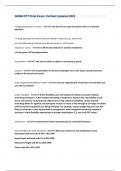
NASM CPT Final Exam| Verified| Updated 2024
• Diagnosing disease or injury - ANSWER-not part of our scope of practice refer to a licensed physician • Energy pathways and when they are utilized in exercise (e.g., which ones are most likely being used during a 40-yard sprint vs. a 90-minute endurance race?). - ANSWER-a 90 minute endurance- aerobic metabolism a 40 yd sprint: ATP phosphocreatine acceleration - ANSWER-the rate at which an object is increasing in speed acidosis - ANSWER-the accumulation of excessive hydrogen ions in the body, causing increased acidity of the blood and muscle. action stage transthoeretical model - ANSWER-exercise regularly but it hasnt been for 6months just yet. plan to maintain Active Flexibility - ANSWER-Active flexibility uses self-myofascial release and active-isolated stretching techniques. Active-isolated stretching is designed to improve the extensibility of soft tissue and increase neuromuscular efficiency by using reciprocal inhibition. Active-isolated stretching allows for agonists and synergists muscles to move a limb through a full range of motion while functional antagonists are being stretched. For example, supine straight-leg raise uses hip flexors and quads to raise leg and hold it unsupported, whiel antagonist hamstring complex is stretched. Active flexibility appropriate at strength levels(phase 2,3, and 4) of OPT model. active force - ANSWER-muscle tension that is generated by its contractile elements acute variables for each opt phase - ANSWER-Muscular endurance and stabilization is best developed with intensity of 50 to 70% 1RM Hypertrophy achieved with 75 to 85% 1RM Maximal strength with 85 to 100% 1RM Power with 30 to 45% 1RM afferent neurons - ANSWER-nerve impulse that move toward the spinal cord and brain from the periphery of the body and are sensory in nature. AGILITY - ANSWER-ABILITY TO MAINTAIN CENTER OF GRAVITY OVER A CHANGING BASE OF SUPPORT WHILE CHANGING DIRECTION AT VARIOUS SPEEDS agonists - ANSWER-muscles that work as the prime mover in an exercise altered arthrokinematics - ANSWER-altered joint motion caused by altered length tension relationships and force couple relationships that affects the joints and causes poor movement efficiency. altered neuromuscular efficiency - ANSWER-when the kinetic chain is not performing optimally to control the body in all three planes of motion
Document information
- Uploaded on
- July 9, 2024
- Number of pages
- 30
- Written in
- 2023/2024
- Type
- Exam (elaborations)
- Contains
- Questions & answers


