

CSET SOCIAL SCIENCE SUBTEST 3: CIVICS
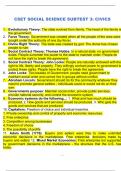
1. Evolutionary Theory: The state evolved from family. The head of the family is
the government.
2. Force Theory: Government was created when all the people of the area were
bought under the authority of one (by force).
3. Divine Right Theory: The state was created by god. The divine has chosen
people to rule.
4. Social Contract Theory: Thomas Hobbs: In a natural state, no government
exists. People surrender the power to the state to maintain order. People do
not have the right to break the agreement.
5. Social Contract Theory: John Locke: People are naturally endowed with the
right to life, liberty and property. They willingly contract power to government to
protect these rights. People have the right to break this agreement.
6. John Locke: Two treaties of Government: people need government to
maintain social order and cannot live in groups without conflict.
7. Abraham Lincoln: Government should do for the community whatever they
need to promote general welfare - individuals could or would not do on their
own.
8. Governments purpose: Maintain social order, provide public services,
provide national security, and control the economic system.
9. Economic systems do the following...: 1. What and how much should be
produced, 2. How goods and services should be produced. 3. Who gets the
goods and services that are produced.
10. Capitalism: Freedom of choice and individual incentive.
1. Private ownership and control of property and economic resources.
2. Free enterprise
3. Competition among businesses
4. Freedom of choice
5. The possibility of profits
11. Adam Smith (1776): Buyers and sellers were free to make unlimited
economic decisions in the marketplace. Free enterprise: decisions made by
buyers and sellers 12. Mixed Market Economies: Free enterprise but supported
by government decisions in the marketplace - the structure that the U.S. has
today.
, . CSET Social Science Subtest 3: Civics
Study online at https://quizlet.com/_38rgif
13. Socialism: Government owns the basic means of production, decides how
to use resources, distributes products and wages, provides social services. 1.
Distribution of wealth and economic opportunity equally among people
2. Society's control, through its government, of all major decisions about
production
3. Public ownership of most land and factories
14. Democratic Socialism: Works within the democratic system to improve
economic conditions.
15 Communism: No social classes, all property is held in common, and
government is not necessary.
16. Karl Marx (1818 - 1883): Advocated violent revolution. Bourgeoisie
(production) and workers (proletariat) would eventually collapse because
smaller groups of capitalists would control all means of production.
17. Command Economy: Decisions of the economy are made by upper levels of
government and handed down to managers.
18. Liberal: Government should promote health, education and justice. Curtail
economic freedom to increase equality. Socially - no restrictions to most
individual freedoms.
19. Conservative: Limiting the role of government except in supporting traditional
moral values. Private individuals should solve social problems. Free market
with limits on government intervention.
20. Moderates: Fall between liberals and conservatives.
21. Libertarians: Support both economic and social freedoms.
22. 6 principles of government: Popular sovereignty, Federalism, Separation of
powers, Checks and Balances, Judicial Review, and Limited Government.
23. Popular Sovereignty: Rule by the people - the authority of government
comes from the people.
24. Federalism: Power divided between the nation and state governments - each
has their own agencies and officials and pass their own laws.
25. Separation of Powers: 3 branches. Legislative - Congress makes the laws.
Executive - Carries out acts of congress. Judicial - Supreme court.
26. Checks and Balances: Each branch holds some control over the other two.
Pres - veto. Congress - Overturn veto by 2/3 vote. Courts - Rule on
constitutionality of the laws created by congress. Pres - Appoints judges.
Congress - Approves appointments.
1. Evolutionary Theory: The state evolved from family. The head of the family is
the government.
2. Force Theory: Government was created when all the people of the area were
bought under the authority of one (by force).
3. Divine Right Theory: The state was created by god. The divine has chosen
people to rule.
4. Social Contract Theory: Thomas Hobbs: In a natural state, no government
exists. People surrender the power to the state to maintain order. People do
not have the right to break the agreement.
5. Social Contract Theory: John Locke: People are naturally endowed with the
right to life, liberty and property. They willingly contract power to government to
protect these rights. People have the right to break this agreement.
6. John Locke: Two treaties of Government: people need government to
maintain social order and cannot live in groups without conflict.
7. Abraham Lincoln: Government should do for the community whatever they
need to promote general welfare - individuals could or would not do on their
own.
8. Governments purpose: Maintain social order, provide public services,
provide national security, and control the economic system.
9. Economic systems do the following...: 1. What and how much should be
produced, 2. How goods and services should be produced. 3. Who gets the
goods and services that are produced.
10. Capitalism: Freedom of choice and individual incentive.
1. Private ownership and control of property and economic resources.
2. Free enterprise
3. Competition among businesses
4. Freedom of choice
5. The possibility of profits
11. Adam Smith (1776): Buyers and sellers were free to make unlimited
economic decisions in the marketplace. Free enterprise: decisions made by
buyers and sellers 12. Mixed Market Economies: Free enterprise but supported
by government decisions in the marketplace - the structure that the U.S. has
today.
, . CSET Social Science Subtest 3: Civics
Study online at https://quizlet.com/_38rgif
13. Socialism: Government owns the basic means of production, decides how
to use resources, distributes products and wages, provides social services. 1.
Distribution of wealth and economic opportunity equally among people
2. Society's control, through its government, of all major decisions about
production
3. Public ownership of most land and factories
14. Democratic Socialism: Works within the democratic system to improve
economic conditions.
15 Communism: No social classes, all property is held in common, and
government is not necessary.
16. Karl Marx (1818 - 1883): Advocated violent revolution. Bourgeoisie
(production) and workers (proletariat) would eventually collapse because
smaller groups of capitalists would control all means of production.
17. Command Economy: Decisions of the economy are made by upper levels of
government and handed down to managers.
18. Liberal: Government should promote health, education and justice. Curtail
economic freedom to increase equality. Socially - no restrictions to most
individual freedoms.
19. Conservative: Limiting the role of government except in supporting traditional
moral values. Private individuals should solve social problems. Free market
with limits on government intervention.
20. Moderates: Fall between liberals and conservatives.
21. Libertarians: Support both economic and social freedoms.
22. 6 principles of government: Popular sovereignty, Federalism, Separation of
powers, Checks and Balances, Judicial Review, and Limited Government.
23. Popular Sovereignty: Rule by the people - the authority of government
comes from the people.
24. Federalism: Power divided between the nation and state governments - each
has their own agencies and officials and pass their own laws.
25. Separation of Powers: 3 branches. Legislative - Congress makes the laws.
Executive - Carries out acts of congress. Judicial - Supreme court.
26. Checks and Balances: Each branch holds some control over the other two.
Pres - veto. Congress - Overturn veto by 2/3 vote. Courts - Rule on
constitutionality of the laws created by congress. Pres - Appoints judges.
Congress - Approves appointments.


