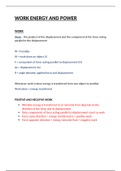
WORK ENERGY AND POWER
WORK
Work – the product of the displacement and the component of the force acting
parallel to the displacement
W = FcosθΔxx
W = work done on object (J)
F = component of force acting parallel to displacement (N)
Δxx = displacement (m)
θ = angle between applied force and displacement
Whenever work is done energy is transferred from one object to another
Work done = energy transferred
POSITIVE AND NEGATIVE WORK
Whether energy is transferred to or removed from depends on the
direction of the force and its displacement
Only components of force acting parallel to displacement count as work
Force same direction = energy transferred to = positive work
Force opposite direction = energy removed from = negative work
, GRAVITATIONAL POTENTIAL ENERGY
Gravitational potential energy – the energy an object possesses due to its
position relative to a reference point
Ep = mgh
m = mass (kg)
g = 9.8
h = height (m) # All of these values are scalars
KINETIC ENERGY
Kinetic energy – the energy an object has as a result of its motion
Ek = ½ mv2
m = mass (kg)
v = velocity (m.s-1)
MECHANICAL ENERGY
Mechanical energy – the sum of the gravitational potential energy and kinetic
energy at a point
Emech = Ep + Ek
WORK
Work – the product of the displacement and the component of the force acting
parallel to the displacement
W = FcosθΔxx
W = work done on object (J)
F = component of force acting parallel to displacement (N)
Δxx = displacement (m)
θ = angle between applied force and displacement
Whenever work is done energy is transferred from one object to another
Work done = energy transferred
POSITIVE AND NEGATIVE WORK
Whether energy is transferred to or removed from depends on the
direction of the force and its displacement
Only components of force acting parallel to displacement count as work
Force same direction = energy transferred to = positive work
Force opposite direction = energy removed from = negative work
, GRAVITATIONAL POTENTIAL ENERGY
Gravitational potential energy – the energy an object possesses due to its
position relative to a reference point
Ep = mgh
m = mass (kg)
g = 9.8
h = height (m) # All of these values are scalars
KINETIC ENERGY
Kinetic energy – the energy an object has as a result of its motion
Ek = ½ mv2
m = mass (kg)
v = velocity (m.s-1)
MECHANICAL ENERGY
Mechanical energy – the sum of the gravitational potential energy and kinetic
energy at a point
Emech = Ep + Ek