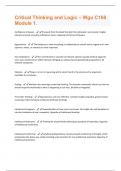
Critical Thinking and Logic – Wgu C168 Module 1 Questions + Answers Graded A+
Confidence in Reason - Proceeds from the belief that both the individual's and society's higher interests are best served by unfettered reason. Opposite of Distrust of Reason. Egocentrism - The tendency to view everything in relationship to oneself and to regard one's own opinions, values, or interests as most important. Fair-mindedness - The commitment to consider all relevant opinions equally without regard to one's own sentiments or selfish interests. Bringing an unbiased and unprejudiced perspective to all relevant viewpoints. Fallacies - Flaws or errors in reasoning which, when found in the premise of an argument, invalidate its conclusion. Feeling - Monitors the meanings created by thinking. This function continually informs us how we should respond emotionally to what is happening in our lives. (Positive or Negative) First-order Thinking - Spontaneous and non-reflective. Contains insight, prejudice, good and bad reasoning. Indiscriminately combined. (Ordinary thinking) Intellectual Arrogance - Overestimation of how much one knows. No insight into self-deception or into the limitations of one's viewpoint. Opposite of Intellectual Humility Intellectual Autonomy - Thinking for oneself while adhering to standards of rationality. Opposite of Intellectual Conformity. Intellectual Conformity - Intellectual dependence. Society rewards conformity of thought, which perpetuates the status quo, while providing scant incentive for true intellectual autonomy. Opposite of Intellectual Autonomy.Intellectual Courage - Confronting ideas, viewpoints, or beliefs with fairness, even when doing so is painful. Opposite of Intellectual Cowardice. Intellectual Cowardice - Fear of ideas or viewpoints that do not conform to one's own. Opposite of Intellectual Courage Intellectual Dishonesty - Marked by contradictions and inconsistencies of which the perpetrator is unconscious. Opposite of Intellectual Integrity. Intellectual Distrust of Reason - Lack of confidence in reason. Inclines us to assert the truth of our own beliefs, flawed though they might be. Opposite of Confidence in Reason. Intellectual Empathy - The act of routinely inhabiting the perspectives of others in order to genuinely understand them. Opposite of Intellectual Self-Centeredness. Intellectual Humility - Openness to the possibility that one's beliefs are mistaken and a willingness to reevaluate them in the face of new evidence or persuasive counter arguments. Opposite of Intellectual Arrogance. Intellectual Integrity - Holding oneself to the same rigorous intellectual standards that one expects others to meet. Opposite of Intellectual Dishonesty. Intellectual Laziness - Giving up quickly when confronted with a tough intellectual challenge. Opposite of Intellectual Perseverance. Intellectual Perseverance - The act of working one's way through intellectual complexities despite frustrations inherent to doing so. Opposite of Intellectual Laziness Intellectual Self-Centeredness - Thinking centered on self. Opposite of Intellectual Empathy Intellectual Traits - Intellectual Humility, Intellectual Autonomy, Intellectual Integrity, Intellectual Courage, Intellectual Perseverance, Confidence in Reason, Intellectual Empathy, and Fair-mindednessIntellectual Unfairness - To feel no responsibility to represent viewpoints with which they disagree fairly and accurately. To always see yourself as right and just. Second-order Thinking - Another term for critical thinking. It is first-order thinking (or ordinary thinking) that is consciously realized (i.e., analyzed, assessed, and improved). Term used by Paul and Elder. Sociocentrism - The assumption that one's own social group is inherently superior to all others. Sophistry - The ability to win a argument regardless of flaws in its reasoning. Stereotype - A fixed or oversimplified conception of a person, group, or idea. Strong-sense Critical Thinking - Thinking that uses critical thinking skills to evaluate all beliefs, especially one's own, and that pursues what is intellectually fair and just.
Written for
- Institution
- Critical Thinking and Logic – Wgu C168 Module 1.
- Course
- Critical Thinking and Logic – Wgu C168 Module 1.
Document information
- Uploaded on
- July 2, 2024
- Number of pages
- 3
- Written in
- 2023/2024
- Type
- Exam (elaborations)
- Contains
- Questions & answers
Subjects
-
critical thinking and logic wgu c168 module 1

Also available in package deal