

BIOL 212 - Quiz 6 Short Answer study set
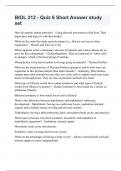
How do animals obtain nutrients? - Using directed movement to find food. Then ingest prey and digest it with their bodies. What are the traits that make animals unique (i.e., that are not seen in other organisms)? - Muscle and Nervous Cells What organism is the evolutionary ancestor of animals, and what evidence do we have for this relationship? - Choanoflagellates. They are identical to "collar cells" in sponges, which is the basal group of animals. What phylum is the basal (earliest evolving) group of animals? - Phylum Porifera What are the characteristics of Phylum Porifera (sponges), and in what ways are organisms in this phylum simpler than other animals? - Sedentary, filter-feeders, simpler than other animals because they use collar cells to capture food from water drawn in through pores. They are also asymmetric and lack true tissue What type of lifestyle would favor radial symmetry and what type of lifestyle would favor bilateral symmetry? - Radial symmetry is best suited for a sessile or planktonic lifestyle. Bilateral symmetry is best suited for an active lifestyle What is the difference between diploblastic and triploblastic embryonic development - Diploblastic: having two embryonic layers, endoderm (internal organs) and ectoderm (outer covering and nervous system) Triploblastic: having a third embryonic layer, mesoderm (body cavity and muscles) What types of tissues arise from ectoderm, mesoderm, and endoderm in triploblastic organisms? - Endoderm: internal organs Mesoderm: body cavity and muscles Ectoderm: outer covering and nervous system What are the advantages of having a body cavity? - Allows external body wall and internal organs to move independently Cushions internal organs Can act as a "skeleton" against which muscles work What are the advantages of deuterostome development? - Allows for embryonic cells to retain capacity to develop into a complete embryo. What are the defining characteristics of lophotrochozoans? And ecdysozoans? - Lophotrochozoans: have lophophores or trochophore larva Ecdysozoans: animals that secrete exoskeletons Describe the lifecycle of a hydrozoan. How is this different from that of plants? - Sessile polyps or free-floating medusas, with some species having both at different stages. Not same as alternation of generations b/c both are diploid! How do cnidarians accomplish movement? - Contractile fibers pull against fluid filled gastrovascular cavity What is the difference between a gastrovascular cavity and an alimentary canal; what is the advantage of having an alimentary canal? - A gastrovascular cavity has only one opening that acts as a mouth and anus while an alimentary canal has two openings one for digestion and the other for secretion Describe adaptations of flatworms for a parasitic existence. - Often undergo both asexual and sexual reproduction and use multiple host species NO gastrovascular cavity just absorbs nutrients over body surface Provide examples of organisms in each of the three main groups of Mollusca: bivalves, gastropods, cephalopods. - Bivalves: clams, mussels Gastropods: snails, slugs Cephalopods: squids, octopuses Describe adaptations of nematodes that make them effective parasites. - Inject plants with molecules that induce growth of root cells to supply worm with nutrients.
Document information
- Uploaded on
- June 30, 2024
- Number of pages
- 4
- Written in
- 2023/2024
- Type
- Exam (elaborations)
- Contains
- Questions & answers


