Penn Foster- intro to Veterinary Technician Lesson 1: Behavior Questions and Answers Already Passed
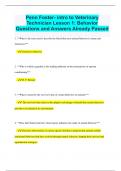
Penn Foster- intro to Veterinary Technician Lesson 1: Behavior Questions and Answers Already Passed 1. **What is the term used to describe the belief that most animal behavior is innate and instinctive?** - Instinctive behavior 2. **Who is widely regarded as the leading authority on the mechanisms of operant conditioning?** - B. F. Skinner 3. **What is meant by the survival value of certain behaviors in animals?** - The survival value refers to the adaptive advantage or benefit that certain behaviors provide to an animal in its environment. 4. **How did Charles Darwin's observations influence the study of animal behavior?** - Darwin's observations of various species led him to propose that animals exhibit instinctual behaviors that have evolved through natural selection, shaping their survival and reproduction strategies. 5. **Describe the origins of behaviorism in psychology.** - Behaviorism originated with John B. Watson, who emphasized observable behaviors and stimulus-response associations as the basis of psychological study, rejecting the focus on internal mental processes. 6. **Summarize B. F. Skinner's experiments in operant conditioning.** - Skinner's experiments involved teaching animals, such as rats, to perform specific behaviors through reinforcement, where behaviors were strengthened by rewards or diminished by punishments. 7. **Briefly explain Pavlov's classical conditioning experiment.** - Pavlov conditioned dogs to associate a neutral stimulus (a bell) with an unconditioned stimulus (food), leading the dogs to salivate at the sound of the bell alone. 8. **How do genetics and instincts influence animal behavior?** - Genetics and instincts provide animals with innate behavioral patterns that enhance their survival and reproductive success, adapting them to their environments over generations. 9. **Define positive reinforcement in behavioral psychology.** - Positive reinforcement involves providing a reward or desirable consequence immediately after a behavior to increase the likelihood of that behavior recurring in the future. 10. **Define negative reinforcement in behavioral psychology.** - Negative reinforcement involves removing an aversive stimulus after a behavior, thereby increasing the likelihood of that behavior being repeated in similar circumstances. 11. **Define punishment in behavioral psychology.** - Punishment involves applying an aversive stimulus or removing a desirable stimulus to decrease the likelihood of an undesirable behavior occurring again. 12. **Define imprinting as observed in animal behavior.** - Imprinting is a rapid, innate learning process where animals form strong attachments or recognition bonds with specific individuals or objects early in life. 13. **What is the core premise of behaviorism in the study of animal behavior?** - Behaviorism asserts that animal behavior is primarily learned through conditioning processes, rather than being driven
Written for
- Institution
- Penn Foster- intro to Veterinary Technician Lesson
- Course
- Penn Foster- intro to Veterinary Technician Lesson
Document information
- Uploaded on
- June 30, 2024
- Number of pages
- 12
- Written in
- 2023/2024
- Type
- Exam (elaborations)
- Contains
- Questions & answers
Subjects
-
penn foster intro to veterinary technician lesson

Also available in package deal