GENERAL GYNAECOLOGY
CASE 1: INTERMENSTRUAL BLEEDING
History
A 48-year-old woman presents with intermenstrual bleeding for 2 months. Episodes of
bleeding occur any time in the cycle. This is usually fresh red blood and much lighter than
a normal period. It can last for 1–6 days. There is no associated pain. She has no hot
flushes or night sweats. She is sexually active and has not noticed vaginal dryness.
She has three children and has used the progesterone only pill for contraception for 5 years.
Her last smear test was 2 years ago and all smears have been normal. She takes no medi-
cation and has no other relevant medical history.
Examination
The abdomen is unremarkable. Speculum examination shows a slightly atrophic-looking
vagina and cervix but there are no apparent cervical lesions and there is no current bleeding.
On bimanual examination the uterus is non-tender and of normal size, axial and mobile.
There are no adnexal masses.
INVESTIGATIONS
Normal range
Haemoglobin 12.7 g/dL 11.7–15.7g/dL
White cell count 4.5 ⫻ 109/L 3.5–11 ⫻ 109/L
Platelets 401 ⫻ 109/L 150–440 ⫻ 109/L
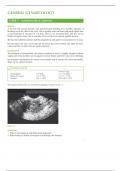
Transvaginal ultrasound scan and hydrosonography is shown in Fig. 1.1.
Figure 1.1
Questions
• What is the diagnosis and differential diagnosis?
• How would you further investigate and manage this woman?
1
, 100 Cases in Obstetrics and Gynaecology
ANSWER 1
The diagnosis is of an endometrial polyp, as shown by the hydrosonography image (Fig.
1.1). These can occur in women of any age although they are more common in older
women and may be asymptomatic or cause irregular bleeding or discharge. The aetiology
is uncertain and the vast majority are benign. In this specific case all the differential diag-
noses are effectively excluded by the history and examination.
! Differential diagnosis for intermenstrual bleeding
• Cervical malignancy
• Cervical ectropion
• Endocervical polyp
• Atrophic vaginitis
• Pregnancy
• Irregular bleeding related to the contraceptive pill
Management
Any woman should be investigated if bleeding occurs between periods. In women over the
age of 40 years, serious pathology, in particular endometrial carcinoma, should be excluded.
The polyp needs to be removed for two reasons:
1 to eliminate the cause of the bleeding
2 to obtain a histological report to ensure that it is not malignant.
Management involves outpatient or day case hysteroscopy, and resection of the polyp
under direct vision using a diathermy loop or other resection technique (Fig. 1.2). This
allows certainty that the polyp had been completely excised and also allows full inspec-
tion of the rest of the cavity to check for any other lesions or suspicious areas. In some
settings, where hysteroscopic facilities are not available, a dilatation and curettage may
be carried out with blind avulsion of the polyp with polyp forceps. This was the standard
management in the past but is not the gold standard now, for the reasons explained.
Figure 1.2 Hysteroscopic
appearance of endometrial polyp
prior to resection. See Plate 1 for
colour image.
KEY POINTS
• Any woman over the age of 40 years should be investigated if bleeding occurs between
the periods, to exclude serious pathology, in particular endometrial carcinoma.
• Hysteroscopy and dilatation and curettage is rarely indicated for women under the age
of 40 years.
2
, General gynaecology
CASE 2: INFERTILITY
History
A 31-year-old woman has been trying to conceive for nearly 3 years without success. Her
last period started 7 months ago and she has been having periods sporadically for about
5 years. She bleeds for 2–7 days and the periods occur with an interval of 2–9 months.
There is no dysmenorrhoea but occasionally the bleeding is heavy.
She was pregnant once before at the age of 19 years and had a termination of pregnancy.
She had a laparoscopy several years ago for pelvic pain, which showed a normal pelvis.
Cervical smears have always been normal and there is no history of sexually transmitted
infection.
The woman was diagnosed with irritable bowel syndrome when she was 25, after thor-
ough investigation for other bowel conditions. She currently uses metoclopramide to
increase gut motility, and antispasmodics.
Her partner is fit and well, and has two children by a previous relationship. Neither part-
ner drinks alcohol or smokes.
INVESTIGATIONS
Normal
Follicle-stimulating hormone 3.1 IU/L Day 2–5
1–11 IU/L
Luteinizing hormone 2.9 IU/L Day 2–5
0.5–14.5 IU/L
Day 21 progesterone 12 nmol/L
Prolactin 1274 mu/L 90–520 mu/L
Testosterone 1.4 nmol/L 0.8–3.1 nmol/L
Thyroid-stimulating hormone 4.1 mu/L 0.5–7 mu/L
Free thyroxine 17 pmol/L 11–23 pmol/L
Questions
• What is the diagnosis and its aetiology?
• How would you further investigate and manage this couple?
3
, 100 Cases in Obstetrics and Gynaecology
ANSWER 2
The infertility is secondary to anovulation as shown by the day 21 progesterone
(⬎30 nmol/L suggests ovulation has occurred). Normal testosterone and gonadotrophins
and high prolactin suggest the likely case of anovulation is hyperprolactinaemia.
Hyperprolactinaemia may be physiological in breast-feeding, pregnancy and stress. The
commonest causes of pathological hyperprolactinaemia are tumours and idiopathic
hypersecretion, but it may also be due to drugs, hypothyroidism, ectopic prolactin secretion
or chronic renal failure. In this case the metoclopramide is the cause, as it is a dopamine
antagonist (dopamine usually acts via the hypothalamus to cause inhibition of prolactin
secretion, and if this is interrupted, prolactin is excreted to excess). Galactorrhoea is not a
common symptom of hyperprolactinaemia, occurring in less than half of affected women.
! Drugs associated with hyperprolactinaemia (due to dopamine antagonist effects)
• Metoclopramide
• Phenothiazines (e.g. chlorpromazine, prochlorperazine, thioridazine)
• Reserpine
• Methyldopa
• Omeprazole, ranitidine, bendrofluazide (rare associations)
The metoclopramide should be stopped and the woman reviewed after 4–6 weeks to
ensure that the periods have restarted and that the prolactin level has returned to normal.
If this does not occur, then further investigation is needed to exclude other causes of
hyperprolactinaemia such as a pituitary micro- or macro-adenoma. It would be advisable
to repeat the day 21 progesterone level to confirm ovulatory cycles. The woman should
have her rubella immunity checked and should be advised to take preconceptual folic acid
until 12 weeks of pregnancy.
If the woman fails to conceive then a full fertility investigation should be planned with
semen analysis and tubal patency testing (hysterosalpingogram or laparoscopy and dye
test).
KEY POINTS
• A full drug history should be elicited in women with amenorrhoea or infertility.
• Galactorrhoea occurs in less than half of women with hyperprolactinaemia.
• Day 21 progesterone over 30 nmol/L is suggestive of ovulation.
4
CASE 1: INTERMENSTRUAL BLEEDING
History
A 48-year-old woman presents with intermenstrual bleeding for 2 months. Episodes of
bleeding occur any time in the cycle. This is usually fresh red blood and much lighter than
a normal period. It can last for 1–6 days. There is no associated pain. She has no hot
flushes or night sweats. She is sexually active and has not noticed vaginal dryness.
She has three children and has used the progesterone only pill for contraception for 5 years.
Her last smear test was 2 years ago and all smears have been normal. She takes no medi-
cation and has no other relevant medical history.
Examination
The abdomen is unremarkable. Speculum examination shows a slightly atrophic-looking
vagina and cervix but there are no apparent cervical lesions and there is no current bleeding.
On bimanual examination the uterus is non-tender and of normal size, axial and mobile.
There are no adnexal masses.
INVESTIGATIONS
Normal range
Haemoglobin 12.7 g/dL 11.7–15.7g/dL
White cell count 4.5 ⫻ 109/L 3.5–11 ⫻ 109/L
Platelets 401 ⫻ 109/L 150–440 ⫻ 109/L
Transvaginal ultrasound scan and hydrosonography is shown in Fig. 1.1.
Figure 1.1
Questions
• What is the diagnosis and differential diagnosis?
• How would you further investigate and manage this woman?
1
, 100 Cases in Obstetrics and Gynaecology
ANSWER 1
The diagnosis is of an endometrial polyp, as shown by the hydrosonography image (Fig.
1.1). These can occur in women of any age although they are more common in older
women and may be asymptomatic or cause irregular bleeding or discharge. The aetiology
is uncertain and the vast majority are benign. In this specific case all the differential diag-
noses are effectively excluded by the history and examination.
! Differential diagnosis for intermenstrual bleeding
• Cervical malignancy
• Cervical ectropion
• Endocervical polyp
• Atrophic vaginitis
• Pregnancy
• Irregular bleeding related to the contraceptive pill
Management
Any woman should be investigated if bleeding occurs between periods. In women over the
age of 40 years, serious pathology, in particular endometrial carcinoma, should be excluded.
The polyp needs to be removed for two reasons:
1 to eliminate the cause of the bleeding
2 to obtain a histological report to ensure that it is not malignant.
Management involves outpatient or day case hysteroscopy, and resection of the polyp
under direct vision using a diathermy loop or other resection technique (Fig. 1.2). This
allows certainty that the polyp had been completely excised and also allows full inspec-
tion of the rest of the cavity to check for any other lesions or suspicious areas. In some
settings, where hysteroscopic facilities are not available, a dilatation and curettage may
be carried out with blind avulsion of the polyp with polyp forceps. This was the standard
management in the past but is not the gold standard now, for the reasons explained.
Figure 1.2 Hysteroscopic
appearance of endometrial polyp
prior to resection. See Plate 1 for
colour image.
KEY POINTS
• Any woman over the age of 40 years should be investigated if bleeding occurs between
the periods, to exclude serious pathology, in particular endometrial carcinoma.
• Hysteroscopy and dilatation and curettage is rarely indicated for women under the age
of 40 years.
2
, General gynaecology
CASE 2: INFERTILITY
History
A 31-year-old woman has been trying to conceive for nearly 3 years without success. Her
last period started 7 months ago and she has been having periods sporadically for about
5 years. She bleeds for 2–7 days and the periods occur with an interval of 2–9 months.
There is no dysmenorrhoea but occasionally the bleeding is heavy.
She was pregnant once before at the age of 19 years and had a termination of pregnancy.
She had a laparoscopy several years ago for pelvic pain, which showed a normal pelvis.
Cervical smears have always been normal and there is no history of sexually transmitted
infection.
The woman was diagnosed with irritable bowel syndrome when she was 25, after thor-
ough investigation for other bowel conditions. She currently uses metoclopramide to
increase gut motility, and antispasmodics.
Her partner is fit and well, and has two children by a previous relationship. Neither part-
ner drinks alcohol or smokes.
INVESTIGATIONS
Normal
Follicle-stimulating hormone 3.1 IU/L Day 2–5
1–11 IU/L
Luteinizing hormone 2.9 IU/L Day 2–5
0.5–14.5 IU/L
Day 21 progesterone 12 nmol/L
Prolactin 1274 mu/L 90–520 mu/L
Testosterone 1.4 nmol/L 0.8–3.1 nmol/L
Thyroid-stimulating hormone 4.1 mu/L 0.5–7 mu/L
Free thyroxine 17 pmol/L 11–23 pmol/L
Questions
• What is the diagnosis and its aetiology?
• How would you further investigate and manage this couple?
3
, 100 Cases in Obstetrics and Gynaecology
ANSWER 2
The infertility is secondary to anovulation as shown by the day 21 progesterone
(⬎30 nmol/L suggests ovulation has occurred). Normal testosterone and gonadotrophins
and high prolactin suggest the likely case of anovulation is hyperprolactinaemia.
Hyperprolactinaemia may be physiological in breast-feeding, pregnancy and stress. The
commonest causes of pathological hyperprolactinaemia are tumours and idiopathic
hypersecretion, but it may also be due to drugs, hypothyroidism, ectopic prolactin secretion
or chronic renal failure. In this case the metoclopramide is the cause, as it is a dopamine
antagonist (dopamine usually acts via the hypothalamus to cause inhibition of prolactin
secretion, and if this is interrupted, prolactin is excreted to excess). Galactorrhoea is not a
common symptom of hyperprolactinaemia, occurring in less than half of affected women.
! Drugs associated with hyperprolactinaemia (due to dopamine antagonist effects)
• Metoclopramide
• Phenothiazines (e.g. chlorpromazine, prochlorperazine, thioridazine)
• Reserpine
• Methyldopa
• Omeprazole, ranitidine, bendrofluazide (rare associations)
The metoclopramide should be stopped and the woman reviewed after 4–6 weeks to
ensure that the periods have restarted and that the prolactin level has returned to normal.
If this does not occur, then further investigation is needed to exclude other causes of
hyperprolactinaemia such as a pituitary micro- or macro-adenoma. It would be advisable
to repeat the day 21 progesterone level to confirm ovulatory cycles. The woman should
have her rubella immunity checked and should be advised to take preconceptual folic acid
until 12 weeks of pregnancy.
If the woman fails to conceive then a full fertility investigation should be planned with
semen analysis and tubal patency testing (hysterosalpingogram or laparoscopy and dye
test).
KEY POINTS
• A full drug history should be elicited in women with amenorrhoea or infertility.
• Galactorrhoea occurs in less than half of women with hyperprolactinaemia.
• Day 21 progesterone over 30 nmol/L is suggestive of ovulation.
4