

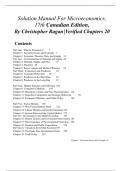
Solution Manual For Microeconomics,
17th Canadian Edition,
By Christopher Ragan |Verified Chapters 20
Contents
Part One: What Is Economics? 1
Chapter 1: Economic Issues and Concepts 3
Chapter 2: Economic Theories, Data, and Graphs 13
Part Two: An Introduction to Demand and Supply 26
Chapter 3: Demand, Supply, and Price 27
Chapter 4: Elasticity 40
Chapter 5: Price Controls and Market Efficiency 54
Part Three: Consumers and Producers 65
Chapter 6: Consumer Behaviour 66
Chapter 7: Producers in the Short Run 81
Chapter 8: Producers in the Long Run 95
Part Four: Market Structure and Efficiency 104
Chapter 9: Competitive Markets 105
Chapter 10: Monopoly, Cartels, and Price Discrimination 116
Chapter 11: Imperfect Competition and Strategic Behaviour 131
Chapter 12: Economic Efficiency and Public Policy 140
Part Five: Factor Markets 150
Chapter 13: How Factor Markets Work 152
Chapter 14: Labour Markets and Income Inequality163
Chapter 15: Interest Rates and the Capital Market 175
Part Six: Government in the Market Economy 183
Chapter 16: Market Failures and Government Intervention 185
Chapter 17: The Economics of Environmental Protection 198
Chapter 18: Taxation and Public Expenditure 210
Part Seven: Canada in the Global Economy219
Chapter 19: The Gains from International Trade 220
Chapter 20: Trade Policy 229
Chapter 1: Economic Issues and Concepts iii
,List of Boxes
Applying Economic Concepts
1-1 The High Opportunity Cost of Your University Degree
7
1-2 Economics Needs the Other Social Sciences
21
2-1 Where Economists Work
30
2-2 Can Economists Design Controlled Experiments to Test Their Theories?
34
3-1 Demand and Supply Shocks Created by the COVID-19 Pandemic
64
3-2 Why Apples but Not iPhones?
72
4-1 Who Really ―Pays‖ for Payroll Taxes?
93
5-1 Minimum Wages and Unemployment
105
5-2 The Debate Over ―Price Gouging‖: Efficiency Versus Public Virtue
118
6-1 Rationality and Framing in Consumer Behaviour
130
7-1 Is It Socially Responsible to Maximize Profits?
160
7-2 Three Examples of Diminishing Returns
168
7-3 The Digital World: When Diminishing Returns Disappear Altogether
174
8-1 The Significance of Productivity Growth
191
9-1 Why Small Firms Are Price Takers
207
9-2 The Parable of the Seaside Inn
217
10-1 Network Effects as Entry Barriers
239
12-1 Potential Mergers in the Canadian Airline Industry
302
14-1 The Rise of the ―Gig‖ Economy
356
15-1 Inflation and Interest Rates
380
,16-1 The World‘s Endangered Fish
398
16-2 Used Cars and the Market for ―Lemons‖
404
18-1 Using a UBI to Eliminate Poverty
466
19-1 Two Examples of Absolute and Comparative Advantage
484
19-2 Comparative Advantage and Global Supply Chains
492
20-1 Canadian Wine: A Free-Trade Success Story
520
Lessons from History
4-1 Economic Development and Income Elasticities
95
8-1 Jacob Viner and the Clever Draftsman
189
9-1 What Do Whaling Ships and Oil Wells Have in Common?
224
10-1 Disruptive Technologies and Creative Destruction
241
12-1 Are Amazon and Facebook the Standard Oil of the Twenty-First Century?
300
13-1 David Ricardo and ―Economic Rent‖
327
20-1 Tariff Wars and the Stark Lessons from the Great Depression
508
iv Instructor‘s Solutions Manual for Ragan, Microeconomics, Seventeenth Canadian Edition
Extensions in Theory
3-1 The Distinction Between Stocks and Flows 53
11-1 The Prisoners‘ Dilemma 270
16-1 Arthur Okun‘s ―Leaky Bucket‖ 406
18-1 Who Really Pays the Corporate Income Tax? 450
19-1 The Gains from Trade More Generally 482
Part One What Is Economics?
, This opening Part of the book provides an introduction to economics. The central themes of
Chapter 1 are scarcity, choice, opportunity cost, and the self-organizing role of markets. The
chapter also examines the gains from specialization and trade, the role of money, the effects of
globalization, and ends with a discussion of the various types of economic systems. Chapter 2
examines how economists build their models and test their theories. It also addresses central
methodological issues, the most important being the idea that the progress of economics (like all
scientific disciplines) depends on relating our theories to what we observe in the world around
us. Finally, the chapter has an extensive section on graphing.
***
Chapter 1 opens with a brief tour of some key economic issues in Canada and other countries—
from rising protectionism and the dangers of climate change to accelerating technological change
and growing income inequality. The purpose is to whet the reader‘s appetite for the kinds of
issues economists are thinking about today. This offers a natural segue to the discussion of
scarcity, without which few of these issues would be very interesting. The chapter addresses the
fundamental concepts of scarcity, choice, and opportunity cost, illustrating these ideas with a
production possibilities boundary. (It is worth noting that these concepts are relevant to all
economies, whether they are organized by central planning or by free markets.) We then examine
the complexity of modern market economies, examining the decision makers, production, trade,
money, and globalization. Finally, we examine different types of economic systems, including
traditional, command, and free-market systems. We emphasize that all actual economies are
mixtures, containing elements of all three pure systems.
Chapter 2 provides a longer introduction to the methodological issues of economics than is
usually included in introductory texts. We do this because most students believe that the
scientific method is limited to the natural sciences. But to fully appreciate economics, they must
understand that its theories are also open to empirical testing and that these theories continually
change as a result of what the
Chapter 1: Economic Issues and Concepts v
empirical evidence shows. We understand that some instructors feel their time is so limited that
they cannot spend class time on Chapter 2. We believe that even if it is not covered in class,
students‘ attention should be called to the issues addressed in the chapter. Our experience is that
students benefit from some discussion of the scientific method and from the insight that the
social sciences are not all that different from the ―hard‖ sciences, at least in their basic
approaches.
vi Instructor‘s Solutions Manual for Ragan, Microeconomics, Seventeenth Canadian Edition
The chapter begins by making the distinction between positive and normative statements. We
then work carefully through the various elements of economic theories, including definitions,
17th Canadian Edition,
By Christopher Ragan |Verified Chapters 20
Contents
Part One: What Is Economics? 1
Chapter 1: Economic Issues and Concepts 3
Chapter 2: Economic Theories, Data, and Graphs 13
Part Two: An Introduction to Demand and Supply 26
Chapter 3: Demand, Supply, and Price 27
Chapter 4: Elasticity 40
Chapter 5: Price Controls and Market Efficiency 54
Part Three: Consumers and Producers 65
Chapter 6: Consumer Behaviour 66
Chapter 7: Producers in the Short Run 81
Chapter 8: Producers in the Long Run 95
Part Four: Market Structure and Efficiency 104
Chapter 9: Competitive Markets 105
Chapter 10: Monopoly, Cartels, and Price Discrimination 116
Chapter 11: Imperfect Competition and Strategic Behaviour 131
Chapter 12: Economic Efficiency and Public Policy 140
Part Five: Factor Markets 150
Chapter 13: How Factor Markets Work 152
Chapter 14: Labour Markets and Income Inequality163
Chapter 15: Interest Rates and the Capital Market 175
Part Six: Government in the Market Economy 183
Chapter 16: Market Failures and Government Intervention 185
Chapter 17: The Economics of Environmental Protection 198
Chapter 18: Taxation and Public Expenditure 210
Part Seven: Canada in the Global Economy219
Chapter 19: The Gains from International Trade 220
Chapter 20: Trade Policy 229
Chapter 1: Economic Issues and Concepts iii
,List of Boxes
Applying Economic Concepts
1-1 The High Opportunity Cost of Your University Degree
7
1-2 Economics Needs the Other Social Sciences
21
2-1 Where Economists Work
30
2-2 Can Economists Design Controlled Experiments to Test Their Theories?
34
3-1 Demand and Supply Shocks Created by the COVID-19 Pandemic
64
3-2 Why Apples but Not iPhones?
72
4-1 Who Really ―Pays‖ for Payroll Taxes?
93
5-1 Minimum Wages and Unemployment
105
5-2 The Debate Over ―Price Gouging‖: Efficiency Versus Public Virtue
118
6-1 Rationality and Framing in Consumer Behaviour
130
7-1 Is It Socially Responsible to Maximize Profits?
160
7-2 Three Examples of Diminishing Returns
168
7-3 The Digital World: When Diminishing Returns Disappear Altogether
174
8-1 The Significance of Productivity Growth
191
9-1 Why Small Firms Are Price Takers
207
9-2 The Parable of the Seaside Inn
217
10-1 Network Effects as Entry Barriers
239
12-1 Potential Mergers in the Canadian Airline Industry
302
14-1 The Rise of the ―Gig‖ Economy
356
15-1 Inflation and Interest Rates
380
,16-1 The World‘s Endangered Fish
398
16-2 Used Cars and the Market for ―Lemons‖
404
18-1 Using a UBI to Eliminate Poverty
466
19-1 Two Examples of Absolute and Comparative Advantage
484
19-2 Comparative Advantage and Global Supply Chains
492
20-1 Canadian Wine: A Free-Trade Success Story
520
Lessons from History
4-1 Economic Development and Income Elasticities
95
8-1 Jacob Viner and the Clever Draftsman
189
9-1 What Do Whaling Ships and Oil Wells Have in Common?
224
10-1 Disruptive Technologies and Creative Destruction
241
12-1 Are Amazon and Facebook the Standard Oil of the Twenty-First Century?
300
13-1 David Ricardo and ―Economic Rent‖
327
20-1 Tariff Wars and the Stark Lessons from the Great Depression
508
iv Instructor‘s Solutions Manual for Ragan, Microeconomics, Seventeenth Canadian Edition
Extensions in Theory
3-1 The Distinction Between Stocks and Flows 53
11-1 The Prisoners‘ Dilemma 270
16-1 Arthur Okun‘s ―Leaky Bucket‖ 406
18-1 Who Really Pays the Corporate Income Tax? 450
19-1 The Gains from Trade More Generally 482
Part One What Is Economics?
, This opening Part of the book provides an introduction to economics. The central themes of
Chapter 1 are scarcity, choice, opportunity cost, and the self-organizing role of markets. The
chapter also examines the gains from specialization and trade, the role of money, the effects of
globalization, and ends with a discussion of the various types of economic systems. Chapter 2
examines how economists build their models and test their theories. It also addresses central
methodological issues, the most important being the idea that the progress of economics (like all
scientific disciplines) depends on relating our theories to what we observe in the world around
us. Finally, the chapter has an extensive section on graphing.
***
Chapter 1 opens with a brief tour of some key economic issues in Canada and other countries—
from rising protectionism and the dangers of climate change to accelerating technological change
and growing income inequality. The purpose is to whet the reader‘s appetite for the kinds of
issues economists are thinking about today. This offers a natural segue to the discussion of
scarcity, without which few of these issues would be very interesting. The chapter addresses the
fundamental concepts of scarcity, choice, and opportunity cost, illustrating these ideas with a
production possibilities boundary. (It is worth noting that these concepts are relevant to all
economies, whether they are organized by central planning or by free markets.) We then examine
the complexity of modern market economies, examining the decision makers, production, trade,
money, and globalization. Finally, we examine different types of economic systems, including
traditional, command, and free-market systems. We emphasize that all actual economies are
mixtures, containing elements of all three pure systems.
Chapter 2 provides a longer introduction to the methodological issues of economics than is
usually included in introductory texts. We do this because most students believe that the
scientific method is limited to the natural sciences. But to fully appreciate economics, they must
understand that its theories are also open to empirical testing and that these theories continually
change as a result of what the
Chapter 1: Economic Issues and Concepts v
empirical evidence shows. We understand that some instructors feel their time is so limited that
they cannot spend class time on Chapter 2. We believe that even if it is not covered in class,
students‘ attention should be called to the issues addressed in the chapter. Our experience is that
students benefit from some discussion of the scientific method and from the insight that the
social sciences are not all that different from the ―hard‖ sciences, at least in their basic
approaches.
vi Instructor‘s Solutions Manual for Ragan, Microeconomics, Seventeenth Canadian Edition
The chapter begins by making the distinction between positive and normative statements. We
then work carefully through the various elements of economic theories, including definitions,


