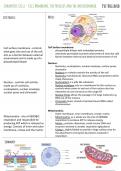
Eukaryotic Cells - Cell Membrane, The Nucleus and the mitochondria Eve Holland
Key Points: Notes:
Cell surface membrane - controls Cell Surface membrane:
what goes into and out of the cell, - phospholipid bilayer with embedded proteins
- selectively permeable (controls what enters & exits the cell)
acts as a barrier between external
- Barrier between internal and external environment of cell
environment and is made up of a
phospholipid bilayer Nucleus:
- Nucleolus, nucleoplasm, nuclear envelope, nuclear pores,
chromatin
- Nucleus as a whole controls the activity of the cell
- Nucleolus manufactures ribosomal RNA and proteins which
make ribosomes.
Nucleus - controls cell activity - Nucleoplasm is a jelly like substance
made up of nucleolus, - Nuclear envelope acts as a membrane for the nucleus so
nucleoplasm, nuclear envelope, controls what comes in and out of the nucleus also has
nuclear pores and chromatin ribosomes on and connects to the rough ER.
- Nuclear Pores allows the passage of of large materials e.g
RNA out of the nucleus
- Chromatin linear strands of protein bound DNA called
chromosomes
Mitochondria:
- Outer membrane, inner membrane, cristae, matrix
Mitochondria - site of AEROBIC - Mitochondria as a whole are the site of AEROBIC
respiration and responsible for respiration to produce ATP to release energy.
producing ATP which is released as - Matrix - contains ribosomes, small circular DNA and
energy. Consists of inner and outer enzymes involved in aerobic respiration (glycolysis)
membrane, cristae and the matrix. - Cristae - highly folded to provide a large surface area for
the attachment of enzymes & proteins involved in
respiration.
Summary:
,Eukaryotic Cells - Golgi Apparatus, Lysosomes, mitochondria, RER & SER Eve Holland
Key Points: Notes:
Golgi Apparatus:
- 3 or more fluid filled sacs with vesicles at the edge
Golgi apparatus - receives proteins
- Receives protein from the rough ER
from RER and modifies and
- Modifies and processes protein e.g adds carbs
packages them
- Packages into vesicles which can be transported to cell
membrane for exocytosis
Lysosomes:
- Vesicles created by the golgi apparatus
Lysosomes - vesicles created by the
- Contain hydraulic enzymes that can break down
golgi apparatus, digest worn out
(hydrolyse) pathogens or worn out cell components of
parts of the cell and pathogens
the cell.
Ribosomes:
- Float freely in the cytoplasm or are attached to the
Ribosomes - attached to the RER or
rough ER.
floating freely, synthesise protein
- Site of protein synthesis
and send it to the RER. made of 2
- Made up of 2 subunits (1 small and 1 large)
subunits and no membranes
- Not membrane bound
Rough Endoplasmic Reticulum:
RER - highly folded membranes
- Highly folded membrane with ribosomes embedded into
cover in ribosomes, large surface
it.
area for protein synthesis, sends
- Large surface area for protein synthesis
protein the golgi apparatus
- Packages and sends proteins to the golgi apparatus
Smooth Endoplasmic Reticulum:
SER - has no ribosomes,site of lipid
- Lacks ribosomes
and carb synthesis and storage
- Tubular in appearance
- Synthesises and stores lipids and carbs
Summary:
, Eukaryotic Cells - Plant, Fungi and Algae Cell Organelles Eve Holland
Key Points: Notes:
Plant cells contain 3 things which
are not included in animal cells:
1. chloroplasts
2. Vauloles
3. Cell walls
Chloroplasts (plants):
- Absorbs sunlight for photosynthesis
Chloroplast - absorbs light for - Double membrane
photosynthesis, double membrane, - Thylakoid disks stack to form grana
contains thylakoid disks which - Grana are linked by lamelles
stack to form grana, the grana is - Those sit in the fluid called stroma
connected by lamelles and this all - The stroma also contains starch granules and circular
floats in a fluid called stroma DNA
Vacuole (plants):
Vacuole - contains cell sap, isolated - Contains cell sap which is a weak solution of sugars and
and stored unwanted chemicals salts
and maintains cell pressure - Has a surrounding membrane called the tonoplast
- Maintains pressure in the cell to stop wilting
- Takes in and stores unwanted chemicals from the cell
Cell Wall (plants, fungi & algae):
Cell wall- made from cellulose in - Made from cellulose in plants and algae
plants and algae and chitin in fungi, - Made from chitin in fungi
provided mechanical strength - Responsible for cell structure
- Ridgid to withstand pressure and stop lysis
Summary:
Key Points: Notes:
Cell surface membrane - controls Cell Surface membrane:
what goes into and out of the cell, - phospholipid bilayer with embedded proteins
- selectively permeable (controls what enters & exits the cell)
acts as a barrier between external
- Barrier between internal and external environment of cell
environment and is made up of a
phospholipid bilayer Nucleus:
- Nucleolus, nucleoplasm, nuclear envelope, nuclear pores,
chromatin
- Nucleus as a whole controls the activity of the cell
- Nucleolus manufactures ribosomal RNA and proteins which
make ribosomes.
Nucleus - controls cell activity - Nucleoplasm is a jelly like substance
made up of nucleolus, - Nuclear envelope acts as a membrane for the nucleus so
nucleoplasm, nuclear envelope, controls what comes in and out of the nucleus also has
nuclear pores and chromatin ribosomes on and connects to the rough ER.
- Nuclear Pores allows the passage of of large materials e.g
RNA out of the nucleus
- Chromatin linear strands of protein bound DNA called
chromosomes
Mitochondria:
- Outer membrane, inner membrane, cristae, matrix
Mitochondria - site of AEROBIC - Mitochondria as a whole are the site of AEROBIC
respiration and responsible for respiration to produce ATP to release energy.
producing ATP which is released as - Matrix - contains ribosomes, small circular DNA and
energy. Consists of inner and outer enzymes involved in aerobic respiration (glycolysis)
membrane, cristae and the matrix. - Cristae - highly folded to provide a large surface area for
the attachment of enzymes & proteins involved in
respiration.
Summary:
,Eukaryotic Cells - Golgi Apparatus, Lysosomes, mitochondria, RER & SER Eve Holland
Key Points: Notes:
Golgi Apparatus:
- 3 or more fluid filled sacs with vesicles at the edge
Golgi apparatus - receives proteins
- Receives protein from the rough ER
from RER and modifies and
- Modifies and processes protein e.g adds carbs
packages them
- Packages into vesicles which can be transported to cell
membrane for exocytosis
Lysosomes:
- Vesicles created by the golgi apparatus
Lysosomes - vesicles created by the
- Contain hydraulic enzymes that can break down
golgi apparatus, digest worn out
(hydrolyse) pathogens or worn out cell components of
parts of the cell and pathogens
the cell.
Ribosomes:
- Float freely in the cytoplasm or are attached to the
Ribosomes - attached to the RER or
rough ER.
floating freely, synthesise protein
- Site of protein synthesis
and send it to the RER. made of 2
- Made up of 2 subunits (1 small and 1 large)
subunits and no membranes
- Not membrane bound
Rough Endoplasmic Reticulum:
RER - highly folded membranes
- Highly folded membrane with ribosomes embedded into
cover in ribosomes, large surface
it.
area for protein synthesis, sends
- Large surface area for protein synthesis
protein the golgi apparatus
- Packages and sends proteins to the golgi apparatus
Smooth Endoplasmic Reticulum:
SER - has no ribosomes,site of lipid
- Lacks ribosomes
and carb synthesis and storage
- Tubular in appearance
- Synthesises and stores lipids and carbs
Summary:
, Eukaryotic Cells - Plant, Fungi and Algae Cell Organelles Eve Holland
Key Points: Notes:
Plant cells contain 3 things which
are not included in animal cells:
1. chloroplasts
2. Vauloles
3. Cell walls
Chloroplasts (plants):
- Absorbs sunlight for photosynthesis
Chloroplast - absorbs light for - Double membrane
photosynthesis, double membrane, - Thylakoid disks stack to form grana
contains thylakoid disks which - Grana are linked by lamelles
stack to form grana, the grana is - Those sit in the fluid called stroma
connected by lamelles and this all - The stroma also contains starch granules and circular
floats in a fluid called stroma DNA
Vacuole (plants):
Vacuole - contains cell sap, isolated - Contains cell sap which is a weak solution of sugars and
and stored unwanted chemicals salts
and maintains cell pressure - Has a surrounding membrane called the tonoplast
- Maintains pressure in the cell to stop wilting
- Takes in and stores unwanted chemicals from the cell
Cell Wall (plants, fungi & algae):
Cell wall- made from cellulose in - Made from cellulose in plants and algae
plants and algae and chitin in fungi, - Made from chitin in fungi
provided mechanical strength - Responsible for cell structure
- Ridgid to withstand pressure and stop lysis
Summary: