

A Level Biology
GENE MUTATIONS OCR A Module 6
Gene mutations
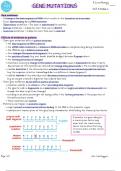
• A change in the base sequence of DNA which results in the formation of a new allele
• Occur spontaneously during DNA replication
• Substitution mutations → one base is substituted for another
• Deletion mutations → a base (or more than one) is deleted
• Insertion mutations → a base (or more than one) is inserted
Effects of mutations on proteins
• Some gene mutations affect protein structure
→ the base sequence of DNA is altered
→ the mRNA codon is altered so a different tRNA anticodon is complementary during translation
→ the tRNA brings a different amino acid
→ this changes the amino acid sequence (the primary structure)
→ the position of bonds (e.g. ionic bonds, disulfide bridges) between R groups alters
→ the tertiary structure is changed
→ mutations involving a change in the number of nucleotides cause a frameshift (all base triplets
downstream of the mutation are altered) and change many amino acids in the encoded polypeptide
→ could be beneficial if the altered protein increases chances of survival and reproductive success
(e.g. the organism is better camouflaged due to a different coloured pigment)
→ could be harmful if the altered protein decreases chances of survival and reproductive success
(e.g. an enzyme involved in digestion has reduced function)
• Some gene mutations do not affect protein structure
→ mutation could be in an intron or other non-coding base sequence
→ the genetic code is degenerate so a substitution mutation might not affect the amino acid even
though the base triplet has changed
→ a change in an amino acid might not always affect the tertiary structure if the properties of
the amino acid are similar
→ these mutations are neutral
• Mutations can happen in promoter regions
→ might prevent a transcription factor binding to the DNA in the promotor region
→ could prevent transcription of the gene being stimulated or inhibited by the transcription factor
original DNA A T CCC A
C T T A mutation in a gene coding for
base
sequence a transcription factor may
I 1.
triplets
I
mean that the transcription
substitution A T C CCC C T T factor has an altered tertiary
mutation structure and is not able to bind
I I I 11 I
to DNA.
deletion A T
/
cC A CT T
mutation
I I I I I
frameshift
acce
insertion A T T
mutation
I I frameshift
Page 1 of 1 © Dr Zoë Huggett
, A Level Biology
GENE EXPRESSION OCR A Module 6
Transcription factors
• Proteins which regulate transcription in eukaryotic cells
• Move from the cytoplasm to the nucleus to bind to DNA
• Promotor regions → DNA base sequences before genes where transcription factors bind
→ have binding sites for specific transcription factors depending on the gene
• Different types of transcription factor
→ activator proteins stimulate transcription of target genes by helping RNA polymerase to bind to
the promoter region
→ repressor proteins inhibit transcription of target genes by preventing RNA polymerase from
binding to the promoter region
transcription factor
⑧↳ /DNA
I promoter I I gene I
The lac operon
• An operon is a cluster of genes under the control of a promoter
• An example of regulation of gene expression at the transcriptional level in prokaryotic cells (E. coli)
• The lac operon allows bacteria to metabolise lactose for use in respiration if it is present
• Components of the lac operon
→ lacl = a regulatory gene coding for the lac repressor protein
Regulatory genes code for
→ promoter (P) = region of DNA where RNA polymerase binds proteins that control
→ operator (O) = region of DNA where the lac repressor binds expression of other
→ lacZ = a structural gene coding for the enzyme lactase genes. Structural genes
→ lacY = a structural gene coding for the enzyme lactose permease code for proteins with
→ lacA = a structural gene coding for the enzyme transacetylase other functions.
RNA
• If lactose is absent polymerase
dry
Deene
-
→ the lac repressor binds to the operator
→ blocks RNA polymerase from binding to the promoter
→ the three structural genes are not transcribed
(lactose metabolism is not required) .
• If lactose concentration is high
→ lactose binds to the lac repressor and it RNA
polymerase lac
changes shape lactos ⑧
repressor
binds to X ⑤
→ the lac repressor cannot bind to the promoter
operator &
lacZ lacY lacA
→ RNA polymerase can bind to the promoter
→ the three structural genes are transcribed
lactase transcribed
lactose permease transcribed -
transacetylase transcribed
-
↓
hydrolysed to
lactose
-
permeability of the cell
glucose + galactose another step in lactose
surface membrane to
lactose increases
metabolism is
catalysed
Page 1 of 2 © Dr Zoë Huggett
, A Level Biology
GENE EXPRESSION OCR A Module 6
Post-transcriptional mRNA editing in eukaryotes
• Happens in the nucleus Prokaryotic DNA does
• Transcription produces a strand of primary mRNA not have introns.
→ complementary to the DNA base sequence of the gene
→ contains coding base sequences (exons) and non-coding base sequences (introns)
• Primary mRNA is capped and tailed to make it more stable and protect it from being broken down
→ a 5’ cap is added at the start of primary mRNA
→ a 3’ poly-A tail (lots of A nucleotides) is added to the end of primary mRNA
• Splicing → introns are removed from primary mRNA to form mature mRNA containing only exons
→ introns are non-coding DNA so they are not translated
→ exons code for polypeptides and are translated
→ sometimes certain exons are also removed in certain tissues, meaning different versions of
the polypeptide can be produced in different tissues (this is called alternative splicing)
primary - mRNA mRNA
exon / 2 3 exonl exon2 exon3
splicing,
exon exon exont exon4
·
.... 3333 ⑧
· ...3333
intron intron intron
exonl exon3 exon4
I
33333
alternative
splicing in
differenttissues exon / exon2 exon4
-
⑧
· -
Post-translational regulation
regulatory
-↓
• Some proteins are translated in an inactive form subunits
• They can be activated by cyclic AMP (cAMP)
• Example: protein kinase A is activated by cAMP: cat
alytiC
->
subunits
-> &&
1) Protein kinase A has four subunits → the enzyme is inactive when
the regulatory subunits are bound to the catalytic subunits. activation
CAMP
by
2) Two cAMP molecules bind to each of the regulatory subunits CAMP
I
which changes their tertiary structure. ↳
. ⑤
3)The catalytic subunits are released and activated.
& &
Page 2 of 2 © Dr Zoë Huggett
, A Level Biology
BODY PLAN OCR A Module 6
Homeobox genes
• Similar base sequences across the plant, animal, and fungi kingdoms
→ highly conserved (very similar) base sequences within the each of the plant, animal, and fungi
kingdoms
• Code for protein transcription factors called homeodomains
• Mutations are often lethal to the organism
• Hox genes → a subset of homeobox genes specific to animals
→ have a homeobox sequence coding for a homeodomain protein transcription factor
→ control development of body segments from front to back to ensure they are in the
right order
→ genes arranged in the same order on the chromosome as the order of the body segments
they control
→ highly conserved (very similar) DNA base sequences in all animals
· D
determine the
eightHox genes
position of the differentsections Fruit flies are often used to
investigate these genes.
*
⑧-
Gene
·↑iI
They have a simple body plan
*
!
-
I
-
A
↑M
x s ⑲
N-
I
i and reproduce rapidly.
*↑
&
do
⑲ -
-
-
⑦
-
⑦
↑
e
i
Mitosis and apoptosis
• Important processes in controlling development of body plan
• Mitosis → produces genetically identical cells See the Module 2 notes
→ enables the organism to produce more cells and grow for more on mitosis
and the cell cycle.
→ cells differentiate to specialise into different cell types
• Apoptosis → genetically programmed cell death
→ the cell shrinks and enzymes digest cell contents into fragments
→ fragments are engulfed by phagocytes to protect surrounding cells
→ destroys cells which are no longer needed e.g. important for destroying cells between the
fingers during human development so that the fingers are not webbed
→ destroys cells with irreparably damaged DNA detected during cell cycle checkpoints
• Genes regulating the cell cycle and apoptosis respond to internal and external stimuli
→ an internal stimulus could be damage to DNA in the cell or cellular stress
→ an external stimulus could be the presence of a hormone outside the cell or presence of a
pathogen
Page 1 of 1 © Dr Zoë Huggett
GENE MUTATIONS OCR A Module 6
Gene mutations
• A change in the base sequence of DNA which results in the formation of a new allele
• Occur spontaneously during DNA replication
• Substitution mutations → one base is substituted for another
• Deletion mutations → a base (or more than one) is deleted
• Insertion mutations → a base (or more than one) is inserted
Effects of mutations on proteins
• Some gene mutations affect protein structure
→ the base sequence of DNA is altered
→ the mRNA codon is altered so a different tRNA anticodon is complementary during translation
→ the tRNA brings a different amino acid
→ this changes the amino acid sequence (the primary structure)
→ the position of bonds (e.g. ionic bonds, disulfide bridges) between R groups alters
→ the tertiary structure is changed
→ mutations involving a change in the number of nucleotides cause a frameshift (all base triplets
downstream of the mutation are altered) and change many amino acids in the encoded polypeptide
→ could be beneficial if the altered protein increases chances of survival and reproductive success
(e.g. the organism is better camouflaged due to a different coloured pigment)
→ could be harmful if the altered protein decreases chances of survival and reproductive success
(e.g. an enzyme involved in digestion has reduced function)
• Some gene mutations do not affect protein structure
→ mutation could be in an intron or other non-coding base sequence
→ the genetic code is degenerate so a substitution mutation might not affect the amino acid even
though the base triplet has changed
→ a change in an amino acid might not always affect the tertiary structure if the properties of
the amino acid are similar
→ these mutations are neutral
• Mutations can happen in promoter regions
→ might prevent a transcription factor binding to the DNA in the promotor region
→ could prevent transcription of the gene being stimulated or inhibited by the transcription factor
original DNA A T CCC A
C T T A mutation in a gene coding for
base
sequence a transcription factor may
I 1.
triplets
I
mean that the transcription
substitution A T C CCC C T T factor has an altered tertiary
mutation structure and is not able to bind
I I I 11 I
to DNA.
deletion A T
/
cC A CT T
mutation
I I I I I
frameshift
acce
insertion A T T
mutation
I I frameshift
Page 1 of 1 © Dr Zoë Huggett
, A Level Biology
GENE EXPRESSION OCR A Module 6
Transcription factors
• Proteins which regulate transcription in eukaryotic cells
• Move from the cytoplasm to the nucleus to bind to DNA
• Promotor regions → DNA base sequences before genes where transcription factors bind
→ have binding sites for specific transcription factors depending on the gene
• Different types of transcription factor
→ activator proteins stimulate transcription of target genes by helping RNA polymerase to bind to
the promoter region
→ repressor proteins inhibit transcription of target genes by preventing RNA polymerase from
binding to the promoter region
transcription factor
⑧↳ /DNA
I promoter I I gene I
The lac operon
• An operon is a cluster of genes under the control of a promoter
• An example of regulation of gene expression at the transcriptional level in prokaryotic cells (E. coli)
• The lac operon allows bacteria to metabolise lactose for use in respiration if it is present
• Components of the lac operon
→ lacl = a regulatory gene coding for the lac repressor protein
Regulatory genes code for
→ promoter (P) = region of DNA where RNA polymerase binds proteins that control
→ operator (O) = region of DNA where the lac repressor binds expression of other
→ lacZ = a structural gene coding for the enzyme lactase genes. Structural genes
→ lacY = a structural gene coding for the enzyme lactose permease code for proteins with
→ lacA = a structural gene coding for the enzyme transacetylase other functions.
RNA
• If lactose is absent polymerase
dry
Deene
-
→ the lac repressor binds to the operator
→ blocks RNA polymerase from binding to the promoter
→ the three structural genes are not transcribed
(lactose metabolism is not required) .
• If lactose concentration is high
→ lactose binds to the lac repressor and it RNA
polymerase lac
changes shape lactos ⑧
repressor
binds to X ⑤
→ the lac repressor cannot bind to the promoter
operator &
lacZ lacY lacA
→ RNA polymerase can bind to the promoter
→ the three structural genes are transcribed
lactase transcribed
lactose permease transcribed -
transacetylase transcribed
-
↓
hydrolysed to
lactose
-
permeability of the cell
glucose + galactose another step in lactose
surface membrane to
lactose increases
metabolism is
catalysed
Page 1 of 2 © Dr Zoë Huggett
, A Level Biology
GENE EXPRESSION OCR A Module 6
Post-transcriptional mRNA editing in eukaryotes
• Happens in the nucleus Prokaryotic DNA does
• Transcription produces a strand of primary mRNA not have introns.
→ complementary to the DNA base sequence of the gene
→ contains coding base sequences (exons) and non-coding base sequences (introns)
• Primary mRNA is capped and tailed to make it more stable and protect it from being broken down
→ a 5’ cap is added at the start of primary mRNA
→ a 3’ poly-A tail (lots of A nucleotides) is added to the end of primary mRNA
• Splicing → introns are removed from primary mRNA to form mature mRNA containing only exons
→ introns are non-coding DNA so they are not translated
→ exons code for polypeptides and are translated
→ sometimes certain exons are also removed in certain tissues, meaning different versions of
the polypeptide can be produced in different tissues (this is called alternative splicing)
primary - mRNA mRNA
exon / 2 3 exonl exon2 exon3
splicing,
exon exon exont exon4
·
.... 3333 ⑧
· ...3333
intron intron intron
exonl exon3 exon4
I
33333
alternative
splicing in
differenttissues exon / exon2 exon4
-
⑧
· -
Post-translational regulation
regulatory
-↓
• Some proteins are translated in an inactive form subunits
• They can be activated by cyclic AMP (cAMP)
• Example: protein kinase A is activated by cAMP: cat
alytiC
->
subunits
-> &&
1) Protein kinase A has four subunits → the enzyme is inactive when
the regulatory subunits are bound to the catalytic subunits. activation
CAMP
by
2) Two cAMP molecules bind to each of the regulatory subunits CAMP
I
which changes their tertiary structure. ↳
. ⑤
3)The catalytic subunits are released and activated.
& &
Page 2 of 2 © Dr Zoë Huggett
, A Level Biology
BODY PLAN OCR A Module 6
Homeobox genes
• Similar base sequences across the plant, animal, and fungi kingdoms
→ highly conserved (very similar) base sequences within the each of the plant, animal, and fungi
kingdoms
• Code for protein transcription factors called homeodomains
• Mutations are often lethal to the organism
• Hox genes → a subset of homeobox genes specific to animals
→ have a homeobox sequence coding for a homeodomain protein transcription factor
→ control development of body segments from front to back to ensure they are in the
right order
→ genes arranged in the same order on the chromosome as the order of the body segments
they control
→ highly conserved (very similar) DNA base sequences in all animals
· D
determine the
eightHox genes
position of the differentsections Fruit flies are often used to
investigate these genes.
*
⑧-
Gene
·↑iI
They have a simple body plan
*
!
-
I
-
A
↑M
x s ⑲
N-
I
i and reproduce rapidly.
*↑
&
do
⑲ -
-
-
⑦
-
⑦
↑
e
i
Mitosis and apoptosis
• Important processes in controlling development of body plan
• Mitosis → produces genetically identical cells See the Module 2 notes
→ enables the organism to produce more cells and grow for more on mitosis
and the cell cycle.
→ cells differentiate to specialise into different cell types
• Apoptosis → genetically programmed cell death
→ the cell shrinks and enzymes digest cell contents into fragments
→ fragments are engulfed by phagocytes to protect surrounding cells
→ destroys cells which are no longer needed e.g. important for destroying cells between the
fingers during human development so that the fingers are not webbed
→ destroys cells with irreparably damaged DNA detected during cell cycle checkpoints
• Genes regulating the cell cycle and apoptosis respond to internal and external stimuli
→ an internal stimulus could be damage to DNA in the cell or cellular stress
→ an external stimulus could be the presence of a hormone outside the cell or presence of a
pathogen
Page 1 of 1 © Dr Zoë Huggett


