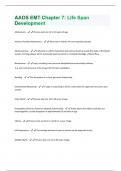
AAOS EMT Chapter 7: Life Span Development Questions And Answers Rated A+
Adolescents - Persons who are 12 to 18 years of age. Anxious-Avoidant Attachment - Observed in infants who are repeatly rejected Atherosclerosis - A disorder in which cholesterol and calcium build up inside the walls of the blood vessels, forming plaque, which eventually leads to partial or complete blockage of blood flow. Barotrauma - Injury resulting from pressure disequilibrium across body surfaces, E.g. too much pressure in the lungs from forceful ventilation. Bonding - The formation of a close, personal relationship. Conventional Reasoning - A type of reasoning in which a child looks for approval from peers and society. Early Adults - Persons who are 19 to 40 years of age. Fontanelles (Anterior, Posterior, Mastoid, Sphenoidal) - Areas where the infant's skull has not fused together; usually disappear at approximately 18 months of age. Infants - Persons who are from 1 month to 1 year of age. Life Expectancy - The average amount of years a person can be expected to live. Middle Adults - Persons who are 41 to 60 years of age.Moro Reflex - An infant reflex in which, when an infant is caught off guard, the infant opens his or her arms wide, spreads the fingers, and seems to grab at things. Neonate - Persons who are birth to 1 month of age. Nephrons - The basic filtering units in the kidneys. Older Adult Respiratory System - Size of airway increases and surface area of alveoli decreases. Increased usage of intercostal muscles to breathe Older Adults - Persons who are 61 years old or older. Palmar Grasp - An infant reflex that occurs when something is placed in the infant's palm; the infant grasps the object. Postconventional Reasoning - A type of reasoning in which a child bases decisions on his or her conscience. Preconventional Reasoning - A type of reasoning in which a child acts almost purely to avoid punishment to get what he or she wants. Preschoolers - Persons who are 3 to 6 years of age. Rooting Reflex - An infant reflex that occurs when something touches an infant's cheek, and the infant instinctively turns his or her head toward the touch. School Age - A person who is 6 to 12 years of age. Self-concept - It is one's perception of oneself. Eg. individual knowledge of who he/she is.Self-esteem - Is how we feel about ourselves and how we "fit in" with our peers Separation Anxiety - Common in older infants can peak between 10 to 18 months old Sucking Reflex - An infant reflex in which the infant starts sucking when his or her lips are stroked.
Written for
- Institution
- AAOS EMT Chapter 7: Life Span Development
- Course
- AAOS EMT Chapter 7: Life Span Development
Document information
- Uploaded on
- June 15, 2024
- Number of pages
- 4
- Written in
- 2023/2024
- Type
- Exam (elaborations)
- Contains
- Questions & answers
Subjects
-
aaos emt chapter 7 life span development

Also available in package deal