

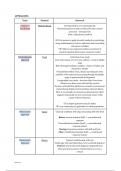
APPROACHES
Topic Name(s) Research
Origins of Wilhelm Wundt Introduced first ever psychology lab
Psychology Presented patients stimuli and describe their mental
processes - introspection
Used a reductionist method
(S) First person to apply scientific method to psychology
using standardisation (can be replicated) and controlling
extraneous variables
(W) Did not use empirical evidence and much of
research repeated did not give consistent results
Psychodynamic Freud Little Hans Case study
approach fears and traumas of a five-year-old boy - stuck in phallic
stage
Went through Oeidopus complex - jealous of father and
attracted to mother
Freud believed Hans’ fears, dreams and fantasies were
symbolic of his unconscious passing through the phallic
stage of psychosexual development
Longitudinal case study - describes Hans’ fears from
when he was three years old until he was five
He also concluded that phobias are caused by unconscious
anxiety being displaced onto harmless external objects
Hans is an example of unconscious determinism which
suggests that people are not consciously aware of the
causes of their behaviour.
(S) In depth qualitative data by father
(W) case study may not generalise to whole population
Behaviourist Pavlov Classical condition with dogs associating bell with food
Approach
Before: neutral stimulus (bell) -> unconditioned
response
Unconditioned stimulus (food) -> unconditioned
response (saliva)
During: formed association with bell and food
After: Conditioned stimulus (bell) -> conditioned
response (saliva)
Behaviourist Skinner Operant conditioning with rats
Approach Small cage with electrified floor, lever and food dispenser
Positive: Learnt that food dispenser dispensed food
when pressed so positive reinforcement as it was a
reward
By Rhea M.
, Negative: when floor would shock them and realised
lever would temporarily stop pain, removed negative
feeling so avoids pain
Cognitive Approach Bartlett English participants read folktale (contained new names
and stories of ghosts)
Recall story and measured how many details they got
wrong
They changed details of the story to match their own
schemas - place names and speaking more english and
spirits to something more familiar with
Schemas a ect how we interpret and remember new
experiences
Biological Approach McGu n et al - Evidence against cognitive approach shows that there are
twin studies genetic explanations for depression 6% of MZ twins
have depression
% of DZ twins had depression which shows that
depression may be genetically influenced - partially
inherited
Biological Approach Limitations of twin MZ share more of their environment by DZ
studies Tend to be treated similarly by friends and family
Bigger concordance rates may be influenced by
environment not just genetics
Social learning Bandura Bobo doll experiment - age -6
theory 6 boys and 6 girls - sat in room with doll - lab
experiment
Group 1: watched model behave aggressively - hit it with
hammer
Group 2: watched model ignore bobo doll and play with
other toys - non aggressive behaviour
Group 3: watched no model, let them play themselves
Observed behaviour when model left the room
Group likely to show most aggressive behaviour, threw
it around the room etc
and did not act aggressively but in group , they were
bit more aggressive than
Boys imitated model fi the model was male rather than
female - identification as they feel similar to them
(S) Lab experiment, control over extraneous - high
internal validity
Consistent results so its reliable
(W) Unfamiliar environment, may be imitating because
they didn't know what to do - behaviour may not
generalise to real life - lack ecological validity
By Rhea M.
Topic Name(s) Research
Origins of Wilhelm Wundt Introduced first ever psychology lab
Psychology Presented patients stimuli and describe their mental
processes - introspection
Used a reductionist method
(S) First person to apply scientific method to psychology
using standardisation (can be replicated) and controlling
extraneous variables
(W) Did not use empirical evidence and much of
research repeated did not give consistent results
Psychodynamic Freud Little Hans Case study
approach fears and traumas of a five-year-old boy - stuck in phallic
stage
Went through Oeidopus complex - jealous of father and
attracted to mother
Freud believed Hans’ fears, dreams and fantasies were
symbolic of his unconscious passing through the phallic
stage of psychosexual development
Longitudinal case study - describes Hans’ fears from
when he was three years old until he was five
He also concluded that phobias are caused by unconscious
anxiety being displaced onto harmless external objects
Hans is an example of unconscious determinism which
suggests that people are not consciously aware of the
causes of their behaviour.
(S) In depth qualitative data by father
(W) case study may not generalise to whole population
Behaviourist Pavlov Classical condition with dogs associating bell with food
Approach
Before: neutral stimulus (bell) -> unconditioned
response
Unconditioned stimulus (food) -> unconditioned
response (saliva)
During: formed association with bell and food
After: Conditioned stimulus (bell) -> conditioned
response (saliva)
Behaviourist Skinner Operant conditioning with rats
Approach Small cage with electrified floor, lever and food dispenser
Positive: Learnt that food dispenser dispensed food
when pressed so positive reinforcement as it was a
reward
By Rhea M.
, Negative: when floor would shock them and realised
lever would temporarily stop pain, removed negative
feeling so avoids pain
Cognitive Approach Bartlett English participants read folktale (contained new names
and stories of ghosts)
Recall story and measured how many details they got
wrong
They changed details of the story to match their own
schemas - place names and speaking more english and
spirits to something more familiar with
Schemas a ect how we interpret and remember new
experiences
Biological Approach McGu n et al - Evidence against cognitive approach shows that there are
twin studies genetic explanations for depression 6% of MZ twins
have depression
% of DZ twins had depression which shows that
depression may be genetically influenced - partially
inherited
Biological Approach Limitations of twin MZ share more of their environment by DZ
studies Tend to be treated similarly by friends and family
Bigger concordance rates may be influenced by
environment not just genetics
Social learning Bandura Bobo doll experiment - age -6
theory 6 boys and 6 girls - sat in room with doll - lab
experiment
Group 1: watched model behave aggressively - hit it with
hammer
Group 2: watched model ignore bobo doll and play with
other toys - non aggressive behaviour
Group 3: watched no model, let them play themselves
Observed behaviour when model left the room
Group likely to show most aggressive behaviour, threw
it around the room etc
and did not act aggressively but in group , they were
bit more aggressive than
Boys imitated model fi the model was male rather than
female - identification as they feel similar to them
(S) Lab experiment, control over extraneous - high
internal validity
Consistent results so its reliable
(W) Unfamiliar environment, may be imitating because
they didn't know what to do - behaviour may not
generalise to real life - lack ecological validity
By Rhea M.


