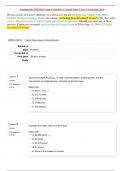
Straighterline CHEM101 General Chemistry I Graded Exam 2 (New Version June 2024)
Question 1 Correct 5.00 points out of 5.00 Aluminum sulfate, Al2(SO4)3, is used in tanning leather, purifying water, and the manufacture of antiperspirants. Calculate its formula mass. Select one: A. 342.17 amu B. 315.15 amu C. 278.02 amu D. 74.98 amu E. 450.06 amu Question 2 Correct 5.00 points out of 5.00 Calculate the molar mass of sulfuric acid. Select one: A. 98.086 g/mol B. 49 g/mol C. 81.078 g/mol D. 41 g/mol E. None of the answers is correct. Straighterline CHEM101 General Chemistry I Graded Exam 2 (New Version June 2024) We are a team of experts offering class attendance for all Straighterline, Online ATI, HESI, NCLEX, Portage Learning, Sophia etc courses (including final proctored exams!!). We also write essays, discussion posts, research papers and school assignments. Should you need any of these services, Contact us via email: or : +1 (540) 753-5914. Guaranteed Passing! CHEM101_MH_V6 | Topic 9: Energy Changes in Chemical Reactions Started on State Finished Completed on Time taken 59 mins 34 secs GradeQuestion 4 Correct 5.00 points out of 5.00 Balance the following equation for the combustion of benzene: C6H6(l) + O2(g) → H2O(g) + CO2(g) Select one: A. C6H6(l) + 9O2(g) → 6H2O(g) + 6CO2(g) B. 2C6H6(l) + 9O2(g) → 6H2O(g) + 12CO2(g) C. C6H6(l) + 9O2(g) → 3H2O(g) + 6CO2(g) D. C6H6(l) + 15O2(g) → 3H2O(g) + 6CO2(g) E. 2C6H6(l) + 15O2(g) → 6H2O(g) + 12CO2(g) Question 3 Correct 5.00 points out of 5.00 Aluminum metal reacts with chlorine gas to form solid aluminum chloride. What mass of chlorine gas is required to react completely with 163 g of aluminum? Select one: A. 214 g B. 643 g C. 428 g D. 321 g E. 286 gQuestion 6 Correct 5.00 points out of 5.00 What is the mass of 7.80 × 10¹⁸ carbon atoms? (NA = 6.022 × 10²³ mol–1) Select one: A. 7.80 × 10¹⁸ g B. 6.43 × 10³ g C. 1.56 × 10⁻⁴ g D. 12.01 g E. 1.30 × 10⁻⁵ g Question 5 Correct 5.00 points out of 5.00 Once the following equation is balanced with the smallest set of whole number coefficients, what is the sum of the coefficients? (Don't forget to include coefficients of one.) SF4 + H2O → H2SO3 + HF Select one: A. 4 B. 9 C. 6 D. 7 E. None of these answers is correct.Question 8 Incorrect 0.00 points out of 5.00 A system which does work on the surroundings with no heat change (i.e., q = 0) has Select one: A. w 0, ΔU 0. B. w 0, ΔU 0. C. w 0, ΔU = 0. D. w 0, ΔU 0. E. w 0, ΔU 0. Question 7 Correct 5.00 points out of 5.00 Balance the following equation: C8H18O3(l) + O2(g) → H2O(g) + CO2(g) Select one: A. C8H18O3(l) + 11O2(g) → 9H2O(g) + 8CO2(g) B. 2C8H18O3(l) + 22O2(g) → 9H2O(g) + 16CO2(g) C. 2C8H18O3(l) + 17O2(g) → 18H2O(g) + 16CO2(g) D. C8H18O3(l) + 13O2(g) → 18H2O(g) + 8CO2(g) E. C8H18O3(l) + 8O2(g) → 9H2O(g) + 8CO2(g)Question 10 Correct 5.00 points out of 5.00 Aluminum oxide can be reduced to aluminum metal using carbon, the other reaction product being carbon monoxide. What is the enthalpy change if 12.50 g of aluminum is produced by this method? Substance CO(g) Al2O3(s) –110.5 –1669.8 Select one: A. 310.0 kJ B. 412.4 kJ C. 386.8 kJ D. 773.6 kJ E. 824.8 kJ Question 9 Correct 5.00 points out of 5.00 An important step in the synthesis of nitric acid is the conversion of ammonia to nitric oxide according to the following balanced chemical equation. What is ΔH°rxn for this reaction? 4NH3(g) + 5O2(g) → 4NO(g) + 6H2O(g) Substance NH3(g) NO(g) H2O(g) (kJ/mol) –46.3 90.3 –241.8 Select one: A. –240.2 kJ/mol B. –1274.8 kJ/mol C. –197.8 kJ/mol D. –904.4 kJ/mol E. 197.8 kJ/molQuestion 12 Correct 5.00 points out of 5.00 Two solutions (the system), each with a volume of 25.0 mL at 25.0°C, are mixed in a beaker. A reaction occurs between them, and the temperature rises to 35.0°C. After the products have equilibrated with the surroundings, the temperature is again 25.0°C and the total volume is 50.0 mL. No gases are involved in the reaction. Which relationship concerning the change from initial to final states (both at 25.0°C) is correct? Select one: A. w = 0 B. C. D. E. q = 0 Suppose a new metallic element X is discovered, and its reactions with oxygen gas and chlorine gas at 298 K are studied. Trial Reaction ΔH°rxn (kJ/mol) 1 4X(s) + 3O2(g) → 2X2O3(s) 600 2 2X(s) + 3Cl2(g) → 2XCl3(s) 800 3 4XCl3(s) + 3O2(g) → 2X2O3(s) + 6Cl2(g) 200 However, it is later discovered that one of the samples was contaminated, and the ΔH°rxn value from this trial is not reliable. Which trial had the contaminated sample, and what should the correct value of ΔH° rxn be for this trial? Select one: A. Trial 1 had the contaminated sample; its ΔH°rxn value should be –900 kJ/mol. B. Trial 2 had the contaminated sample; its ΔH°rxn value should be +100 kJ/mol. C. Trial 3 had the contaminated sample; its ΔH°rxn value should be +1000 kJ/mol. D. Trial 3 had the contaminated sample; its ΔH°rxn value should be –1000 kJ/mol. E. Not enough information is provided; all three trials must be redone. Question 11 Correct 5.00 points out of 5.00Question 14 Incorrect 0.00 points out of 5.00 What is the molecular geometry of NO2– as predicted by the VSEPR model? Select one: A. tetrahedral B. bent C. trigonal pyramidal D. linear E. trigonal planar Question 15 Correct 5.00 points out of 5.00 Consider the species N2–, N2, and N2+. Which of these species will be paramagnetic? Select one: A. N2+ and N2– B. N2 and N2– C. N2–, N2, and N2+ D. N2+ and N2 E. None is paramagnetic. Question 13 Correct 5.00 points out of 5.00 To which one of the following reactions, occurring at 25°C, does the symbol ΔH°f [H2SO4(l)] refer? Select one: A. H2(g) + S(s) + 2 O2(g) ---- H2SO4(l) B. H2(g) + S(g) + 2 O2(g) ---- H2SO4(l) C. 2 H(g) + S(g) + 4 O(g) ---- H2SO4(l) D. H2SO4(l) ---- H2(g) + S(s) + 2 O2(g) E. H2SO4(l) ---- 2 H(g) + S(s) + 4 O(g)Question 17 Correct 5.00 points out of 5.00 What does the abbreviation VSEPR stand for? Select one: A. Very Selective Electron Pair theory B. Valence Shell for Every Proton C. Very Specific Electron and Proton Repair D. Valence-Shell Electron-Pair Repulsion E. Variable Selective of Electron and Protons Question 18 Correct 5.00 points out of 5.00 According to the VSEPR model, which molecule is predicted to be linear? Select one: A. BF3 B. H2CO C. H2S D. HCN E. SO3 Question 16 Correct 5.00 points out of 5.00 A molecule with the formula AB3 and a trigonal planar molecular geometry uses to form its σ bonds. Select one: A. sp3d2 hybrid orbitals B. sp3d hybrid orbitals C. sp hybrid orbitals D. sp2 hybrid orbitals E. sp3 hybrid orbitalsQuestion 20 Correct 5.00 points out of 5.00 Which one of these salts will form an acidic solution upon dissolving in water? Select one: A. NaCN B. NH4Br C. KOH D. LiBr E. NaF Question 19 Correct 5.00 points out of 5.00 According to molecular orbital theory, what is the bond order in the O2+ ion? Select one: A. 2.5 B. 5.5 C. 4 D. 1.5 E. 5Question 22 Incorrect 0.00 points out of 5.00 Which is the weakest acid? Select one: A. HBrO B. HBrO4 C. HBrO3 D. HBrO2 E. HBr Question 21 Correct 5.00 points out of 5.00 Below is a representation of an aqueous solution of a weak acid HA at equilibrium. (Each circle represents 1.0 × 10⁻³ mol of atoms, and the volume of the box is 1.0 L. Solvent water molecules are not shown for clarity.) What is the pH of the solution? Select one: A. 11.6 B. 11.0 C. 2.1 D. 3.0 E. 2.4Question 24 Correct 5.00 points out of 5.00 A 0.15 M solution of chloroacetic acid has a pH of 1.86. What is the value of Ka for this acid? Select one: A. 2.7 × 10⁻⁴ B. 7.2 × 101 C. 9.9 × 10⁻² D. 1.4 × 10⁻³ E. 1.6 × 10⁻¹ Question 25 Incorrect 0.00 points out of 5.00 Find the pH of a 0.183 M aqueous solution of hypobromous acid (HOBr), for which . Select one: A. 4.712 B. 0.738 C. 4.576 D. 8.686 E. 9.288 Question 23 Correct 5.00 points out of 5.00 Which one of the following is a strong acid? Select one: A. H3PO4 B. CH3COOH C. HClO3 D. NH3 E. H2SO3© 2023 StraighterLine. All rights reserved Quiz navigation 1 2 3 4 5 6 7 8 9 10 Show one page at a time Finish review
Written for
- Institution
-
Straighterline.Com
- Course
-
CHEM101
Document information
- Uploaded on
- June 12, 2024
- Number of pages
- 12
- Written in
- 2023/2024
- Type
- Exam (elaborations)
- Contains
- Questions & answers
Subjects
-
straighterline chem101 general chemistry i graded

Also available in package deal