Chapter 1 – The role of purchasing in the value chain
Purchasing: the management of the company’s external resources in such way that the
supply of all goods, services, capabilities and knowledge which are necessary for running,
maintaining and managing the company’s primary and support activities is secured under
the most favorable conditions
→ Purchasing + supply chain management = key business drivers
1. Strategic role:
a. Analyzing the purchasing spend
b. Identify key and commercial suppliers
c. Develop differentiated supplier strategies
2. Tactical role:
a. Standardize purchasing processes
b. Establish effective information links
c. Strive for continuous improvement of supplier performance
3. Operational role:
a. Secure efficient material supply from supplier in time, right quality, quantity
and lowest overall costs
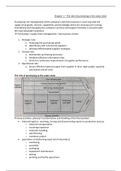
The role of purchasing in the value chain
Primary activities: physical transformation and handling of the final product
• Inbound logistics: receiving, storing and disseminating inputs to production process
o Inbound transportation
o incoming inspection
o materials handling
o warehousing
o inventory control
• operations: transforming input into final product
o machining
o assembly
o packaging
o equipment maintenance
o testing
o printing and facility operations
, • outbound logistics: collecting, storing and physically distributing the final product to
customers
o finished goods warehousing
o materials handling
o outbound transportation
o order processing and scheduling
• marketing and sales
o advertising & promotion
o sales
o distribution
o channel selection
o management of channel relations
o pricing
• Services: providing services to customers to enhance or maintain value of product
o Installation
o repair and maintenance
o parts supply
o product adjustment
Support activities: support primary activities
• Procurement: all activities required to get product to final destination
o consumable items (raw material, supplies)
o assets (machinery, laboratory equipment, office equipment and buildings)
• Technology development: technology embodies in every activity
o Know-how
o Procedures
o Technology embodies on process and design
• Human resource management: active in both primary and support activities
o Recruiting
o Hiring
o Training
o Compensation of all types of personnel
• Firm infrastructure: supports entire set of of company processes
o Management
o Planning
o Finance
o Accounting
o Legal
o Government affairs
o Quality management
o Facilities management (housing and accommodation)
→ all activities need to be performed in such way that the total value generated by the
company, as perceived by its customers, is more than the sum of its costs
,Procurement should provide support to following activities: purchasing direct material
(becoming part of the value proposition)
• Primary activities: manufacturing processes
o Make to stock (MTS): standard products are manufactured and stocked,
customers are serviced from an end product inventory, large batches,
planning based on sales forecasts
▪ E.g.: steel plate, maintenance, repair and operating supplies
o Make to order (MTO): products are manufactured from raw materials after a
customer order has been received
▪ E.g. very large or customer-specific product ranges or bulk products
that are expensive in stock
o Engineer to order (ETO): all manufacturing activities from design to assembly
and purchasing of material are related to customer order
• Support activities: supplying products and services for other support functions by
buying purchasing indirect material (do not become part of value proposition)
o Laboratory equipment for research and development
o Computer hardware and software for the central computer department
o Lease cars for the sales force and senior management
o Office equipment for accounting
o Food and beverages for the catering department
o Cleaning materials for housekeeping
o Machinery and infrastructure etc.
Definition of concepts
Purchasing function covers activities aimed at:
- Determining the purchasing specifications (quality, quantity) of the goods and
services that need to be bought
- Selecting the best possible supplier and developing procedures and routines to be
able to do this
- Preparing and conducting negotiations with the supplier in order to establish an
agreement and to make legal contract
- placing order with selected supplier to develop efficient purchase order and handling
routines
- monitoring and control of order to secure supply → expediting
- follow-up and evaluation
Does not include: materials requirement planning, materials scheduling, inventory
management, incoming inspection, quality control
,Ordering: placing purchase order against arranged conditions
Buying: commercial activity of soliciting competitive bids and make contract with lowest
bidder
Purchasing: specifications are challenged
Procurement: whole process of getting product to destination
Supply: purchasing, stores and receiving
Sourcing: developing most appropriate supplier strategy for certain commodity or product
category → sourcing strategy: how many suppliers a company favors for that category, what
type of relation to pursue and what type of contract to negotiate
Purchasing management: manage supplier relationships so that their activities to be aligned
with company’s overall interests → improving purchasing processes
Supply chain management: management of all activities, information, knowledge and
financial resources associated with the flow and transformation of goods and services from
raw materials suppliers, component suppliers and other suppliers so that expectations of
end customers can be met
Value chain management: improve company’s value proposition to customer
Importance of purchasing to business
DuPont analysis: financial diagnostic tool to calculate the company’s ROI based upon sale
margin and capital turnover ratio.
Purchasing contributes to improving a company’s return on net assets in three ways:
1. through reduction of all direct material costs e.g. reduction of number of suppliers,
improved product standardization etc.
2. through reduction of the net working capital employed by the company e.g. longer
payment terms, just-in-time agreements
3. through improving the company’s revenue generating potential e.g. innovation
Classification of purchasing goods
• Raw materials: undergone no transformation, basis material
o Physical raw materials: copper, iron, coal
o Natural raw materials: grains, soya, coffee
• Supplementary materials: not absorbed physically in end product
o E.g. water, oil, polishing materials
• Semi-manufactured materials: have already been processed and will further
o E.g. Steel plate, plastic foils
• Components: manufactured goods which will not undergo additional change, but will
be incorporated in a system and have functional relationship with other components
o E.g.: Lamp units, batteries, engine parts,
o Specific, customized components: according to design or specification of
customer
o Standard components: industry norm
• Finished products or trade items: purchased to be sold after added value
o E.g.: accessories for cars like navigation system, car stereo
• Investment goods or capital equipment: not consumed immediately but purchasing
value depreciates during economic life
o E.g.: machines, buildings (balance sheet)
• Maintenance, repair and operating materials (MRO items): necessary for keeping
organization running in general
o E.g.: office supplies, cleaning materials, copy paper
, • Services: executed by third parties
o E.g.: providing cleaning service, hiring temporary workers
New developments in purchasing
Leveraged purchasing and supply strategies:
- Combining common purchasing requirements → purchasing advantages
- In many large, European companies, across national borders
Global sourcing:
- Components are sourced from foreign, low cost countries
- Pro-actively integrating common items, materials, technologies, designs across
worldwide purchasing, engineering and operating locations
Supplier integration:
- IT improves relationship with supplier and productivity within materials activities
- Close cooperation between production planning, inventory control, quality
inspection and purchasing are needed
- System standardization is required where supplier is part of
Early supplier involvement in new product development:
- Involve supplier early in product development process
- Rapid development and technology forces industry to work close with supplier
Reciprocity agreements:
- Companies are often obliged to compensate part of their sales turnover by counter-
purchase obligations
Corporate Social responsibility and business integrity:
- contributing to a better world in terms of environment, labor conditions and social
factors
Purchasing: the management of the company’s external resources in such way that the
supply of all goods, services, capabilities and knowledge which are necessary for running,
maintaining and managing the company’s primary and support activities is secured under
the most favorable conditions
→ Purchasing + supply chain management = key business drivers
1. Strategic role:
a. Analyzing the purchasing spend
b. Identify key and commercial suppliers
c. Develop differentiated supplier strategies
2. Tactical role:
a. Standardize purchasing processes
b. Establish effective information links
c. Strive for continuous improvement of supplier performance
3. Operational role:
a. Secure efficient material supply from supplier in time, right quality, quantity
and lowest overall costs
The role of purchasing in the value chain
Primary activities: physical transformation and handling of the final product
• Inbound logistics: receiving, storing and disseminating inputs to production process
o Inbound transportation
o incoming inspection
o materials handling
o warehousing
o inventory control
• operations: transforming input into final product
o machining
o assembly
o packaging
o equipment maintenance
o testing
o printing and facility operations
, • outbound logistics: collecting, storing and physically distributing the final product to
customers
o finished goods warehousing
o materials handling
o outbound transportation
o order processing and scheduling
• marketing and sales
o advertising & promotion
o sales
o distribution
o channel selection
o management of channel relations
o pricing
• Services: providing services to customers to enhance or maintain value of product
o Installation
o repair and maintenance
o parts supply
o product adjustment
Support activities: support primary activities
• Procurement: all activities required to get product to final destination
o consumable items (raw material, supplies)
o assets (machinery, laboratory equipment, office equipment and buildings)
• Technology development: technology embodies in every activity
o Know-how
o Procedures
o Technology embodies on process and design
• Human resource management: active in both primary and support activities
o Recruiting
o Hiring
o Training
o Compensation of all types of personnel
• Firm infrastructure: supports entire set of of company processes
o Management
o Planning
o Finance
o Accounting
o Legal
o Government affairs
o Quality management
o Facilities management (housing and accommodation)
→ all activities need to be performed in such way that the total value generated by the
company, as perceived by its customers, is more than the sum of its costs
,Procurement should provide support to following activities: purchasing direct material
(becoming part of the value proposition)
• Primary activities: manufacturing processes
o Make to stock (MTS): standard products are manufactured and stocked,
customers are serviced from an end product inventory, large batches,
planning based on sales forecasts
▪ E.g.: steel plate, maintenance, repair and operating supplies
o Make to order (MTO): products are manufactured from raw materials after a
customer order has been received
▪ E.g. very large or customer-specific product ranges or bulk products
that are expensive in stock
o Engineer to order (ETO): all manufacturing activities from design to assembly
and purchasing of material are related to customer order
• Support activities: supplying products and services for other support functions by
buying purchasing indirect material (do not become part of value proposition)
o Laboratory equipment for research and development
o Computer hardware and software for the central computer department
o Lease cars for the sales force and senior management
o Office equipment for accounting
o Food and beverages for the catering department
o Cleaning materials for housekeeping
o Machinery and infrastructure etc.
Definition of concepts
Purchasing function covers activities aimed at:
- Determining the purchasing specifications (quality, quantity) of the goods and
services that need to be bought
- Selecting the best possible supplier and developing procedures and routines to be
able to do this
- Preparing and conducting negotiations with the supplier in order to establish an
agreement and to make legal contract
- placing order with selected supplier to develop efficient purchase order and handling
routines
- monitoring and control of order to secure supply → expediting
- follow-up and evaluation
Does not include: materials requirement planning, materials scheduling, inventory
management, incoming inspection, quality control
,Ordering: placing purchase order against arranged conditions
Buying: commercial activity of soliciting competitive bids and make contract with lowest
bidder
Purchasing: specifications are challenged
Procurement: whole process of getting product to destination
Supply: purchasing, stores and receiving
Sourcing: developing most appropriate supplier strategy for certain commodity or product
category → sourcing strategy: how many suppliers a company favors for that category, what
type of relation to pursue and what type of contract to negotiate
Purchasing management: manage supplier relationships so that their activities to be aligned
with company’s overall interests → improving purchasing processes
Supply chain management: management of all activities, information, knowledge and
financial resources associated with the flow and transformation of goods and services from
raw materials suppliers, component suppliers and other suppliers so that expectations of
end customers can be met
Value chain management: improve company’s value proposition to customer
Importance of purchasing to business
DuPont analysis: financial diagnostic tool to calculate the company’s ROI based upon sale
margin and capital turnover ratio.
Purchasing contributes to improving a company’s return on net assets in three ways:
1. through reduction of all direct material costs e.g. reduction of number of suppliers,
improved product standardization etc.
2. through reduction of the net working capital employed by the company e.g. longer
payment terms, just-in-time agreements
3. through improving the company’s revenue generating potential e.g. innovation
Classification of purchasing goods
• Raw materials: undergone no transformation, basis material
o Physical raw materials: copper, iron, coal
o Natural raw materials: grains, soya, coffee
• Supplementary materials: not absorbed physically in end product
o E.g. water, oil, polishing materials
• Semi-manufactured materials: have already been processed and will further
o E.g. Steel plate, plastic foils
• Components: manufactured goods which will not undergo additional change, but will
be incorporated in a system and have functional relationship with other components
o E.g.: Lamp units, batteries, engine parts,
o Specific, customized components: according to design or specification of
customer
o Standard components: industry norm
• Finished products or trade items: purchased to be sold after added value
o E.g.: accessories for cars like navigation system, car stereo
• Investment goods or capital equipment: not consumed immediately but purchasing
value depreciates during economic life
o E.g.: machines, buildings (balance sheet)
• Maintenance, repair and operating materials (MRO items): necessary for keeping
organization running in general
o E.g.: office supplies, cleaning materials, copy paper
, • Services: executed by third parties
o E.g.: providing cleaning service, hiring temporary workers
New developments in purchasing
Leveraged purchasing and supply strategies:
- Combining common purchasing requirements → purchasing advantages
- In many large, European companies, across national borders
Global sourcing:
- Components are sourced from foreign, low cost countries
- Pro-actively integrating common items, materials, technologies, designs across
worldwide purchasing, engineering and operating locations
Supplier integration:
- IT improves relationship with supplier and productivity within materials activities
- Close cooperation between production planning, inventory control, quality
inspection and purchasing are needed
- System standardization is required where supplier is part of
Early supplier involvement in new product development:
- Involve supplier early in product development process
- Rapid development and technology forces industry to work close with supplier
Reciprocity agreements:
- Companies are often obliged to compensate part of their sales turnover by counter-
purchase obligations
Corporate Social responsibility and business integrity:
- contributing to a better world in terms of environment, labor conditions and social
factors