Topic 4 – The Role of Education in society
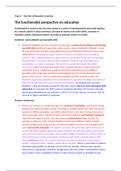
The functionalist perspective on education
Functionalists is based on the view that society is a system of interdependent parts held together
by a shared culture or value consensus. Each part of society such as the family, economy or
education system, performs functions that help to maintain society as a whole.
Durkheim: social solidarity and specialist skills
Durkheim identified two main functions of education: creating social solidarity and teaching
specialist skills. Durkheim argues that society needs a sense of solidarity. Without it, social
life and cooperation would be impossible because each individual would pursue their own
selfish desires. The education system helps to create social solidarity by transmitting
society’s culture (shared beliefs and values) from one generation to the next. For example
the teaching of a country’s history instils in children a sense of shared heritage and a
commitment to a wider social group. This can also be achieved through the hidden
curriculum. Modern industrial economies have a complex division of labour where the
production of even a single item usually involved the cooperation of many different
specialists. This cooperation promotes social solidarity but, for it to be successful, each
person must have the necessary specialist knowledge and skills to perform their role.
Durkheim argues that education teaches individuals the specialist knowledge and skills that
they need to play their part in the social division of labour. Sociologists have criticised
Durkheim’s ideas by pointing out that the education system does not teach specialised skills
adequately. For example, the Wolf review of vocational education (2011) claims that high
quality apprenticeships are rare and up to a third of 16-19 year olds are on courses that do
not lead to higher education or good jobs.
Parsons: meritocracy
Parsons see schools as an important place for secondary socialisation; acting as the bridge
between the family and wider society. This bridge is needed because the family and society
operate on different principles, so children need to learn a new way of living if they are to
cope in the wider world. Within the family, the child is judged by particularistic standards
(rules that only apply to them). They also have an ascribed status (fixed at birth). For
example, an elder son and a younger daughter may be given different rights or duties
because of differences in age and sex. In school and wider society we are all judged by the
same universalistic standards. For example, in society the same laws apply to everyone. In
school each pupil is judged against the same standards. They all sit the same exam and the
pass mark is the same for everyone. Those students might be expected to achieve a place at
university because of their exam grades, not because they knew someone who worked
there. Meritocracy refers to a society where jobs and pay are allocated on the basis of
people’s individual talents, abilities, qualifications and skills. There is a great deal of evidence
that equal opportunities in education do not exist. For example, achievement is greatly
influenced by class/gender and ethnic background rather than ability. Marketisation policies
have created a more competitive climate in which schools see girls as desirable recruits
The functionalist perspective on education
Functionalists is based on the view that society is a system of interdependent parts held together
by a shared culture or value consensus. Each part of society such as the family, economy or
education system, performs functions that help to maintain society as a whole.
Durkheim: social solidarity and specialist skills
Durkheim identified two main functions of education: creating social solidarity and teaching
specialist skills. Durkheim argues that society needs a sense of solidarity. Without it, social
life and cooperation would be impossible because each individual would pursue their own
selfish desires. The education system helps to create social solidarity by transmitting
society’s culture (shared beliefs and values) from one generation to the next. For example
the teaching of a country’s history instils in children a sense of shared heritage and a
commitment to a wider social group. This can also be achieved through the hidden
curriculum. Modern industrial economies have a complex division of labour where the
production of even a single item usually involved the cooperation of many different
specialists. This cooperation promotes social solidarity but, for it to be successful, each
person must have the necessary specialist knowledge and skills to perform their role.
Durkheim argues that education teaches individuals the specialist knowledge and skills that
they need to play their part in the social division of labour. Sociologists have criticised
Durkheim’s ideas by pointing out that the education system does not teach specialised skills
adequately. For example, the Wolf review of vocational education (2011) claims that high
quality apprenticeships are rare and up to a third of 16-19 year olds are on courses that do
not lead to higher education or good jobs.
Parsons: meritocracy
Parsons see schools as an important place for secondary socialisation; acting as the bridge
between the family and wider society. This bridge is needed because the family and society
operate on different principles, so children need to learn a new way of living if they are to
cope in the wider world. Within the family, the child is judged by particularistic standards
(rules that only apply to them). They also have an ascribed status (fixed at birth). For
example, an elder son and a younger daughter may be given different rights or duties
because of differences in age and sex. In school and wider society we are all judged by the
same universalistic standards. For example, in society the same laws apply to everyone. In
school each pupil is judged against the same standards. They all sit the same exam and the
pass mark is the same for everyone. Those students might be expected to achieve a place at
university because of their exam grades, not because they knew someone who worked
there. Meritocracy refers to a society where jobs and pay are allocated on the basis of
people’s individual talents, abilities, qualifications and skills. There is a great deal of evidence
that equal opportunities in education do not exist. For example, achievement is greatly
influenced by class/gender and ethnic background rather than ability. Marketisation policies
have created a more competitive climate in which schools see girls as desirable recruits