BIO 192 - NAU - Final Questions with 100 % correct answers | verified
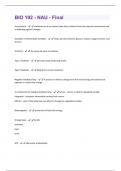
Homeostasis - maintanence of an internal state that is distinct from the external environment and is defending against changes Examples of Homeostatic variables - temp, pH, fluid volume, glucose, sodium, oxygen tension, Co2 tension Set Point - the value we want to maintain Type 1 Diabetes - pancreas stops producing insulin Type 2 Diabetes - body forms insulin resistance Negative Feedback loop - A process in which a change from the normal range of function that opposes or resists that change 3 components of negative feedback loop - Sensor - senses or detects regulated variable Integrator - interprets information coming from sensor Effector - part of the body that can affect or change the regulated variable Bioenergetics - conversion of food into energy Energy types - kinetic potential heat work ATP - adenosine triphosphatebiological currency 80-100 g stored in the body Carbohydrates - C, H, O 4 cal/g Fats - C, H, O 4 cal/g Examples of Fats - fatty acids - the form the body uses ex. saturated & unsaturated triglycerides - storage form of fat phospholipids - membranes - not an energy source steroids - derived from cholesterol Protein - C, H, N, O 4 cal/g composed of amino acids Three systems to replenish ATP - phosphagen system glycolytic system oxidative system Phosphagen System - immediate ATP production energy for high intensity activities last up to 20sec breakdown of phophocreatinine does not require oxygenGlycolysis - carbohydrate breakdown to make ATP anerobic yields 2 molecules of of ATP/glucose Formula for Glycolysis - Glucose + NAD+ = pyruvic acid + 2 NADH + H + 2 ATP Reduction - Gaining an electron Oxidation - Losing an electron Oxidative System - Provides energy for low intensity activities longer than 3 min aerobic 32 ATP production can use carbs, fats and proteins as substrates 3 types of muscles - skeletal - striates/multinucliated smooth - non striated/single nuclei cardiac - striated/single nuclei CNS - brain spinal cord PNS - affarent efferent - somatic vs autonomic S A M E (muscle acronym) - sensory affarent motor efferentFassicle - group of muscle fibers Outer to Inner muscle layers - epimyseium perimyseium endomyseium motor unit - 1 motor neuron and all the muscle fibers it innervates (creates ratio) sarcolemma - muscle cell membrane sarcoplasm - muscle cytoplasm
Written for
- Institution
- BIO 192 - NAU
- Course
- BIO 192 - NAU
Document information
- Uploaded on
- June 6, 2024
- Number of pages
- 12
- Written in
- 2023/2024
- Type
- Exam (elaborations)
- Contains
- Questions & answers
Subjects

Also available in package deal