

AUBF STUDY GUIDE |100% Correct| Question and Answer #UPDATED!!!
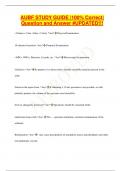
AUBF STUDY GUIDE |100% Correct| Question and Answer #UPDATED!!! • Volume • Color • Odor • Clarity *Ans* Physical Examination 10 chemical reactions *Ans* Chemical Examination • RBCs, WBCs, Bacterias, Crystals, etc. *Ans* Microscopic Examination Urinalysis *Ans* Its purpose is to detect and to identify insoluble materials present in the urine Noted on the report form. *Ans* If obtaining a 12-mL specimen is not possible, as with pediatric patients, the volume of the specimen used should be: fresh or adequately preserved *Ans* Specimens should be examined while: midstream clean-catch *Ans* The --- specimen minimizes external contamination of the sediment Refrigeration *Ans* - may cause precipitation of amorphous urates and phosphates and other non-pathologic crystals decantation *Ans* A uniform amount of urine and sediment should remain in the tube after aspirated off *Ans* To maintain a uniform sediment concentration factor, urine should be --- rather than poured off, unless otherwise specified by the commercial system in use. gentle agitation *Ans* The sediment must be thoroughly resuspended by Vigorous agitation *Ans* This should be avoided, as it may disrupt some cellular elements. 20 uL (0.02 mL) *Ans* When using the conventional glass-slide method, the recommended volume is --- covered by a 22 x 22 mm glass cover slip 10 fields *Ans* Observation of a minimum of --- under both low and high power. low power *Ans* The slide is first examined under --- to detect casts and to ascertain the general composition of the sediment rare, few, moderate, and many / 1+, 2+, 3+, and 4+ *Ans* Epithelial cells, crystals, and other elements are frequently reported in semi-quantitative terms such as, --- or ---
Document information
- Uploaded on
- June 4, 2024
- Number of pages
- 31
- Written in
- 2023/2024
- Type
- Exam (elaborations)
- Contains
- Questions & answers


