MOLECULAR BIOLOGY OF THE CELL, SIXTH EDITION
Chapter 17: THE CELL CYCLE
© Garland Science 2015
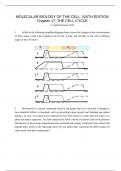
1 Which of the following simplified diagrams better shows the changes in the concentrations
of three major cyclin–Cdk complexes (G 1/S-Cdk, S-Cdk, and M-Cdk) in the cell in different
stages of the cell cycle?
G1 G2
A
B
C
D
E
2 Resveratrol is a natural compound found in red grapes (and red wine) and is thought to
have beneficial effects in mammals, such as preventing tumor growth and delaying age-related
diseases. In vitro, resveratrol and its derivatives have been shown to cause cell-cycle arrest in S
phase and induce apoptosis. You have analyzed the DNA content of cultured cells in the presence
and absence of these drugs using fluorescence-activated cell sorting. Compared with control cells
(dashed line), which of the following curves do you think better represents the DNA content of
cells treated with these compounds?
,Number of cells
Number of cells
A B
Number of cells
Number of cells
0 1 2 0 1 2
C D
Number of cells
0 1 2 0 1 2
Relative cellular
DNA content
E
0 1 2
Relative cellular
DNA content
,Reference: FACS Data Analysis (Questions 3-4)
You have been studying the effect of loss-of-function mutations in the Cdk inhibitor protein (CKI)
p21. You add the drug fucoxanthin to cell cultures harboring either wild-type or mutant versions
of the p21 gene. Fucoxanthin is known to induce cell-cycle arrest in G1. After a day, you add the
thymidine analog BrdU to the culture media, collect the cells after an hour, treat them with anti-
BrdU antibody and the fluorescent DNA stain DAPI, and finally subject them to fluorescence-
activated cell sorting (FACS). The FACS data can be viewed as a two-dimensional dot plot
composed of thousands of dots, in which each cell is represented by one dot at coordinates that
correspond to the intensities of the DAPI fluorescence signal (X axis) and BrdU fluorescence
signal (Y axis) for that cell. Answer the following question(s) according to the simplified dot plot
below, generated from your experiment.
BrdU signal intensity
BrdU signal intensity
a b
1 1
3 3
2 2
DAPI signal intensity DAPI signal intensity
3 Indicate which boxed region (1, 2, or 3) in the FACS plots corresponds better to each of
the following phases of the cell cycle. Your answer would be a three-digit number composed of
numbers 1 to 3, with each number used once, e.g. 312.
( ) G1 phase
( ) S phase
( ) G2 and M phases
, 4 Which one of the FACS plots (a or b) would you expect to correspond to the loss-of-
function p21 mutants? Write down a or b as your answer.
5 Sort the following schematic diagrams (A to F) to reflect the order of events in a typical
eukaryotic M phase. An interphase cell in G 2 phase is drawn on the left for comparison. Your
answer would be a six-letter string composed of letters A to F only, e.g. BCEADF.
G2 phase A B C D E F
6 Consider two mammalian cells, one in G1 and the other in G0 (stationary) phase. If they are
stimulated to pass the restriction point by the addition of an extracellular proliferation signal, but
the signal is then immediately removed, what would you expect to happen?
A. Both cells will replicate their DNA.
B. Only the G1 cell will replicate its DNA.
C. Only the G0 cell will replicate its DNA.
D. Only the G1 cell will start to replicate its DNA, but will stop halfway through the
replication and will not reach G2.
E. Neither of the cells will replicate their DNA.
7 Which of the time points (A to E) in the following schematic drawing of the mammalian
cell cycle represents the restriction point?
Chapter 17: THE CELL CYCLE
© Garland Science 2015
1 Which of the following simplified diagrams better shows the changes in the concentrations
of three major cyclin–Cdk complexes (G 1/S-Cdk, S-Cdk, and M-Cdk) in the cell in different
stages of the cell cycle?
G1 G2
A
B
C
D
E
2 Resveratrol is a natural compound found in red grapes (and red wine) and is thought to
have beneficial effects in mammals, such as preventing tumor growth and delaying age-related
diseases. In vitro, resveratrol and its derivatives have been shown to cause cell-cycle arrest in S
phase and induce apoptosis. You have analyzed the DNA content of cultured cells in the presence
and absence of these drugs using fluorescence-activated cell sorting. Compared with control cells
(dashed line), which of the following curves do you think better represents the DNA content of
cells treated with these compounds?
,Number of cells
Number of cells
A B
Number of cells
Number of cells
0 1 2 0 1 2
C D
Number of cells
0 1 2 0 1 2
Relative cellular
DNA content
E
0 1 2
Relative cellular
DNA content
,Reference: FACS Data Analysis (Questions 3-4)
You have been studying the effect of loss-of-function mutations in the Cdk inhibitor protein (CKI)
p21. You add the drug fucoxanthin to cell cultures harboring either wild-type or mutant versions
of the p21 gene. Fucoxanthin is known to induce cell-cycle arrest in G1. After a day, you add the
thymidine analog BrdU to the culture media, collect the cells after an hour, treat them with anti-
BrdU antibody and the fluorescent DNA stain DAPI, and finally subject them to fluorescence-
activated cell sorting (FACS). The FACS data can be viewed as a two-dimensional dot plot
composed of thousands of dots, in which each cell is represented by one dot at coordinates that
correspond to the intensities of the DAPI fluorescence signal (X axis) and BrdU fluorescence
signal (Y axis) for that cell. Answer the following question(s) according to the simplified dot plot
below, generated from your experiment.
BrdU signal intensity
BrdU signal intensity
a b
1 1
3 3
2 2
DAPI signal intensity DAPI signal intensity
3 Indicate which boxed region (1, 2, or 3) in the FACS plots corresponds better to each of
the following phases of the cell cycle. Your answer would be a three-digit number composed of
numbers 1 to 3, with each number used once, e.g. 312.
( ) G1 phase
( ) S phase
( ) G2 and M phases
, 4 Which one of the FACS plots (a or b) would you expect to correspond to the loss-of-
function p21 mutants? Write down a or b as your answer.
5 Sort the following schematic diagrams (A to F) to reflect the order of events in a typical
eukaryotic M phase. An interphase cell in G 2 phase is drawn on the left for comparison. Your
answer would be a six-letter string composed of letters A to F only, e.g. BCEADF.
G2 phase A B C D E F
6 Consider two mammalian cells, one in G1 and the other in G0 (stationary) phase. If they are
stimulated to pass the restriction point by the addition of an extracellular proliferation signal, but
the signal is then immediately removed, what would you expect to happen?
A. Both cells will replicate their DNA.
B. Only the G1 cell will replicate its DNA.
C. Only the G0 cell will replicate its DNA.
D. Only the G1 cell will start to replicate its DNA, but will stop halfway through the
replication and will not reach G2.
E. Neither of the cells will replicate their DNA.
7 Which of the time points (A to E) in the following schematic drawing of the mammalian
cell cycle represents the restriction point?