ASPT Certification Test Material Questions And Answers Graded A+
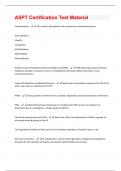
Professionalism - The conduct and qualities that characterize a professional person. Self Confidence Integrity Compassion Self-Motivation Dependability Ethical Behavior Health Insurance Portability and Accountability Act (HIPAA) - 1996 federal law passed requiring healthcare providers to obtain consent in writing before disclosing medical information to any unauthorized person. Centers for Medicare and Medicaid Services - Replaced list of procedure codes found in ICD 9 CM with a new code set called the ICD 10 PCS HMOs - Group practices reimbursed on a prepaid, negotiated, and discounted basis of admission. PPOs - Independent groups of physicians or hospitals that offer services to employers at discounted rates in exchange for a steady supply of patients. Clinical Lab Improvement Act (CLIA) - Allows the CMS in the Department of HHS to regulate all sites performing lab testing in the US. CLIA regulations mandate all labs use the same standards regardless of location, type, or size. The Joint Commission - An independent, not for profit organization charged with establishing standards for the operation of hospitals and health related facilities and services.College of American Pathologists - Agency that influences quality care through standards for the lab and phlebotomy. Offers proficiency testing and continuous forms of lab inspection by a team of pathologists and lab managers. Clinical and Lab Standards Institute (CLSI) - CLSI controls phlebotomy procedures. Develops clinical and lab practices and promotes their use worldwide. National Accrediting Agency for Clinical Lab Sciences (NAACLS) - The authority on quality lab education. Hematology Department - Performs lab tests that identify diseases associated with blood and the blood forming tissues. Coagulation Department - Study of the ability of blood to form and dissolve clots. Ran on patients with blood thinners. Chemistry Department - Largest department, performs most lab tests. Serology/Immunology Department - Serology means the study of serum, deals with the bodys response to the presence of bacterial viral fungal or parasitic diseases stimulating antigen-antibody rxns that can be easily demonstrated in the lab. Urinalysis Department - Examines the presence or absence of blood cells, bacteria, crystals, and other substances present in urine. Microbiology Department - Analyzes body fluids and tissues for the presence of microbes by means of C&S testing.Blood Bank/Immunohematology Department - Prepares blood products to be used for patient transfusion Cytogenic and Flow Cytometry - Samples are examined microscopically for chromosomal deficiencies that relate to genetic disease. Histology Department - Study of the microscopic structure of tissues. Cytology Department - Cells in body tissues and fluids are identified, counted, and studied to diagnose malignant and premalignant conditions.
Written for
- Institution
- ASPT Certification
- Course
- ASPT Certification
Document information
- Uploaded on
- June 2, 2024
- Number of pages
- 4
- Written in
- 2023/2024
- Type
- Exam (elaborations)
- Contains
- Questions & answers
Subjects

Also available in package deal