POLITICAL SCIENCE AND POLITICS
EXAM Q&A
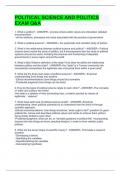
1. What is politics? - ANSWER-- process where public values are articulated, debated
and prescribed
- all the relations, processes and value associated with the practice of government
2. What is political science? - ANSWER-- the systematic and scientific study of politics
3. What is the relationship between political science and politics? - ANSWER-- Political
science does involve the study of politics, but it encompasses also the study of political
systems around the world, including the structure and functioning of disparate
governments in every region around the world.
4. What is Max Weber's definition of the state? How does he define the relationship
between politics and the state? - ANSWER--the "state" is a "human community the
successfully monopolizes the legitimate use of physical force within a given area"
5. What are the three main tasks of political science? - ANSWER-- Empirical
understanding (how things are) positive
- Ethical recommendations (how things should be) normative
- Prudential judgment (how things can be done)
6. How do the tasks of political science relate to each other? - ANSWER--The concepts
of 'state' and 'politics' are linked
-the state is a relation of men dominating men, a relation sported by means of
legitimate... violence"
7. What does each task of political science entail? - ANSWER--Empirical
understanding: when political scientists try to understand how the world is through
scientific approach.
-Ethical recommendations: how things should be, 'what ought to be?" question for good
political life, names and describes political values and whats to achieve them without
being strictly limited to each other
-Prudential judgment: what can be, or "sensible guidance in political life". Incorporating
lessons form the things we know, practical wisdom, in order to form realistic public
policies.
8. What are the seven steps of scientific inquiry? - ANSWER-- Formulate a research
question
- Developing a theory
- Identifying the variables
- Operationalizing the variables
- Generalizing hypothesis
EXAM Q&A
1. What is politics? - ANSWER-- process where public values are articulated, debated
and prescribed
- all the relations, processes and value associated with the practice of government
2. What is political science? - ANSWER-- the systematic and scientific study of politics
3. What is the relationship between political science and politics? - ANSWER-- Political
science does involve the study of politics, but it encompasses also the study of political
systems around the world, including the structure and functioning of disparate
governments in every region around the world.
4. What is Max Weber's definition of the state? How does he define the relationship
between politics and the state? - ANSWER--the "state" is a "human community the
successfully monopolizes the legitimate use of physical force within a given area"
5. What are the three main tasks of political science? - ANSWER-- Empirical
understanding (how things are) positive
- Ethical recommendations (how things should be) normative
- Prudential judgment (how things can be done)
6. How do the tasks of political science relate to each other? - ANSWER--The concepts
of 'state' and 'politics' are linked
-the state is a relation of men dominating men, a relation sported by means of
legitimate... violence"
7. What does each task of political science entail? - ANSWER--Empirical
understanding: when political scientists try to understand how the world is through
scientific approach.
-Ethical recommendations: how things should be, 'what ought to be?" question for good
political life, names and describes political values and whats to achieve them without
being strictly limited to each other
-Prudential judgment: what can be, or "sensible guidance in political life". Incorporating
lessons form the things we know, practical wisdom, in order to form realistic public
policies.
8. What are the seven steps of scientific inquiry? - ANSWER-- Formulate a research
question
- Developing a theory
- Identifying the variables
- Operationalizing the variables
- Generalizing hypothesis