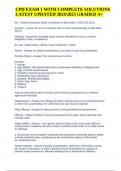
CPD EXAM 1 WITH COMPLETE SOLUTIONS UPDATED 2024/2025 GRADED A+.
CPD EXAM 1 WITH COMPLETE SOLUTIONS UPDATED 2024/2025 GRADED A+. Act - Answer includes a failure or omission to take action. (720 ILCS 5/2-2) Conduct - Answer An act or a series of acts, and the accompanying mental state. (5/2-4) Dwelling - Answer An enclosed space used or intended for use as a human habitation, home, or residence. Ex: tent, mobile home, vehicle, house, apartment , trailer. Felony - Answer An offense punishable by one year or more in a penitentiary. Forcible Felony - Answer The most serious of crimes. Includes: 1. murder 2. Agg. Battery: with great bodily harm or permanent disability or disfigurement. 3. Agg. Criminal sexual assault 4. Predatory criminal sexual assault of a child 5. Kidnapping, Agg. Kidnapping 6. Burglary, Residential Burglary 7. Arson, Agg. Arson 8. Robbery 9. Treason And any other felony which involves use of threat of physical force or violence against an individual. Misdemeanor - Answer Any offense for which a sentence to a term of imprisonment in other than a penitentiary for LESS than one year may be imposed. Petty Offense - Answer An offense which is not punishable by imprisonment. Offense - Answer Violation of any penal statute of this state. (each state has own criminal code) Peace Officer - Answer 1. Any person who by virtue of his or her public office or employment is vested by law with a duty to maintain public order or to make arrests for offenses. 2. Any person who by statute, is granted and authorized to exercise powers similar to those conferred upon. (employed by law enforcement agency of this state) ex: university police Penal Institution - Answer Includes a penitentiary, state farm, reformatory, prison, jail, house of correction, or other institution for the incarceration or custody of persons under sentence for offenses awaiting trial or sentence for offenses. CPD EXAM 1 WITH COMPLETE SOLUTIONS LATEST UPDATED 2024/2025 GRADED A+ Reasonable Belief - Answer Means that person concerned, acting as a reasonable person, believes that the described facts exist. ("totality of the facts") Voluntary Act - Answer A material element of every offense is a voluntary act, which includes an omission to perform a duty which the law imposes on the offender and which he is physically capable of performing. Posession as a Voluntary Act - Answer If the offender knowingly procured or received the thing posessed, or was aware of his control thereof for a sufficient time to have been able to terminate his posession. Place of Trial - Answer (a) Generally. Criminal offenses in Illinois shall be tried in the county where the offense occurred, except otherwise provided by law. Presumption of Innocence and proof of guilt - Answer Every person is presumed innocent until proven guilty beyond a reasonable doubt. General Limitations - Answer Limits the time period within which the state must commence prosecution. a. For certain offenses there is no time limit (ex: homicide, treason, arson, agg. arson, and forgery) b. Generally, prosecution for a felony must be commenced within 3 YEARS. c. Generally, prosecution for a misdemeanor must be commenced within one year and 6 months after its comission. Methods of Prosecution - Answer When authorized by law a prosecution may be commenced by: a. complaint b. information c. indictment Mental State - Answer State of mind under which the act was committed. a. intent b. knowledge c. recklessness d. negligence An act does not make the doer guilty, unless the mind is guilty. Result - Answer Effect or commission of the act accompanied by the criminal mental element. The nature of this injury often determinative of the crime charged. Elements of a Crime - Answer a. A voluntary act b. A mental state c. A result Intent - Answer When his or her conscious objective or purpose is to accomplish that result or engage in that conduct. Knowledge - Answer When he or she is consciously aware of the nature or result of his conduct. Recklessness - Answer When he or she consciously disregards a substantial and unjustifiable risk. Negligence - Answer When he or she fails to be aware of a substantial and unjustifiable risk. Absolute Liability - Answer A person may be guilty of an offense without having one of the mental states if the offense is a misdemeanor which is not punishable by incarceration or by a fine exceeding $1000. Accountability for conduct of another - Answer A person is responsible for conduct which is an element of an offense if the conduct is either that of the person himself, or that of another and he is legally accountable for such conduct. Exists when a person: a. Participates BEFORE the crime, with specific intent to promote or facilitate an offense. b. Participates AFTER the crime. c. With the intent that the offense be committed, solicits, aids, abets, agrees or attempts to aid a person in the planning or commission of an offense. Affirmative Defenses - Answer When he or she argues that, because of the existence of factors, his or her conduct should be excused or not punished. Law provides that certain circumstances create possible defenses. (must present evidence). Ignorance or mistake - Answer A defense if it negatives the existence of the mental state which the statute prescribes with respect to an element of the offense. Infancy - Answer No person shall be convicted of any offense unless he or she had attained his 13th birthday at the time the offense was committed. Insanity - Answer A person is not criminally responsible for their conduct if at the time of such conduct, as a result of mental disease or defect he or she lacks substantial capacity to appreciate the criminality of his conduct. Intoxicated or Drugged Condition - Answer A person who is in an intoxicated and drugged condition is criminally responsible for conduct unless the condition is involuntarily produced and deprives him or her of substantial capacity to appreciate the criminality of his conduct or to conform his or her conduct to the requirements of law. Compulsion - Answer A person is not guilty of an offense, other than an offense punishable by death, by reason of conduct which he or she performs under compulsion of threat or menace of the imminent infliction of death or great bodily harm, if he reasonably believes such death or great bodily harm will be inflicted upon him or her, or upon his or her spouse or child if he does not perform such conduct. Cannot be used as a defense for intentionally or knowingly taking the life of another. Necessity - Answer Conduct which would otherwise be an offense is justifiable by this reason if the accused was without blame in occasioning or developing the situation and reasonably believed such conduct was necessary to avoid a public or private injury greater than the injury which might reasonably result from his own conduct. Solicitation - Answer 1. With the intent that an offense be committed ( other than first degree murder) 2. Commands, encourages, or requests another to commit that offense. Solicitation of Murder - Answer When he or she commits solicitation with the intent that the offense of first degree murder be committed. Conspiracy - Answer 1. With intent that an offense be committed, 2. agrees with another to the commission of that offense, and an 3. act in furtherance is committed. (done in preparation for the intended crime). Mr. X and Mr. Y agree, with specific intent to cause death, to shoot and kill the neighbor. The following day, Mr. X purchases the agreed upon murder weapon. What charge for both of them? - Answer Conspiracy Mr. X Asks Mr. Y to kill his neighbor. Mr. Y refuses. Charge for Mr. X? Mr. Y? - Answer Mr. X: solicitation of murder Mr. Y: None Attempt - Answer 1. With the intent to commit a specific offense, 2. does any act which constitutes a substantial step towards the commission of the offense. (verge of committing the crime). Mr. X intends to cause the death of Y b shooting and killing him. X shoots Y, but he survives. Charge for X?? - Answer Attempted Murder Multiple convictions - Answer No person shall be convicted of both the inchoate and the principal offense. Once the principal offense is committed, that is what the person is charged with. A person cannot be charged with both attempted murder and murder for same criminal conduct. Offense - Answer Includes conduct which if performed in another state would be criminal by the laws of that state and which conduct if performed in this state would be an offense under the laws of this state. First Degree Murder - Answer A person who kills an individual without lawful justification. Voluntarily perfoms the acts which cause the death of another, with intent or knowledge of the probability of causing death or great bodily harm. No specific intent to kill Arnie hates his co-worker. After work one day Arnie waits in the parking lot in his car. Seeing the co-worker exit the building, Arnie speeds up and purposely
Written for
- Institution
- CPD
- Course
- CPD
Document information
- Uploaded on
- May 30, 2024
- Number of pages
- 21
- Written in
- 2023/2024
- Type
- Exam (elaborations)
- Contains
- Questions & answers
Subjects
- cpd
- updated latest 2024
- graded
- verified answers
-
cpd exam 1 with complete solutions

Also available in package deal