Skin Integrity and Wound Care Chapter 29 Graded A+
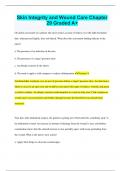
Skin Integrity and Wound Care Chapter 29 Graded A+ On initial assessment of a patient, the nurse notices an area of redness over the right trochanter that, when pressed lightly, does not blanch. What does this assessment finding indicate to the nurse? a. The presence of an infection in the area b. The presence of a stage I pressure ulcer c. An allergic reaction to the sheets d. The need to apply a cold compress to reduce inflammation Answer: b Nonblanchable erythema over an area of pressure defines a stage I pressure ulcer. An infection is likely to occur in an open sore and would be associated with signs of redness, warmth, and green or yellow exudate. An allergic reaction would manifest as a rash or itchy area. Cold compresses would cause vasoconstriction and further damage because the blood flow has already been restricted. Four days after abdominal surgery, the patient is getting out of bed and feels something "pop" in his abdominal wound. An increase in amount of drainage from the wound is seen, and further examination shows that the sutured incision is now partially open, with tissue protruding from the wound. What is the nurse's next action? a. Apply Steri-Strips to close the wound edges. b. Cover the wound with saline-moistened gauze, and notify the physician. c. Assure the patient that this is common, and document the findings. d. Apply a binder to pull the wound edges together and provide support to the edges. Answer: b This is likely to be an evisceration of the surgical wound and, as such, may require surgical intervention. The normal saline keeps the wound and tissue moist until they can be evaluated by the physician. Steri-Strips can be used to reinforce a closed wound when sutures or staples are removed but are not used to try to close a wound that has opened and has tissue protruding through. False reassurance should not be given. A binder is used to support a closed incision and should not be applied to a wound with tissue protruding. Which features are characteristic of a closed drainage system such as a Jackson-Pratt (JP) drain? (Select all that apply.) a. Works by gravity b. Provides for early discharge c. Usually is inserted in surgery d. Reduces the amount of antibiotics required e. Allows for accurate measurement of wound drainage f. Allows bacteria to migrate up the drain from the surrounding dressing Answers: c, e JP drains usually are inserted at surgery. Unlike an open drainage device such as the Penrose drain, a JP drain does not allow drainage to soak into the surrounding dressing and allows for an accurate measurement of the drainage. JP drains work by suction, not gravity. Discharge and antibiotic use are not dependent on the type of drain. Bacteria migration from the dressing will not occur because a JP drain is a closed system.
Written for
- Institution
- Skin Integrity and Wound Care Chapter 29
- Course
- Skin Integrity and Wound Care Chapter 29
Document information
- Uploaded on
- May 27, 2024
- Number of pages
- 13
- Written in
- 2023/2024
- Type
- Exam (elaborations)
- Contains
- Questions & answers
Subjects
-
skin integrity and wound care chapter 29 graded a

Also available in package deal