

Astro 7N Exam 2 Questions and Answers | Verified Updated| Latest 2024.
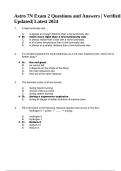
Astro 7N Exam 2 Questions and Answers | Verified Updated| Latest 2024. 1. A high-luminosity star ... A: is always at a larger distance than a low-luminosity star B: emits more light than a low-luminosity star C: is always redder than a star with a lower luminosity D: is at a lower temperature than a low-luminosity star E: is always at a smaller distance than a low-luminosity star 2. If a red giant appears the same brightness as a red main sequence star, which one is farther away? A: the red giant B: we cannot tell C: it depends on the phase of the Moon D: the main sequence star E: they are at the same distance 3. The heaviest nuclei of all are formed ... A: during helium burning B: as part of the p-p chain C: during carbon burning D: during a supernova explosion E: during all stages of stellar evolution of massive stars 4. Fill in the blank in the following chemical reaction that occurs in the Sun: Hydrogen-2 + proton = _____ + energy: A: Hydrogen-2 B: Hydrogen-1 C: Helium-3 D: Carbon-12 E: Helium-4 Astro 7N Exam 2 Questions and Answers | Verified Updated| Latest 2024 5. Which of the following has the smallest radius? A: type A main sequence star B: main sequence star with surface temperature 8000 K C: type K main sequence star D: white dwarf E: neutron star 6. Why does the main sequence part of a star’s life end? A: The Helium in the core is exhausted. B: The gravitational force is no longer large enough to balance the pressure. C: The Hydrogen in the core is exhausted. D: The temperature drops so that nuclear reactions are no longer possible. E: Much of the mass of the star has evaporated. 7. Which of the following will have the shortest lifetime on the main sequence? A: main sequence star with surface temperature 20000 K B: main sequence star with surface temperature 3000 K C: main sequence star with luminosity one tenth that of the Sun D: the Sun E: main sequence star with mass 2 times the Sun's 8. Many of the brightest 100 stars viewed from Earth are not on the main sequence (even though most stars are) because ... A: only high mass stars formed near to us in the Galaxy. B: the most luminous stars are giants and supergiants that have already finished their main sequence lifetimes. C: our region of the Galaxy is very young. D: the main sequence is the shortest part of a star’s life so stars do not spend much time there. E: our region of the Galaxy is very old. 9. A 2-solar-mass main sequence star is at the same distance as a 0.2-solar-mass main sequence star. Which star appears brighter? A: depends on the phase of the Moon B: the 2 solar mass main sequence star appears brighter C: the stars are approximately the same brightness D: the 0.2 solar mass main sequence star appears brighter E: we cannot tell with the information given 10. The temperature of the photosphere of the Sun is closest to ... A: 107 Kelvin B: 106 Kelvin C: 100 Kelvin D: 600,000 Kelvin E: 6000 Kelvin 11. An estimate of the number of communicating / technological civilizations that we expect in our Galaxy would be a larger number if ... A: the average lifetime of a communicating civilization were smaller B: the star formation rate in our Galaxy were smaller C: the average number of planets that could support life for each star wereD: it were more difficult for life to develop intelligence, once life had formed E: a smaller percentage of stars formed planets.
Document information
- Uploaded on
- May 27, 2024
- Number of pages
- 15
- Written in
- 2023/2024
- Type
- Exam (elaborations)
- Contains
- Questions & answers


