1 / WGU D265 Critical Thinking Section 4
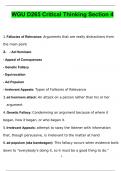
1.Fallacies of Relevance: Arguments that are really distractions from the main point
2.- Ad Hominem
-Appeal of Consquences
-Genetic Fallacy
-Equivocation
-Ad Populum
-Irrelevant Appeals: Types of Fallacies of Relevance
3.ad hominem attack: An attack on a person rather than his or her argument
4.Genetic Fallacy: Condemning an argument because of where it began, how it began, or who began it.
5.Irrelevant Appeals: attempt to sway the listener with information that, though persuasive, is irrelevant to the matter at hand
6.ad populum (aka bandwagon): This fallacy occurs when evidence boils down to "everybody's doing it, so it must be a good thing to do." .appeal of consquences: attempt to motivate belief with an appeal either to the good consequences of believing or the bad consequences of disbelieving
8.Equivocation: the use of ambiguous language to conceal the truth or
to avoid committing oneself; prevarication
9.Fallacies of Weak Induction: A group of informal fallacies that occur because the connection between the premises and conclusion is not strong enough to support the conclusion
10.- Hasty Generalization
-Appeal to Ignorance
-Post Hoc Ergo Propter Hoc: Types of Fallacies of Weak Induction
11.Appeal to Ignorance: A fallacy that uses an opponent's inability to disprove a conclusion as proof of the conclusion's correctness.
12.post hoc ergo propter hoc: This fallacy is Latin for "after which therefore because of which," meaning that it is incorrect to always claim that something is a cause just because it happened earlier. One may loosely summarize this fallacy by saying that correlation does not imply causation.
13.Hasty Generalization: A fallacy in which a faulty conclusion is reached
1.Fallacies of Relevance: Arguments that are really distractions from the main point
2.- Ad Hominem
-Appeal of Consquences
-Genetic Fallacy
-Equivocation
-Ad Populum
-Irrelevant Appeals: Types of Fallacies of Relevance
3.ad hominem attack: An attack on a person rather than his or her argument
4.Genetic Fallacy: Condemning an argument because of where it began, how it began, or who began it.
5.Irrelevant Appeals: attempt to sway the listener with information that, though persuasive, is irrelevant to the matter at hand
6.ad populum (aka bandwagon): This fallacy occurs when evidence boils down to "everybody's doing it, so it must be a good thing to do." .appeal of consquences: attempt to motivate belief with an appeal either to the good consequences of believing or the bad consequences of disbelieving
8.Equivocation: the use of ambiguous language to conceal the truth or
to avoid committing oneself; prevarication
9.Fallacies of Weak Induction: A group of informal fallacies that occur because the connection between the premises and conclusion is not strong enough to support the conclusion
10.- Hasty Generalization
-Appeal to Ignorance
-Post Hoc Ergo Propter Hoc: Types of Fallacies of Weak Induction
11.Appeal to Ignorance: A fallacy that uses an opponent's inability to disprove a conclusion as proof of the conclusion's correctness.
12.post hoc ergo propter hoc: This fallacy is Latin for "after which therefore because of which," meaning that it is incorrect to always claim that something is a cause just because it happened earlier. One may loosely summarize this fallacy by saying that correlation does not imply causation.
13.Hasty Generalization: A fallacy in which a faulty conclusion is reached