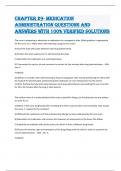
Chapter 29- Medication administration Questions and Answers with 100% Verified solutions
Chapter 29- Medication administration Questions and Answers with 100% Verified solutions The nurse is preparing to administer a medication via a nasogastric tube. What guideline is appropriate for the nurse to 1. follow when administering a drug via this route? A) Flush the tube with water between each drug administered. B) Position the client supine prior to administering the drug. C) Administer the medication at a cold temperature. D) If connected to suction, do not reconnect to suction for five minutes after drug administration. - ANS- Ans: A Feedback: Guidelines to consider when administering a drug via nasogastric tube include positioning the client with the head of the bed elevated, administering the medication at room temperature for the client's comfort, flushing the tube with water between each drug administered, and avoiding the use of suction for 20 to 30 minutes after the drug is administered. The medical chart of a newly admitted client notes a penicillin allergy, yet the physician has just written an order for an antibiotic in the same drug family after reviewing the client's wound culture and sensitivity. How should the nurse 2. respond to this situation? A) Withhold the medication until the potential drug allergy has been addressed by the care team. B) Administer the medication and increase the frequency of assessments in the hours that follow. C) Substitute an antibiotic with similar action, but which is from a different drug family. D) Discuss the severity, signs and symptoms of the drug allergy with the client in order to ascertain the risks of administration. - ANS- Ans: A Feedback: Client safety is paramount, and the nurse has a responsibility to ensure that a potential threat of harm is identified and dealt with promptly. It is beyond the nurse's scope of practice to independently substitute another drug, and it would be unsafe to administer the drug in light of this revelation. The nurse would not administer the drug even if the client stated that his or her allergy is mild. 3. Which of the following clients receives a drug that requires parenteral route? A) A woman who has been ordered intravenous antibiotics B) A woman who takes a diuretic pill each morning C) A man with emphysema who uses nebulized bronchodilators D) A man who has an antifungal ointment applied to his skin rash daily - ANS- Ans: A Feedback: The parenteral route includes such methods as intravenous administration and injections. Pills are given by an oral route and a nebulizer is administered by the pulmonary route. An ointment is a topical medication. A physician has ordered peak and trough levels of a medication. When would the nurse schedule the trough level 4. specimen? A) Before administering the first dose B) Immediately after the first dose C) 30 minutes before the next dose D) 24 hours after the last dose - ANS- Ans: C Feedback: The trough level is the point when the drug is at its lowest concentration, and the specimen is usually drawn in the 30- minute interval before the next dose. The peak level, in contrast, is the highest plasma concentration of the drug. A client taking insulin has his levels adjusted to ensure that the concentration of drug in the blood serum produces the 5. desired effect without causing toxicity. What is the term for this desired effect? A) Peak level B) Trough level C) Half-life D) Therapeutic range - ANS- Ans: D Feedback: A drug's therapeutic range is the concentration of drug in the blood serum that produces the desired effect without causing toxicity. The peak level, or highest plasma concentration, of the drug should be measured when absorption is complete. The peak level may be affected by factors that affect drug absorption as well as the route of administration. The trough level is the point when the drug is at its lowest concentration, and this specimen is usually drawn in the 30- minute interval before the next dose. A drug's half-life is the amount of time it takes for 50% of the blood concentration of a drug to be eliminated from the body. A client who is taking an oral narcotic for pain relief tells the nurse he is constipated. What is this common response to 6. narcotics called? A) Therapeutic effect B) Adverse effect C) Toxic effect D) Idiosyncratic effect - ANS- Ans: B Feedback: Although therapeutic effect is the desired outcome of medication administration, sometimes adverse effects occur. Adverse effects (such as constipation from narcotics) often are predictable and can usually be tolerated. Toxic effects (toxicities) are specific groups of symptoms related to drug therapy that carry risk for permanent damage or death. An idiosyncratic effect(sometimes called paradoxical effect) is any unusual or peculiar response to a drug that may manifest itself by over-response, under-response, or even the opposite of the expected response. A nurse is conducting an interview for a health history. In addition to asking the client about medications being taken, 7. what else should be asked to assess the risk for drug interactions? A) The effects of prescribed medications B) Type and amount of foods eaten C) Daily amount of intake and output D) Use of herbal supplements - ANS- Ans: D Feedback: Herbal remedies can interact with prescribed medications. When asking a client if he or she is taking any medications, the nurse should specifically ask if herbal supplements are also being used. A nurse is converting the dosage of a medication to a different unit in the metric system. The medication label specifies 8. the drug as being 0.5 g per tablet. The order is for 500 mg. How many tablets will the nurse give? A) 1 B) 2 C) 5 D) 10 - ANS- Ans: A Feedback: To convert in the metric system from a smaller unit to a larger unit, move the decimal point three places to the right. As 0.5 g = 500 mg, the nurse would administer one tablet. A physician has ordered that a medication be given "stat" for a client who is having an anaphylactic drug reaction. At 9. what time would the nurse administer the medication? A) At the next scheduled medication time B) Immediately after the order is noted C) Not until verifying it with the client D) Whenever the client asks for it - ANS- Ans: B Feedback: A stat order is a single order, and it is carried out immediately. This is a legal order. The nurse would not wait until the next scheduled medication time or verify the order with the client. With a p.r.n. order, the client receives medication when it is requested or required. 10. What does the nurse do to verify an order for a medication listed on a medication administration record (MAR)? A) Compare it with the original physician's order. B) Ask another nurse what the drug is. C) Look up the drug in a textbook. D) Call the pharmacist for verification. - ANS- Ans: A Feedback: In many institutions, the medication order is copied onto the client's medication record. The nurse is responsible for checking that the medication order was transcribed correctly by comparing it with the original physician's order. A nurse is administering a medication that is formulated as enteric-coated tablets. What is the rationale for not crushing 11. or chewing enteric-coated tablets? A) To prevent absorption in the mouth B) To prevent absorption in the esophagus C) To facilitate absorption in the stomach D) To prevent gastric irritation - ANS- Ans: D Feedback: Enteric-coated tablets are covered with a hard surface to impede absorption until the tablet has left the stomach. Enteric- coated tablets should not be chewed or crushed because the active ingredient of the drug is irritating to the gastric mucosa. A nurse is administering a liquid medication to an infant. Where will the nurse place the medication to prevent 12. aspiration? A) Between the gum and the cheek B) In front of the teeth and gums C) On the front of the tongue D) Under the tongue - ANS- Ans: A Feedback:
Written for
- Institution
- Chapter 29- Medication administration
- Course
- Chapter 29- Medication administration
Document information
- Uploaded on
- May 25, 2024
- Number of pages
- 15
- Written in
- 2023/2024
- Type
- Exam (elaborations)
- Contains
- Questions & answers
Subjects
-
chapter 29 medication administration questions an

Also available in package deal