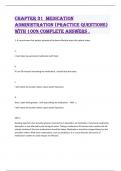
Chapter 31 Medication Administration (practice questions) with 100% complete answers .
Chapter 31 Medication Administration (practice questions) with 100% complete answers . 1. A nurse knows that patient education has been effective when the patient states a. I must take my parenteral medication with food. b. If I am 30 minutes late taking my medication, I should skip that dose. c. I will rotate the location where I give myself injections. d. Once I start feeling better, I will stop taking my medication. - ANS- c. I will rotate the location where I give myself injections. ANS: C Rotating injection sites provides greater consistency in absorption of medication. Parenteral medication absorption is not affected by the timing of meals. Taking a medication 30 minutes late is within the 60-minute window of the time medications should be taken. Medications should be stopped based on the providers orders. With some medications, such as antibiotics, it is crucial that the full course of medication is taken to avoid relapse of infection. 2. Which statement by the patient is an indication to use the Z-track method? a. Im really afraid that a big needle will hurt. b. The last shot like that turned my skin colors. c. I am allergic to many medications. d. My legs are too obese for the needle to go through. - ANS- B.The last shot like that turned my skin colors. ANS: B The Z-track is indicated when the medication being administered has the potential to irritate sensitive tissues. The Z-track method is not meant to reduce discomfort from the procedure. If a patient is allergic to a medication, it should not be administered. If a patient has additional subcutaneous tissue to go through, a needle of a different size may be selected. 3. A 2-year-old child is ordered to have ear irrigation performed daily. The nurse correctly performs the procedure by a. Pulling the auricle down and back to straighten the ear canal. b. Pulling the auricle upward and outward to straighten the ear canal. c. Instilling the irrigation solution by holding the syringe just inside the ear canal. d. Holding the fluid in the canal for 2 to 3 minutes with a cotton swab. - ANS- a. Pulling the auricle down and back to straighten the ear canal. ANS: A Children up to 3 years of age should have the auricle pulled down and back, children 4 years of age to adults should have the auricle pulled upward and outward. Irrigation solution should be instilled 1 cm (1/2) above the opening of the ear canal. Irrigation solution should be allowed to drain freely during instillation. 4. A patient has an order to receive 10 units of U-50 insulin. The nurse is using a U-100 syringe. How many units should the nurse draw up in the syringe and administer? a. 0.2 units b. 2 units c. 5 units d. 20 units - ANS- d. 20 units ANS: D The nurse is careful to perform nursing calculations to ensure proper medication administration. U-50 insulin has 50 units of insulin in every milliliter, a U-100 syringe has 100 units in every milliliter. Conversion equals 20 units. 5. A patient has an order to receive 20 units of U-50 insulin. The nurse is using a U-100 syringe. How many units should the nurse draw up in the syringe and administer? a. 0.04 mL b. 0.4 mL c. 4 mL d. 10 mL - ANS- b. 0.4 mL ANS: B The nurse is careful to perform nursing calculations to ensure proper medication administration. U-50 insulin has 50 units of insulin in every milliliter, a U-100 syringe has 100 units in every milliliter. Conversion equals 20 units. 6. The patient is to receive phenytoin (Dilantin) at 0900. The nurse knows that the ideal time to draw a trough level is a. 0800. b. 0830. c. 0900. d. 0930. - ANS- b. 0830 ANS: B Trough levels are generally drawn 30 minutes before the drug is administered. If the medication is administered at 0900, the trough should be drawn at 0830. 7. A patient who has been receiving intermittent chemotherapy through a peripheral IV site is ordered to receive a high dose of vancomycin through the same vein. Why does this concern the nurse? a. Chemotherapy is irritating to the vascular system and may cause the vein to infiltrate. b. Two medications should never be placed into the same IV site. c. Once chemotherapy is in a patients system, any additional medicine given will cause a synergistic effect. d. Chemotherapy treatments require a special pump designed solely for chemotherapy. - ANS- a. Chemotherapy is irritating to the vascular system and may cause the vein to infiltrate. ANS: A Chemotherapy medications and vancomycin are irritating to the veins and introduce increased risk for infiltration. Infiltration of a chemotherapy medication can lead to extravasation, a serious IV complication. Medications can be placed into the same IV site if they are compatible. Chemotherapy does not cause a synergistic effect with antibiotics. Chemotherapy medications can be infused through the same device as maintenance IV fluids or even antibiotics. 8. A physician orders 1000 mL of normal saline to infuse at a rate of 50 mL/hr. The nurse plans on hanging a new bag at what time? a. 2 hours b. 5 hours c. 10 hours d. 20 hours - ANS- d. 20 hours ANS: D It will take 20 hours for a liter (1000 mL) of fluid to infuse at a rate of 50 mL/hr. After 2 hours, only 100 mL would have infused. After 5 hours, only 250 mL would have infused. At 10 hours, 500 mL would have infused. 9. The nurse is preparing to administer a 0.5-mL rabies vaccine into the deltoid muscle of a patient. Which needle size is best for the procedure? a. 20 gauge 1 1/2 inch b. 23 gauge 1/2 inch c. 25 gauge 5/8 inch d. 27 gauge 3/8 inch - ANS- c. 25 gauge 5/8 inch ANS: C For an intramuscular injection into the deltoid, a 25-gauge, 5/8-inch needle is recommended. Needles that are 20 gauge 11/2 inch, 23 gauge 1/2 inch, and 27 gauge 3/8inch are not appropriately sized for this type of injection. 10. The nurse knows that the purpose of aspiration on IM injections is to a. Ensure proper placement of the needle. b. Increase the force of the injection. c. Reduce the discomfort of the injection. d. Prolong the absorption time of the medication. - ANS- a. Ensure proper placement of the needle. ANS: A The purpose of aspiration is to ensure that the needle is in the belly of the muscle and not in the vascular system. Blood return upon aspiration indicates improper placement, and the injection should not be given. Increasing the force of the injection, reducing discomfort, and prolonging absorption time are not reasons for aspirating medications. 1. The nurse is giving an IM injection. Upon aspiration, the nurse notices blood return in the syringe. What should the nurse do? a. Administer the injection at a slower rate b. Withdraw the needle and prepare the injection again. c. Pull the needle back slightly and inject the medication. d. Give the injection and hold pressure over the site for 3 minutes. - ANS- b. Withdraw the needle and prepare the injection again. ANS: B Blood return upon aspiration indicates improper placement, and the injection should not be given. Instead withdraw the needle, dispose of the syringe and needle properly, and prepare the medication again. Administering the medication into a blood vessel could have dangerous adverse effects, and the medication will be absorbed faster than intended owing to increased blood flow. Holding pressure is not an appropriate intervention. Pulling back the needle slightly does not guarantee proper placement of the needle and medication administration.
Written for
- Institution
- Chapter 31: Medication Administration (practice qu
- Course
- Chapter 31: Medication Administration (practice qu
Document information
- Uploaded on
- May 24, 2024
- Number of pages
- 39
- Written in
- 2023/2024
- Type
- Exam (elaborations)
- Contains
- Questions & answers
Subjects
-
chapter 31 medication administration practice qu

Also available in package deal