

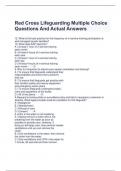
Red Cross Lifeguarding Multiple Choice
Red Cross Lifeguarding Multiple Choice Questions And Actual Answers 12. What is the best practice for the frequency of in-service training participation at well-managed aquatic facilities? 10. What does EAP stand for? A | At least 1 hour of in-service training each month B | At least 4 hours of in-service training each year C | At least 1 hour of in-service training each day D | At least 4 hours of in-service training each month - D 9. Why is it important to attend a pre-season orientation and training? A | To ensure that lifeguards understand their responsibilities and know how to perform their job B | To ensure that lifeguards get practice with their facility's safety and rescue equipment and emergency action plans C | To ensure lifeguards understand codes, rules and regulations of the facility D | All of the above - D A lifeguard is texting while on surveillance duty and fails to recognize a swimmer in distress. What legal principle could be a problem for this lifeguard? A | Negligence B | Abandonment C | Refusal of care D | Consent - A A victim in the water is not breathing. A | Always remove a victim who is not breathing from the water as soon as possible to provide care. However, if doing so will delay care, then perform inwater ventilations until you can remove the victim. B | Give ventilations in the water, then remove the victim from the water. C | Give ventilations and CPR in the water for 1 minute, 30 seconds and then remove them from the water. D | Wait for additional assistance to remove the victim from the water. - A All of the following describe appropriate care for a conscious person with an airway obstruction (choking) EXCEPT: A | Check the victim for breathing and a pulse for no more than 10 seconds.
Document information
- Uploaded on
- May 24, 2024
- Number of pages
- 9
- Written in
- 2023/2024
- Type
- Exam (elaborations)
- Contains
- Questions & answers


