Paralegal 101 Questions And Answers Graded A+
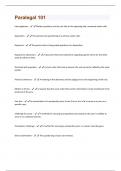
Interrogatories - Written questions sent by one side to the opposing side, answered under oath. Deposition - The pretrial oral questioning of a witness under oath. Deponent - The person who is being asked questions at a deposition. Request for admissions - A document that lists statements regarding specific items for the other party to admit or deny. Dismissal with prejudice - A court order that ends a lawsuit; the suit cannot be refiled by the same parties. Pretrial conference - A meeting of the attorneys and the judge prior to the beginning of the trial. Motion in limine - A request that the court order that certain information not be mentioned in the presence of the jury. Voir dire - An examination of a prospective juror to see if he or she is fit to serve as a juror on a specific case. Challenge for cause - A method for excusing a prospective juror based on the juror's inability to serve in an unbiased manner. Peremptory challenge - A method for excusing a prospective juror; no reason need be given. Direct examination - The questioning of your own witness.Leading question - The question that suggests the answer; generally, leading questions may not be asked during direct examination of a witness. Cross-examination - The questioning of an opposing witness. Directed verdict - A verdict ordered by a trial judge if the plaintiff fails to present a prima facie case or if the defendant fails to present a necessary defense. Pattern jury instructions - A set of standardized jury instructions. Verdict - The opinion of a jury on a question of fact. Mistrial - A trial ended by the judge because of a major problem, such as a prejudicial statement by one of the attorneys. Judgment - The decision of the court regarding the claims of each side. It may be based on a jury's verdict. Writ of execution - A court order authorizing a sheriff to take property in order to enforce a judgment. Judgment notwithstanding the verdict (judgment N.O.V.) - A judgment that reverses the verdict of the jury when the verdict had no reasonable factual support or was contrary to law. Motion for a new trial - A request that the court order a rehearing of a lawsuit because irregularities, such as errors of the court or jury misconduct, make it probable that an impartial trial did not occur. Appellate brief - An attorney's written argument presented to an appeals court, setting forth a statement of the law as it should be applied to the client's facts.Clearly erroneous - Standard used by appellate courts when reviewing a trail court's findings of fact. Harmless error - A trial court error that is not sufficient to warrant reversing the decision. Reversible error - An error made by the trial judge sufficiently serious to warrant reversing the trial court's decision. Affirm - When a higher court agrees with what a lower court has done. Reverse - When an appellate court overturns or negates the decision of a lower court. Remand - When an appellate court sends a case back to the trial court for a new trial or other action. Rules of criminal procedure - Federal and state rules that regulate how criminal proceedings are conducted. Insanity defense - A defense requiring proof that the defendant was not mentally responsible. M'Naghten test - A test that provides that the defendant is not guilty due to insanity if, at that time of the killing, the defendant suffered from a defect or disease of the mind and could not understand whether the act was right or wrong. Irresistible impulse test - A test that provides that the defendant is not guilty due to insanity if, at the time of the killing, the defendant could not control his or her actions.
Document information
- Uploaded on
- May 20, 2024
- Number of pages
- 22
- Written in
- 2023/2024
- Type
- Exam (elaborations)
- Contains
- Questions & answers