MHR 523 - MID TERM #1 QUESTIONS & ANSWERS SOLVED 100% CORRECT!
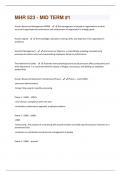
Human Resources Management (HRM) - the management of people in organizations to drive successful organizational performance and achievement of organization's strategic goals. Human Capital - the knowledge, education, training, skills, and expertise of an organization's workforce. Scientific Management - also known as Taylorism, is scientifically analyzing manufacturing processes to reduce costs and compensating employees based on performance. The Hawthorne Studies - illustrates how psychological and social processes affect productivity and work adjustment. It is concerned with the impact of fatigue, rest pauses, and lighting on employee productivity. Human Resources Movement: Evolutionary Phases - Phase 1 - early 1900's -personnel administration -hiring, firing, payroll, benefits processing Phase 2 - 1930's - 1950's -union liaison, compliance with new laws -orientation, performance appraisal, employee relations Phase 3 - 1960's -1980's -HRM -Outsourcing : the practice of contracting with outside vendors to handle specific business functions on a permanent basis. -emphasis on contribution and proactive management of people Phase 4 - 1990's - present-every line manager must posses basis HR skills -help achieve strategic objectives -new roles: activist, change steward, talent manager/ organizational designer, operational executor and business ally strategy - the formulation of organizational missions, goals, objectives and action plans for achievement that explicitly recognize the competition and the impact of outside environmental forces. External Influences - - economic conditions - labour market issues - technology - government - globalization - environmental concerns Internal Influences - - organizational culture - organizational climate - management practices External Influences on HR - increasing workforce diversity: visible and ethnic minorities; women; aboriginal population; people with disabilities Labour Market Issues - higher overall level of education, however higher level of functional illiteracy Technology - -concerns over data control, accuracy, right to privacy, and ethics -computerized monitoring of e-mail, voice mail, telephone conversation, computer usage, and behaviour Government - ensure policies and practices comply with new and changing laws covering: -HR-Employment Standards -Labour Relations -Occupational health and safety -Workers' compensation Environmental Concerns - climate change, global warming, sustainability, pollution, carbon footprints, extinction of wildlife species, ecosystem fragility Organizational climate - the prevailing atmosphere that exists in an organization and its impact on employees organizational culture - the core values, beliefs, and assumptions that are widely shared by members of an organization Job Analysis - a process by which information about jobs is systematically gathered and organized Job - a group of related activities/ duties for one or more employees Position - the collection of tasks/ responsibilities performed by one person Organizational Structure - the formal relationships among jobs in an organization Process Chart - shows the flow of inputs and outputs from the job under study Job Design - the process of systematically organizing work into tasks that are required to perform a specific job Job Specialization - work simplification, industrial engineering
Written for
- Institution
- MHR 523
- Course
- MHR 523
Document information
- Uploaded on
- May 19, 2024
- Number of pages
- 7
- Written in
- 2023/2024
- Type
- Exam (elaborations)
- Contains
- Questions & answers
Subjects

Also available in package deal