

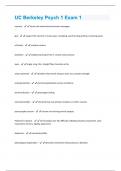
UC Berkeley Psych 1 Exam 1 Questions with well explained answers
neurons - nerve cells where brain processes messages glia - support the neurons in many ways--insulating, synchronizing activity, removing waste cell body - contains nucleus dendrites - widely branching ("tree"), receive transmissions axon - single, long, thin, straight fiber, branches at tip action potential - excitation that travels along an axon at a constant strength resting potential - electrical polarization across membrane terminal bouton - presynaptic ending neurotransmitter - chemical that can activate receptors on other neurons post-synaptic neuron - neuron on receiving end of synapse Parkinson's disease - 1% of people over 50; difficulty initiating voluntary movement, slow movement, tremors, rigidity, depression dopamine - neurotransmitter physiological explanation - describes mechanism that produces a behaviorevolutionary explanation - relates behavior to the evolutionary history of the species electroencephalograph (EEG) - uses electrodes on the scalp to record rapid changes in brain electrical activity magnetoencephalograph (MEG) - records magnetic changes positron-emission tomography (PET) - records radioactivity of various brain areas emitted from injected chemicals functional magnetic resonance imaging (fMRI) - uses magnetic detectors outside the head to compare the amounts of hemoglobin with and without oxygen in different brain areas central nervous system - brain and spinal cord peripheral nervous system - bundles of nerves between the spinal cord and the rest of the body cerebral cortex - outer covering of forebrain occipital lobe - rear of head, specialized for vision; damage causes cortical blindness temporal lobe - sides of head, hearing and complex aspects of vision parietal lobe - forward from occipital, specialized for body senses primary somatosensory cortex - back end of parietal lobe, cells sensitive to touch in different body areasfrontal lobe - forward end; includes PRIMARY MOTOR CORTEX primary motor cortex - important for planned control of fine movements prefrontal cortex - back of frontal lobe pons and medulla - control muscles of head spinal cord - controls muscles from neck down and reflexes reflexes - rapid, automatic response to a stimulus cerebellum - part of hindbrain; important for aim or timing autonomic nervous system - controls internal organs, heart, etc. endocrine system - glands that produce hormones and release them into the blood hormones - chemicals released by glands and conveyed by the blood to alter activity in various organs corpus callosum - set of axons that connect left and right hemispheres of cerebral cortex epilepsy - condition in which cells somewhere in brain emit abnormal rhythmic, spontaneous impulses binding problem - question of how separate brain areas combine forces to produce a unified perception of a single objectstimulants - drugs that increase energy, alertness, and activity depressants - drugs that decrease arousal alcohol - class of molecules that includes methanol, ethanol, propyl alcohol (rubbing alcohol); ethanol=drinks tranquilizers; anxiolytic drugs - help people relax narcotics - drugs that produce drowsiness, insensitivity to pain, decreases responsiveness opiates - either natural drugs derived from opium poppy or synthetic drugs with a chemical structure resembling natural opiates endorphins - bind to the opiate receptors; neurotransmitters that inhibit the release of substance P and thereby weaken pain sensations hallucinogens - drugs that induce sensory distortions stimuli - energies from the world around us that affect us receptors - specialized cells that convert environmental energies into signals for the nervous system electromagnetic spectrum - light; continuum of all the frequencies of radiated energy pupil - adjustable opening in the eye though which light enters iris - colored structure on the surface of the eyeretina - layer of visual receptors covering the back surface of the eyeball cornea - rigid transparent structure on the outer surface of the eyeball
Document information
- Uploaded on
- May 18, 2024
- Number of pages
- 11
- Written in
- 2023/2024
- Type
- Exam (elaborations)
- Contains
- Questions & answers


