NC BLET HAZMAT questions and answers.
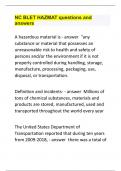
A hazardous material is "any substance or material that possesses an unreasonable risk to health and safety of persons and/or the environment if it is not properly controlled during handling, storage, manufacture, processing, packaging, use, disposal, or transportation. Definition and incidents- Millions of tons of chemical substances, materials and products are stored, manufactured, used and transported throughout the world every year The United States Department of Transportation reported that during ten years from , there was a total of 166,036 hazardous materials incidents that occurred while the materials were being transported, The majority of these incidents (approximately 87.9 percent) occurred while being transported via highways In 2018, the Pipeline and Hazardous Materials Safety Administration reported_______hazardous materials incidents occurred in North Carolina with ______ of those occurring on the highways? 512, 487 United States Department of Labor, Occupational Safety and Health Administration (OSHA) regulates: hazardous waste operations, regulations, and emergency response Awareness Level- Recognize the presence or potential presence of a hazardous material, Recognize the type of container at a site and identify the material in it if possible, Transmit information to an appropriate authority and call for appropriate assistance, Identify actions to protect themselves and others from hazards, Establish scene control by isolating the hazardous area and denying entry. (DOT) also regulates the transfer and transportation of hazardous and explosive materials by air, highway, rail, and water. Environmental Protection Agency (EPA)- also plays a part in regulating hazardous materials, as they can have a distinct effect on environmental interests or be hazardous to human health National Incident Management System (NIMS)- is a comprehensive, national approach to incident management that is applicable to all jurisdictional levels and across functional disciplines it intends to Be applicable, Improve coordination and cooperation, Provide a common standard for overall incident management. Incident command system (ICS)- created in the 1970's due to california wildfire, each responder answers to one person, Allows us to integrate with fire, rescue, and medical personnel in a smooth, effective manner. Control of situation shifts as more highly trained personnel arrive on scene. Boiling point: "The temperature at which the vapor pressure of a liquid is equal or greater than atmospheric pressure. Flash point: "The minimum temperature at which a liquid or volatile solid gives off sufficient vapors to form an ignitable mixture with air near its surface. Vapor density: "The weight of a given volume of pure vapor or gas compared to the weight of an equal volume of dry air at the same temperature and pressure Specific gravity: "The ratio of the density (heaviness) of a material to the density of some standard material at standard conditions of pressure and temperature. Chronic exposure: "Of long duration, or recurring over a period of time Acute exposure: "Single exposure (dose) or several repeated exposures to a substance within a short time period. Routes of entry: Refers to those "pathways by which hazardous materials get into (or affect) the human body. Ingestion- "Process of taking in materials through the mouth by means other than simple inhalation Inhalation- "Process of taking in materials by breathing through the nose or mouth Injection- "Process of taking in materials through a puncture or break in the skin Absorption- "Process of taking in materials through the skin or eyes Six clues- location/occupancy, your senses, container shapes, labels and written resources driver information. Olfactory fatigue- The nose becomes saturated with a product, and you think the product is gone Bill of lading is required to be in a cab in the reach of a driver. Written resources- responders in identifying hazardous materials at both fixed facilities and transportation incidents. Fixed facilities should have safety data sheets, inventory records Safety data sheet (SDS)- An SDS is "a sixteen-section information sheet provided by a chemical product's manufacturer or importer that contains information such as the chemical composition, physical and chemical properties, health and safety hazards, emergency response procedures, and transportation and regulatory information of the specified materials The United States Department of Transportation- regulates the packaging and vehicles used in transporting hazardous materials and types of labels/placards that must be attached to containers and vehicles The GHS is a system for standardizing and harmonizing the classification and labeling of chemicals. Classes of placards class 1 explosives. Class 2, gases, class 3 class 3 flammable, class 4 flammable solids, class 5 oxidizing substance, class 6 toxic materials. Class 7 radioactive. Class 8 corrosives, class 9 miscellaneous goods Explosives- Materials that are capable of an instantaneous release of energy Gases- Materials shipped in a gaseous form, usually under pressure. Solid materials that ignite readily and burn vigorously. oxidizers - Any substance that yields oxygen readily to stimulate the combustion of organic materials. Poisonous and toxic substances- Any substance that causes harm to living organisms Radioactive material- Any substance that spontaneously emits ionizing radiation Corrosives- Any substance that causes visible destruction of human skin tissue on contact or that has a corrosion rate on steel. Miscellaneous dangerous goods (DOT class 9)- Materials that pose limited risks during transport and do not fit into the other eight categories. Emergency Response Guidebook (erg)- "The ERG is primarily a guide to aid emergency responders in quickly identifying the specific or generic hazards of materials involved in an emergency incident and protecting themselves and the general public during the initial response phase of the incident Numerical index- "The yellow-bordered pages of the ERG provide an index list of hazardous materials in numerical order of ID number. Alphabetic index- "The blue-bordered pages of the ERG provide an index of dangerous goods in alphabetical order by material name so that the first responder can quickly identify the Guide to consult for the name of the material involved Response guide- "The orange-bordered section of the book is the most important because it provides safety recommendations and general hazards information.
Written for
- Institution
- Nc blet
- Course
- Nc blet
Document information
- Uploaded on
- May 17, 2024
- Number of pages
- 34
- Written in
- 2023/2024
- Type
- Exam (elaborations)
- Contains
- Questions & answers
Subjects

Also available in package deal