

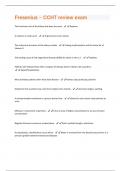
Fresenius ~ CCHT review exam Questions & Answers Already Graded A+
The functional unit of the kidney that does the work - Nephron A nephron is made up of - A glomerulus and a tubule The endrocrine functions of the kidney include - making erythropoietin and the active for of Vitamin D The leading cause of End-Stage Renal Disease (ESRD) for adults in the U.S. - Diabetes Patients with kidney failure often complain of itching, which is likely to be caused by - HyperPhosphatemia Why do kideny patients often have bone disease - Kidneys stop producing calcitriol Symptoms that a patient may need more dialysis time include - Anorexia, fatigue, swelling A semipermeable membrane is a porous barrier that - allows for only certain sized particles to cross Diffusion is movement of particles - from an area of higher concentration to an area of lower concentration Negative Pressure is pressure created when - fluid is pulled through a restriction During Dialysis, ultrafiltration occurs when - Water is removed from the blood because there is a pressure gradient between blood and dialysateat which point in the extracorporeal circuit is the blood usually under negative pressure - The arterial line section before the blood pump Which of the following will increase the amount of the solutes that will diffuse across the semipermeable membrane - High concentration gradients The components of the dialysate treatment that affect clearance include - Dialysate flow, time of treatment, dialyzer size, blood flow rate Two things that affect the dialyzer's ability to remove wastes from the body include - Surface area and molecular weight cutoff Dialysate is the fluid that helps remove waste products from the body. It contains a number of substances. What might be prescribed for a dialysate solution - Bicarbonate, Sodium, Potassium What is the most important safety monitor during a dialysis treatment - The dialysis technician Dialysate conductivity measures - the total electrical charge of a solution Dialysate that has too much sodium may cause patient injury. Too much sodium or hypernatremia can cause - Headaches, high blood pressure, and shriveling of the red blood cells Dialysate that has too much calcium can cause - Vomiting, confusion, irritability Dialysate that has too little sodium can cause - low blood pressure, cramping, and bursting of Red Blood Cells Things that can affect dailysis adequacy include - time on treatment, Blood and dialysate flow rates, dialyzer clotting normal body temperature taken orally - 98.6 degrees Fthe instrument used for measuring blood pressure is called - Sphygmomanometer a rapid pulse of 104 beats/min would indicate that the patient has - tachycardia
Document information
- Uploaded on
- May 17, 2024
- Number of pages
- 6
- Written in
- 2023/2024
- Type
- Exam (elaborations)
- Contains
- Questions & answers


