100 Free MCCQE1 Questions and answers
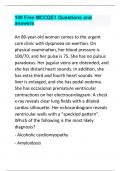
An 80-year-old woman comes to the urgent care clinic with dyspnoea on exertion. On physical examination, her blood pressure is 100/70, and her pulse is 75. She has no pulsus paradoxus. Her jugular veins are distended, and she has distant heart sounds. In addition, she has extra third and fourth heart sounds. Her liver is enlarged, and she has pedal oedema. She has occasional premature ventricular contractions on her electrocardiogram. A chest x-ray reveals clear lung fields with a dilated cardiac silhouette. Her echocardiogram reveals ventricular walls with a "speckled pattern". Which of the following is the most likely diagnosis? - Alcoholic cardiomyopathy - Amyloidosis - Haemochromatosis - Tuberculosis - Viral myocarditis Amyloidosis Restrictive cardiomyopathy with 'speckled' left ventricular wall Primary cardiac amyloidosis usually develops into diastolic dysfunction Alcoholic cardiomyopathy: biventricular dilated cardiomyopathy A 92-year-old man with a 45-year history of chronic obstructive pulmonary disease is intubated in the ICU because of a bout of viral pneumonia that fails to improve after 72 hours of antibiotics. Although the inspired fraction of oxygen is 100%, the patient's pO2 remains at 57 mmHg. Positive-end expiratory pressure (PEEP) is added to allow the inspired fraction of oxygen. Twelve hours after the introduction of PEEP the patient suddenly become hypotensive. At the same time, his oxygen saturation drops from 92% to 61%. On physical examination, his BP is 80/50 mmHg and his pulse is 124/min. He has distended neck veins and distant heart sounds. Which of the following would also most likely be seen on this patient's physical examination? - Absence of breath sounds in the right hemithorax - High amplitude carotid artery upstroke - A pleural friction rub - Pulsus alternans - Splenomegaly Absence of breath sounds in the right hemithorax Patient has developed a tension pneumothorax, characterised by PEEP followed by sudden hypotension and decreased oxygenation Jugular venous distention occurs because venous return to the right side of the heart is being compressed Rx: immediate needle/tube thoracostomy A 46-year-old man with a history of hypertension and hypercholesterolemia visits the physician for a routine followup. The patient's job involves a lot of travelling, and he admits to occasionally forgetting to take his medications with him when he travels. He complains of several episodes of chest pain in the past few months. The pain is sharp in nature, mainly over his lower chest and epigastrium, and tends to come on when walking. He believes these episodes are due to indigestion and has been taking antacids. There is a family history of heart disease, and his father died of a heart attack at age 48. On physical examination, his blood pressure is 150/80 mmHg and heart rate is 86/min. His lungs are clear to auscultation. Cardiac auscultation reveals normal rate and rhythm, without rubs, gallops, or murmurs. There is no pedal oedema. He is sent for an exercise stress test. Five minutes into the test, he develops ST Coronary angiography Multiple risk factors for atherosclerotic coronary artery disease A stress test is considered positive when there are ST depression of >1mm for longer than 0.08 seconds Positive stress test = coronary angiography A 74-year-old woman, who has been followed for the past 25 years for chronic obstructive pulmonary disease comes to the ED complaining of 48 hours of temperature to 38.6 C and worsening shortness of breath. She has a chronic productive cough, which has become more copious. On physical examination, she has rhonchi and increased fremitus in the posterior mid-lung field. A Gram's stain reveals many epithelial cells and multiple gram-positive and gram-negative organisms; no neutrophils are seen. Which of the following is the most likely organism causing the symptoms? - Escherichia coli - Haemophilus influenzae - Klebsiella pneumoniae - Mycobacterium tuberculosis - Mycoplasma pneumoniae Haemophilus influenzae Evidence of community-acquired pneumonia and common organisms in patients with COPD are Strep. pneumoniae, Haem. influenzae and Moraxella catarrhalis. Klebseilla pneumonia is typically found in alcoholic patients. Primary E. coli pneumonia is rare and there is no history of infection elsewhere (e.g. UTI). Mycoplasma pneumoniae does not present with a lobar consolidation and generally occurs in younger patients - x-ray reveals faint bilateral interstitial infiltrates. A 62-year-old man is being treated for an acute myocardial infarction. He originally came to the ED with substernal chest pain and diaphoresis. Given his risk factors of hypertension, diabetes, tobacco use, and family history, he is considered high risk. An ECG in the ED reveals a left-bundle branch pattern, and cardiac enzymes are elevated slightly. After a focused evaluation in the ED, the patient receives IV thrombolytics. Although his bundle branch pattern never resolves, the patient is chest pain-free and haemodynamically stable after thrombolysis. Two days later, however, the patient reports episodes of recurrent chest discomfort and shortness of breath overnight. In evaluating for potential myocardial reinfarction, which of the following is the most appropriate diagnostic test? - Creatinine kinase - Dynamic ECG changes - Lactate dehydrogenase - Myoglobin levels - Troponin I level Creatinine kinase CK, total levels and specific MB fraction, are elevated as early as 3 hours after onset of chest pain and have a duration of no more than 2 days, peaking within 18-24 hours Myoglobin is the first enzyme elevated and lasts no more than 1 day, but is nonspecific to AMI Troponin levels increase in 3-12 hours, peak in approximately 1 day, and gradually taper over the next 10 days
Written for
- Institution
- CDM
- Course
- CDM
Document information
- Uploaded on
- May 16, 2024
- Number of pages
- 115
- Written in
- 2023/2024
- Type
- Exam (elaborations)
- Contains
- Questions & answers
Subjects
-
100 free mccqe1 questions and answers

Also available in package deal