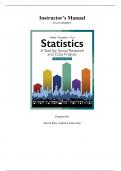
Instructor’s Manual
to accompany
Prepared by
Steven Prus, Carleton University
, TABLE OF CONTENTS
Preface.............................................................................................................................. iv
Chapter 1: Introduction .................................................................................................. 1-1
Chapter 2: Basic Descriptive Statistics: Percentages, Ratios and Rates, Tables,
Charts, and Graphs ......................................................................................................... 2-1
Chapter 3: Measures of Central Tendency and Dispersion ........................................... 3-1
Chapter 4: The Normal Curve........................................................................................ 4-1
Chapter 5: Introduction to Inferential Statistics: Sampling and the
Sampling Distribution .................................................................................................... 5-1
Chapter 6: Estimation Procedures for Sample Means and Proportions ......................... 6-1
Chapter 7: Hypothesis Testing with Nominal and Ordinal Variables: Chi Square ....... 7-1
Chapter 8: Measures of Association for Variables Measured at the Nominal Level..... 8-1
Chapter 9: Measures of Association for Variables Measured at the Ordinal Level ...... 9-1
Chapter 10: Hypothesis Testing with Means and Proportions:
The One-Sample Case.................................................................................................. 10-1
Chapter 11: Hypothesis Testing with Means and Proportions:
The Two-Sample Case ................................................................................................. 11-1
Chapter 12: Hypothesis Testing with More Than Two Means: One-Way Analysis
of Variance ................................................................................................................... 12-1
Chapter 13: Hypothesis Testing and Measures of Association for Variables Measured
at the Interval-Ratio Level ........................................................................................... 13-1
Chapter 14: Partial Correlation and Multiple Regression and Correlation .................. 14-1
Copyright © 2023 Cengage Learning Canada, Inc. iii
, CHAPTER 1
INTRODUCTION
SUMMARY
Statistics: A Tool for Social Research, Fifth Canadian Edition, begins by explaining the
role of statistics in the research process. The discussion is guided by ―The Wheel of
Science,‖ as conceptualized by Walter Wallace (Figure 1.1). The text consistently
presents statistics in the context of the research enterprise; that is, statistics are always
presented not as ends in themselves, but as useful devices or tools for answering
questions and testing theories.
The chapter also distinguishes between descriptive and inferential statistics, and between
univariate, bivariate, and multivariate statistics. The distinction between discrete and
continuous variables and the concept of level of measurement are presented as well. The
latter is stressed throughout the text as an organizational device and as a major criterion
for selecting statistics appropriately. Exercises are provided at the end of the chapter for
reviewing the characteristics of the three levels of measurement used in this text.
NEW TO THE FIFTH CANADIAN EDITION
The ―You are the Researcher‖ section has been updated with new survey data, the 2018
GSS and CCHS.
WHAT CAN I DO IN CLASS?
1. Provide students with a table consisting of a variable (Column 1), the variable’s
response categories (Column 2), whether it is independent or dependent (Column
3), and the level of measurement (Column 4). Ask students to identify the
variables as independent or dependent, as well as the level of measurement for
each given variable. Go over the answers in class. For example, gender is an
independent nominal-level variable and health is a dependent variable measured
at either the interval-ratio (body weight in kilograms), ordinal (poor, good, or
excellent self-rated health), or nominal (have a family doctor, yes or no) level.
2. Show a list of examples of populations and samples, and have students identify
each as such. For example, we want to know if more male students or more
female students visit the local pub on campus in a given week.
a. Sample: The number of male and female visitors you observe visiting
during a one-hour period
b. Population: Everyone who visits the local pub on campus in a given week
Copyright © 2023 Cengage Learning Canada, Inc. iv
, WHAT CAN I DO ONLINE?
1. Have students look up examples online of variables that can be identified as
having more than one level of measurement, depending on how they are
categorized. For example, household income can be reported as a continuous
variable or grouped into finite categories (see, for example,
https://www150.statcan.gc.ca/n1/en/catalogue/98-400-X2016097).
2. Have students search a recent news story or report online and identify and list
variables that could be used to conduct a quantitative analysis (see, for example,
Angus Reid Institute’s report on term care facilities in Canada during the COVID-
19 pandemic, https://angusreid.org/long-term-care-covid/).
CHAPTER 2
BASIC DESCRIPTIVE STATISTICS
Percentages, Ratios and Rates, Tables, Charts, and Graphs
SUMMARY
This chapter covers relatively simple descriptive devices: percentages and proportions,
ratios, rates, frequency distributions, pie and bar charts, histograms, and frequency
polygons. The emphasis is on frequency distributions and the construction and
interpretation of these tables for variables measured at each of the three different levels.
Instructors may want to supplement this material with additional examples of each
technique and/or graphs and charts, especially those created by software such as
Microsoft Excel.
The underlying theme of this chapter is the need to present results clearly, to
communicate results accurately and concisely but without losing too much detail. The
problem used in Section 2.6: Charts and Graphs, for example, is intended to contrast the
anarchy of raw, unorganized data with the clarity and simplicity of frequency
distributions and various graphs.
NEW TO THE FIFTH CANADIAN EDITION
Most tables, graphs, and application boxes have been updated to better reflect the
underlying relevance and importance of using basic descriptive statistics to help
understand society. The SPSS exercises have been updated with the new Canadian survey
data used in the textbook.
ANSWERS TO TEXT PROBLEMS
2.1
Copyright © 2023 Cengage Learning Canada, Inc. v
to accompany
Prepared by
Steven Prus, Carleton University
, TABLE OF CONTENTS
Preface.............................................................................................................................. iv
Chapter 1: Introduction .................................................................................................. 1-1
Chapter 2: Basic Descriptive Statistics: Percentages, Ratios and Rates, Tables,
Charts, and Graphs ......................................................................................................... 2-1
Chapter 3: Measures of Central Tendency and Dispersion ........................................... 3-1
Chapter 4: The Normal Curve........................................................................................ 4-1
Chapter 5: Introduction to Inferential Statistics: Sampling and the
Sampling Distribution .................................................................................................... 5-1
Chapter 6: Estimation Procedures for Sample Means and Proportions ......................... 6-1
Chapter 7: Hypothesis Testing with Nominal and Ordinal Variables: Chi Square ....... 7-1
Chapter 8: Measures of Association for Variables Measured at the Nominal Level..... 8-1
Chapter 9: Measures of Association for Variables Measured at the Ordinal Level ...... 9-1
Chapter 10: Hypothesis Testing with Means and Proportions:
The One-Sample Case.................................................................................................. 10-1
Chapter 11: Hypothesis Testing with Means and Proportions:
The Two-Sample Case ................................................................................................. 11-1
Chapter 12: Hypothesis Testing with More Than Two Means: One-Way Analysis
of Variance ................................................................................................................... 12-1
Chapter 13: Hypothesis Testing and Measures of Association for Variables Measured
at the Interval-Ratio Level ........................................................................................... 13-1
Chapter 14: Partial Correlation and Multiple Regression and Correlation .................. 14-1
Copyright © 2023 Cengage Learning Canada, Inc. iii
, CHAPTER 1
INTRODUCTION
SUMMARY
Statistics: A Tool for Social Research, Fifth Canadian Edition, begins by explaining the
role of statistics in the research process. The discussion is guided by ―The Wheel of
Science,‖ as conceptualized by Walter Wallace (Figure 1.1). The text consistently
presents statistics in the context of the research enterprise; that is, statistics are always
presented not as ends in themselves, but as useful devices or tools for answering
questions and testing theories.
The chapter also distinguishes between descriptive and inferential statistics, and between
univariate, bivariate, and multivariate statistics. The distinction between discrete and
continuous variables and the concept of level of measurement are presented as well. The
latter is stressed throughout the text as an organizational device and as a major criterion
for selecting statistics appropriately. Exercises are provided at the end of the chapter for
reviewing the characteristics of the three levels of measurement used in this text.
NEW TO THE FIFTH CANADIAN EDITION
The ―You are the Researcher‖ section has been updated with new survey data, the 2018
GSS and CCHS.
WHAT CAN I DO IN CLASS?
1. Provide students with a table consisting of a variable (Column 1), the variable’s
response categories (Column 2), whether it is independent or dependent (Column
3), and the level of measurement (Column 4). Ask students to identify the
variables as independent or dependent, as well as the level of measurement for
each given variable. Go over the answers in class. For example, gender is an
independent nominal-level variable and health is a dependent variable measured
at either the interval-ratio (body weight in kilograms), ordinal (poor, good, or
excellent self-rated health), or nominal (have a family doctor, yes or no) level.
2. Show a list of examples of populations and samples, and have students identify
each as such. For example, we want to know if more male students or more
female students visit the local pub on campus in a given week.
a. Sample: The number of male and female visitors you observe visiting
during a one-hour period
b. Population: Everyone who visits the local pub on campus in a given week
Copyright © 2023 Cengage Learning Canada, Inc. iv
, WHAT CAN I DO ONLINE?
1. Have students look up examples online of variables that can be identified as
having more than one level of measurement, depending on how they are
categorized. For example, household income can be reported as a continuous
variable or grouped into finite categories (see, for example,
https://www150.statcan.gc.ca/n1/en/catalogue/98-400-X2016097).
2. Have students search a recent news story or report online and identify and list
variables that could be used to conduct a quantitative analysis (see, for example,
Angus Reid Institute’s report on term care facilities in Canada during the COVID-
19 pandemic, https://angusreid.org/long-term-care-covid/).
CHAPTER 2
BASIC DESCRIPTIVE STATISTICS
Percentages, Ratios and Rates, Tables, Charts, and Graphs
SUMMARY
This chapter covers relatively simple descriptive devices: percentages and proportions,
ratios, rates, frequency distributions, pie and bar charts, histograms, and frequency
polygons. The emphasis is on frequency distributions and the construction and
interpretation of these tables for variables measured at each of the three different levels.
Instructors may want to supplement this material with additional examples of each
technique and/or graphs and charts, especially those created by software such as
Microsoft Excel.
The underlying theme of this chapter is the need to present results clearly, to
communicate results accurately and concisely but without losing too much detail. The
problem used in Section 2.6: Charts and Graphs, for example, is intended to contrast the
anarchy of raw, unorganized data with the clarity and simplicity of frequency
distributions and various graphs.
NEW TO THE FIFTH CANADIAN EDITION
Most tables, graphs, and application boxes have been updated to better reflect the
underlying relevance and importance of using basic descriptive statistics to help
understand society. The SPSS exercises have been updated with the new Canadian survey
data used in the textbook.
ANSWERS TO TEXT PROBLEMS
2.1
Copyright © 2023 Cengage Learning Canada, Inc. v